Craft dossier · Bronze
Sword of Goujian: The 2,500-Year-Old Blade Explained
越王勾践剑Yuèwáng Gōujiàn jiàn
The Sword of Goujian explained: its 1965 discovery in a Chu tomb, exact size, bird-worm inscription, bronze alloy, what really kept it from rusting, and its king.
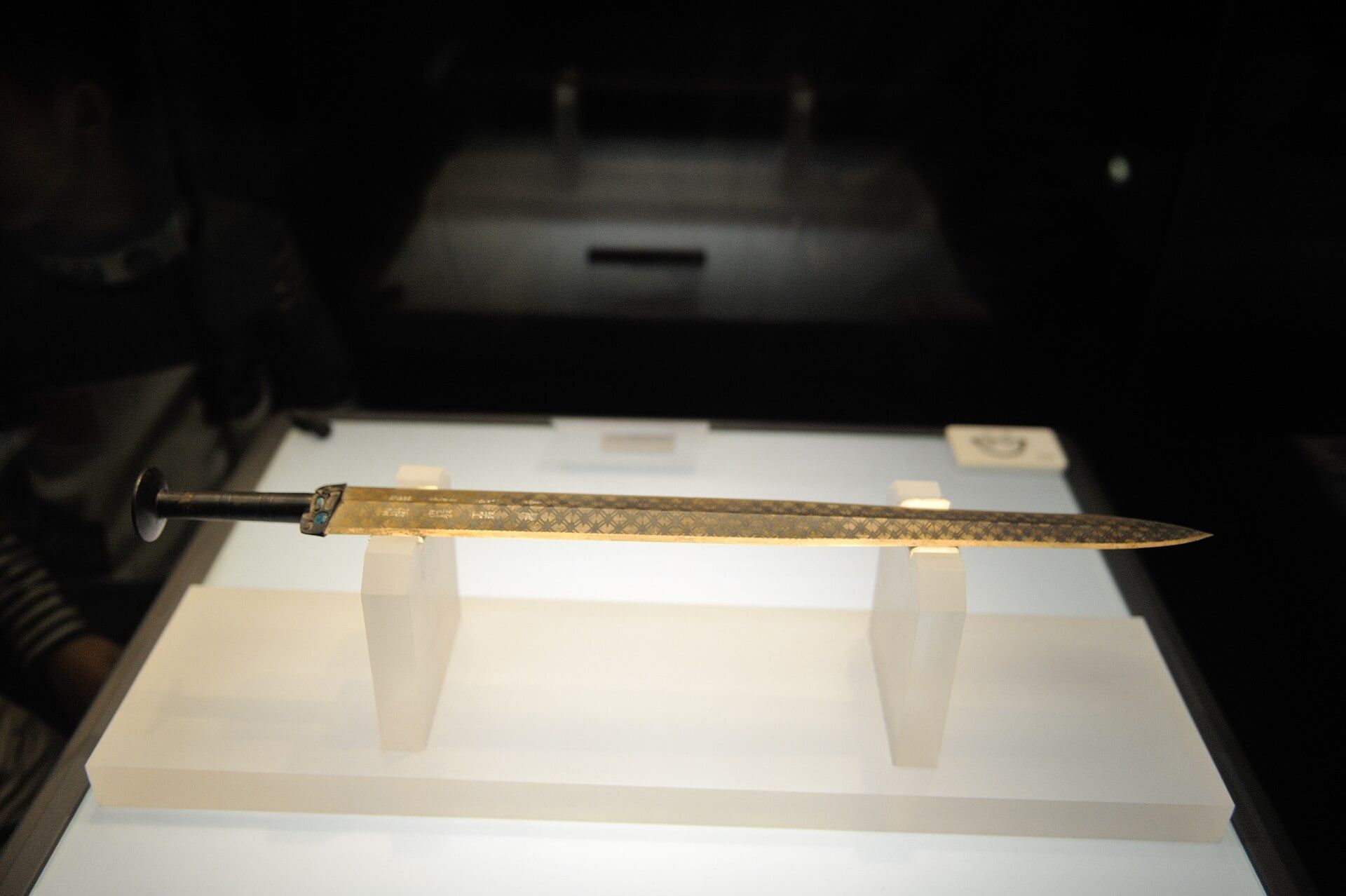
Key facts
- The Sword of Goujian (越王勾践剑) is a bronze jian made for King Goujian of Yue (r. 496–465 BCE) and excavated in December 1965 from Wangshan Tomb No. 1 in Jiangling, Hubei.
- It is 55.6 cm long with an 8.4 cm hilt, 4.6 cm wide at the base and weighs 875 g; it is kept in the Hubei Provincial Museum in Wuhan.
- Its eight-character bird-worm seal script inscription reads 越王鸠浅,自乍用剑, “King Goujian of Yue made this sword for his own use”; 鸠浅 is a phonetic spelling of 勾践.
- The blade is copper–tin bronze with about 18–20% tin; the museum's own study found it was cast in one piece and that its dark diamond pattern was made with tin, not sulfur.
- It survived almost untarnished thanks to a low-lead alloy, a deep, sealed tomb and a close-fitting lacquered scabbard, not because bronze cannot corrode.
- Type
- Bronze jian (straight, double-edged sword)
- Owner
- King Goujian of Yue (r. 496–465 BCE)
- Found
- December 1965, Wangshan Tomb No. 1, Jiangling, Hubei
- Length
- 55.6 cm overall (blade about 47.3 cm, hilt 8.4 cm)
- Width · weight
- 4.6 cm at the base · 875 g
- Alloy
- Copper–tin bronze, blade about 18–20% tin
- Inscription
- 越王鸠浅,自乍用剑 (8 characters, bird-worm seal script)
- Where now
- Hubei Provincial Museum, Wuhan
The Sword of Goujian is a bronze jian made for King Goujian of Yue, who ruled from 496 to 465 BCE, and excavated in 1965 from a Chu noble’s tomb in Hubei province. Roughly 2,500 years old, still bright and still keen, it is the most famous ancient sword in China and the star of the Hubei Provincial Museum in Wuhan. Its story mixes hard metallurgy with one of China’s great revenge legends, and with a myth that needs correcting: it did not survive because it is rustproof.
Discovery: Wangshan Tomb No. 1, 1965
In autumn 1965, archaeologists surveying the route of an irrigation channel for the Zhang River Reservoir in Jiangling County (today part of Jingzhou), Hubei, began excavating a cluster of tombs from the state of Chu. The dig ran from October 1965 to January 1966 and opened more than fifty tombs. In December, in Wangshan Tomb No. 1, about 7 km from Jinancheng, the ruins of the Chu capital Ying, they found a sword in a black-lacquered wooden scabbard beside the skeleton in the inner coffin.
When it was unsheathed, the blade gleamed. Excavation team member Fang Zhuangyou first deciphered six of its eight characters, “King of Yue” and “made this sword for his own use”. The remaining two, the king’s name, set off more than two months of debate, mostly by letter, among scholars including Guo Moruo and Tang Lan. Their verdict: Goujian.
Why was a Yue king’s sword in a Chu tomb? The tomb’s occupant, identified from bamboo slips as a Chu aristocrat named Dao Gu (悼固), lived in the mid-Warring States period, more than a century after Goujian. The likeliest answer is diplomacy: the Hubei Provincial Museum highlights the marriage alliance between King Zhao of Chu and Goujian, and one popular theory makes the sword part of a royal dowry. Others see it as war booty.
Size, shape and decoration
| Feature | Measurement or detail |
|---|---|
| Overall length | 55.6 cm |
| Blade length | about 47.3 cm |
| Hilt | 8.4 cm |
| Width at the base | 4.6 cm |
| Weight | 875 g |
| Guard | About 5 cm wide; blue glass on one face, turquoise on the other |
| Pommel | Disc cast with 11 concentric rings |
| Grip | Bound with silk |
| Surface | Dark diamond (lozenge) pattern over both faces |
The proportions are textbook. The Kaogong ji, a pre-Qin manual of crafts later bundled into the Zhou li, grades swords by the ratio of blade to hilt: in the “upper” grade (上制), carried by senior officers, the blade is five times the hilt and the sword weighs nine lüe (锊). Goujian’s blade is about 5.6 times its 8.4 cm hilt. Near the tip the edges swell gently outward before narrowing to the point, giving the blade its elegant double curve.
The inscription: why 鸠浅 means Goujian
Two columns of eight gilded characters run down one face near the guard, in bird-worm seal script , an ornate script favoured by the southern states of Wu, Yue and Chu, whose strokes sprout birds and insects:
越王鸠浅,自乍用剑
King Jiuqian of Yue made this sword for his own use.
乍 is an early way of writing 作, “to make”. 鸠浅 (jiūqiǎn) is the king’s name written with characters chosen for their sound, a phonetic loan (通假) of the kind common in early inscriptions; scholars concluded that it represents 勾践 (Gōujiàn). The phrase 自作用剑, “made for his own use”, marks it as the king’s personal weapon rather than a gift made in his name.
Bronze, tin and the diamond pattern
Bronze is copper hardened with tin. More tin gives a harder, keener edge, but past roughly 20% the alloy turns brittle. The Kaogong ji’s “six alloys” (六齐) set an ideal for blades:
叁分其金而锡居一,谓之大刃之齐。
Divide the metal into three and let tin be one part: this is the alloy for large blades.
Depending on whether 金 means the copper or the whole alloy, that is 25% or 33% tin, more than has been measured in Goujian’s blade, a reminder that the text records ideals rather than workshop practice. The Yuejue shu, a Han-era compilation of Wu and Yue lore, puts the smiths’ goal more poetically: a true treasure sword is one in which tin and copper are blended “and never separate” (金锡和铜而不离). The sword itself has been studied twice:
- 1977, Fudan University, Shanghai. Non-destructive proton-induced X-ray fluorescence (PIXE), the first time a national treasure was analysed this way, put the blade at about 80.3% copper and 18.8% tin with fractions of a percent of lead and iron. The dark lozenges held more tin and traces of sulfur, which launched the popular story of a “sulfurised” anti-rust pattern.
- 2017–2025, Hubei Provincial Museum. Microscopy showed that the dendrites, the crystal structure of the cast metal, run continuously from edge to body, so the museum concluded that the blade was cast in one piece from one alloy. At the sword’s 60th-anniversary event on 29 April 2025, the museum put the blade’s tin content at about 18–20% and proposed seven steps: cast blade and tang together; make the lozenges by hot tin-plating; grind the edges; cast the guard onto the blade; cast the pommel separately and weld it to the tang; then set the glass and turquoise.
The tin-based explanation fits independent work: a 2020 British Museum study of Eastern Zhou weapons with the same trellis decoration concluded the pattern was most likely made by heating a tin-rich paste on the surface.
It also corrects a claim many websites and AI answers repeat: that this is a two-pour composite sword. The technique was real. Some Wu and Yue smiths cast a ridge of low-tin, tougher bronze and then cast high-tin, harder edges onto it, leaving a visibly two-tone blade. But according to the museum’s study, the Sword of Goujian is a single casting.
Why it “never rusted”: the myth explained
The Sword of Goujian is not stainless; it was found almost, not completely, untarnished. What is extraordinary is how little it corroded. In 2017 the museum tested the old sulfur theory against two other swords from the same tomb: where their surfaces carried sulfur, corrosion was worse, not better. Its conclusion named three reasons instead:
- The alloy. The bronze contains very little lead, while lead-rich objects from the same tomb were badly corroded.
- The tomb. Wangshan Tomb No. 1 was about 10.8 m deep from mound to chamber floor, backfilled with rammed clay and soaked in groundwater for over 2,000 years, which cut off oxygen.
- The scabbard. The blade sat in a close-fitting lacquered scabbard inside nested coffins, protection on top of protection.
Since 1965 it has lived in climate-controlled cases. On loan to Singapore in the 1990s it was bumped against its display case, leaving a crack of about 7 mm, and in 2013 China placed it on the third list of cultural relics forbidden to leave the country for exhibition. The edge is still keen: in a test filmed for the 1977 documentary The Ancient Sword (古剑), it sliced through more than twenty sheets from a stack of about thirty.
Goujian’s revenge and Phantom Blade Zero
The man named on the blade is the hero of China’s most famous revenge story. In 496 BCE Goujian’s army defeated Wu at Zuili, and King Helü of Wu died of his wounds. Two years later Helü’s son Fuchai crushed Yue at Fujiao; Goujian, trapped on Mount Kuaiji with 5,000 men, surrendered and served at the Wu court. Allowed home, he rebuilt Yue and, says Sima Qian, refused to forget:
置胆于坐,坐卧即仰胆,饮食亦尝胆也。曰:“女忘会稽之耻邪?”
He hung a gall bladder by his seat; sitting or lying down he would look up at it, and at every meal he tasted it, saying: “Have you forgotten the shame of Kuaiji?”
In 473 BCE Yue conquered Wu and Fuchai took his own life. The idiom 卧薪尝胆, “sleeping on brushwood and tasting gall”, sums up the story, but only the gall is in Sima Qian. The full phrase first appears in Su Shi’s 11th-century Imitation of Sun Quan’s Reply to Cao Cao, written in another ruler’s voice, and was attached to Goujian later.
The game’s official premise is a revenge clock: framed for murdering his master and wounded through the heart, Soul has sixty-six days to live, and his journey runs, in S-GAME’s words, “through rain and blood, kindness and vengeance”. Goujian is the classical mirror image, an avenger who tasted gall for two decades because he could afford to wait. Soul cannot. Side by side, they show both faces of the Chinese revenge tradition: patience as a weapon, and time as the enemy.
 Every Treasure Tells a Story: The Sword of King Goujian of Yue – The Winner is the King
Famous ancient Chinese swords and where they are today
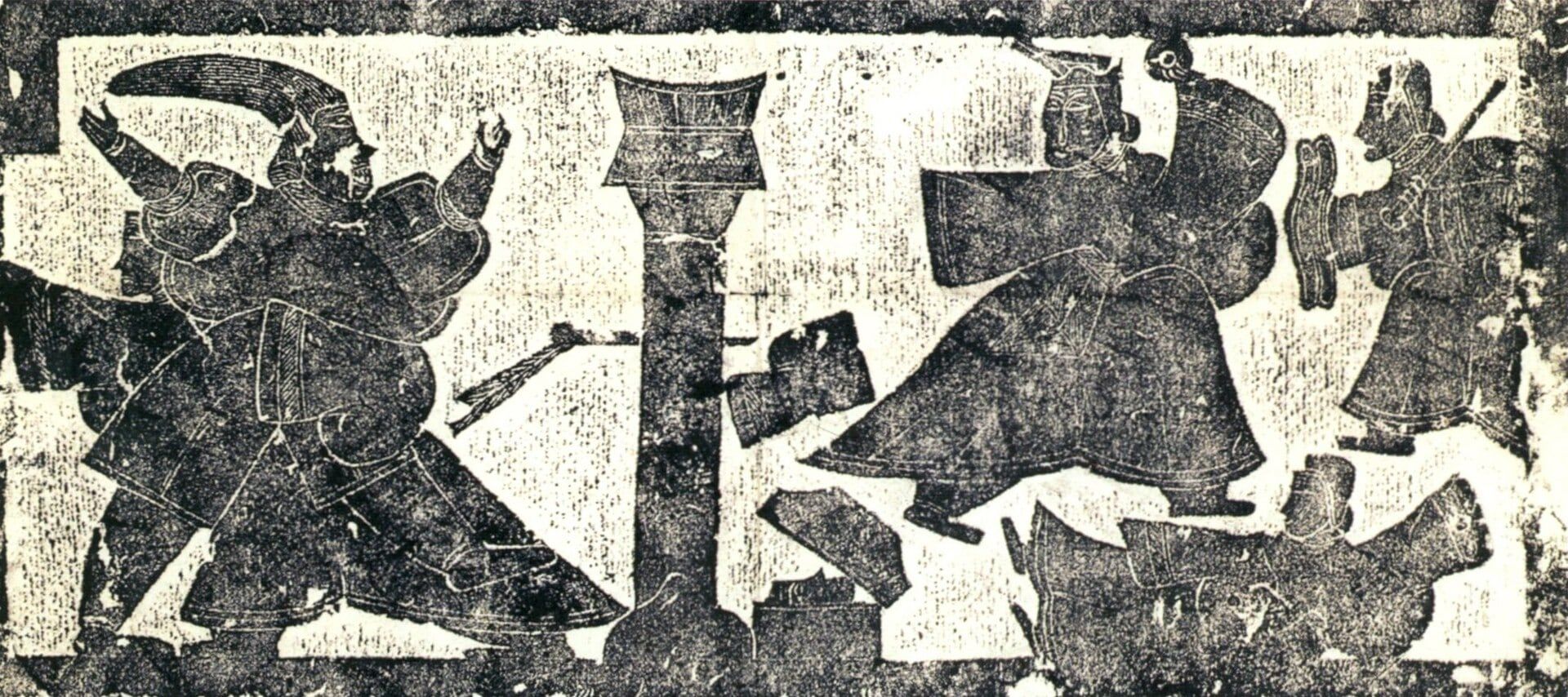
Wu and Yue were the sword country of the ancient world. The Yuejue shu says Goujian owned five treasure swords forged by the legendary smith Ou Yezi, including Yuchang, the “fish-gut” blade that the assassin Zhuan Zhu hid in a fish to kill King Liao of Wu (see Chinese assassins). None of the five names matches this sword; whatever Goujian called it has been lost.
| Sword | Date | Material | Where it is today |
|---|---|---|---|
| Sword of Goujian | Early 5th century BCE | Bronze, 55.6 cm | Hubei Provincial Museum, Wuhan |
| Zhanlu, Chunjun, Shengxie, Yuchang, Juque | Legendary, Spring and Autumn | Bronze, by legend | Lost; known only from the Yuejue shu |
| Longyuan, Tai’a, Gongbu | Legendary, Spring and Autumn | Iron, by legend | Lost; known only from the Yuejue shu |
| Bronze swords of the Terracotta Army | Late 3rd century BCE | Bronze, over 90 cm | Emperor Qinshihuang’s Mausoleum Site Museum, Xi’an |
| Zhongping-era “hundred-refined” sword | 184–189 CE | Steel, about 110 cm | Tokyo National Museum, from the Tōdaijiyama tomb in Nara |
From Goujian’s bronze to the hundred-refined steel of the Han and the forges of Longquan, the jian kept its shape while its metal changed completely. That continuity, a 2,500-year-old blade that still looks ready to draw, is exactly the kind of history wuxia stories, and games like Phantom Blade Zero, keep reforging.
Names in this article · Codex
Frequently asked
Q01Why hasn't the Sword of Goujian rusted?
Q02Where is the Sword of Goujian now?
Q03How old is the Sword of Goujian?
Q04Is the Sword of Goujian still sharp?
Q05What does the inscription on the Sword of Goujian say?
Sources & further reading
- The Sword of Goujian, King of Yue: A Special Exhibition — Hubei Provincial Museum
- Sword of Goujian — Wikipedia
- Report on the museum's 60th-anniversary research findings (29 April 2025) — Beijing News (新京报)
- 《国家宝藏》:越王勾践剑为什么“千年不腐”? (excerpt on the museum's 2017 study) — The Paper (澎湃新闻), 18 May 2018
- A Scientific Study of Eastern Zhou Bronze Weapons with Tin-Rich Surface Decoration — Quanyu Wang, Yi Chen and Daniel O'Flynn, Materials Science Forum 983 (2020): 47–55
- Yuejue shu, juan 11: Records of Precious Swords — Han-dynasty compilation (Wikisource)
- Shiji, ch. 41: Hereditary House of Goujian, King of Yue — Sima Qian, c. 94 BCE (Wikisource)
Cite this page
Wuxiapunk Editors. (2026, October 27). Sword of Goujian: The 2,500-Year-Old Blade Explained. Wuxiapunk. https://wuxiapunk.com/craft/sword-of-goujian/
“Sword of Goujian: The 2,500-Year-Old Blade Explained.” Wuxiapunk, 27 Oct. 2026, https://wuxiapunk.com/craft/sword-of-goujian/.
Keep reading
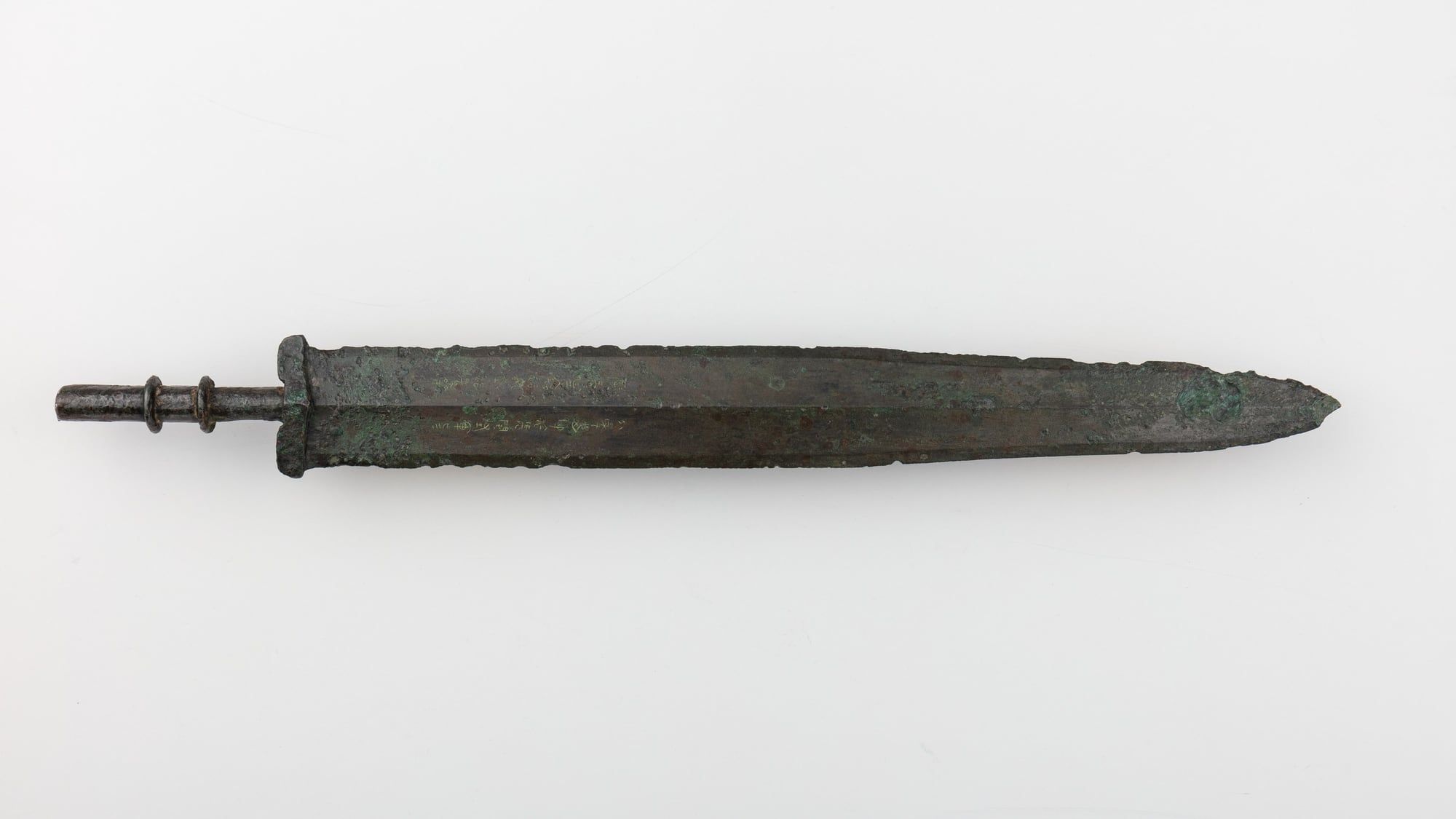
Jian: The Chinese Straight Sword, Explained
What a jian is, how the double-edged Chinese sword evolved from bronze to steel, its anatomy, how it was used, and why it is called the gentleman of weapons.
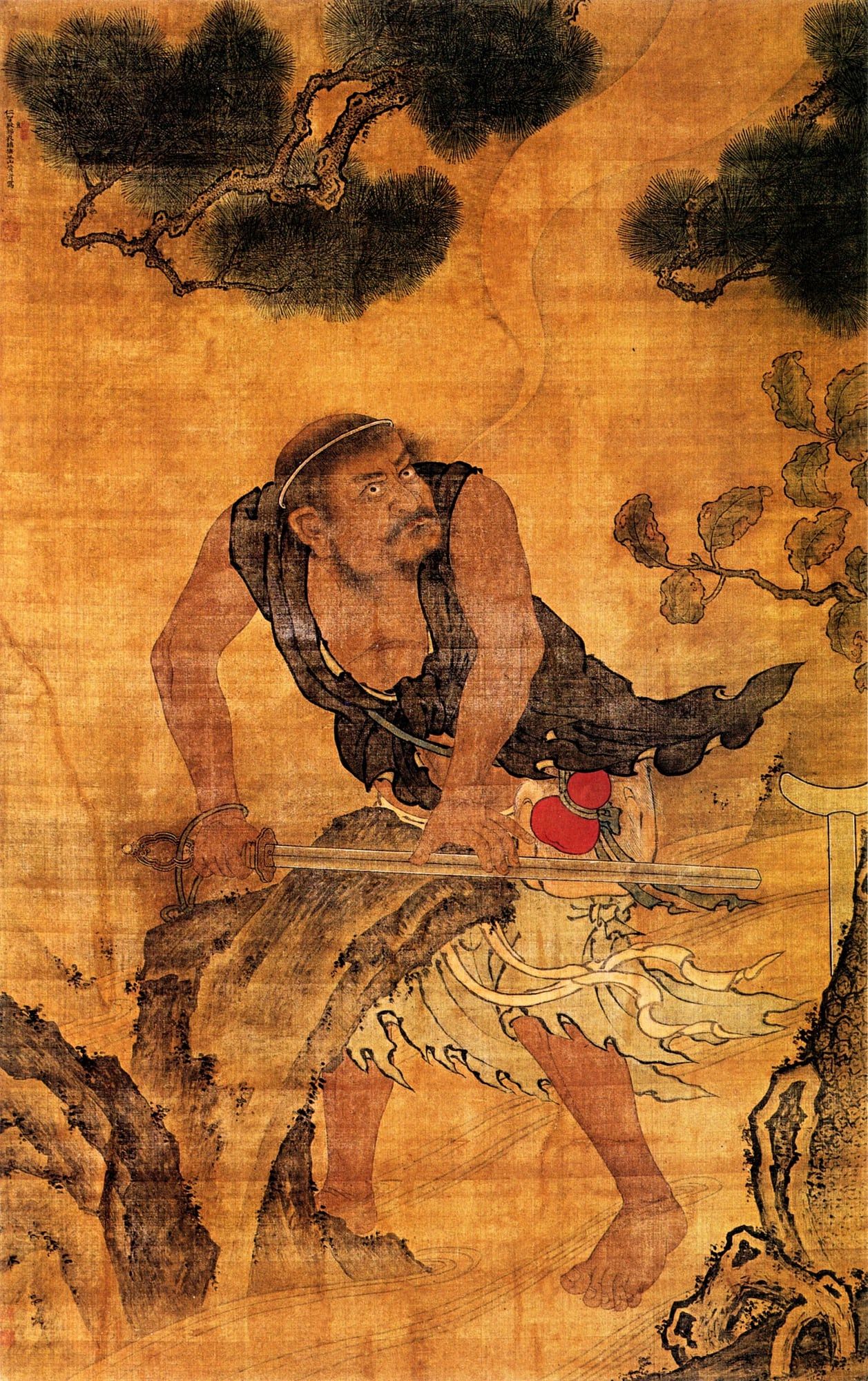
Hundred-Refined Steel: How Chinese Smiths Folded Steel
Chinese sword forging explained: cast iron, puddled steel, hundred-refined folding, co-fusion steel and composite blades, with original texts, dates and layer maths.
Assassins in Chinese History: Jing Ke, Zhuan Zhu & More
Ancient China's real assassins — Cao Mo, Zhuan Zhu, Yu Rang, Nie Zheng and Jing Ke — from Sima Qian's Shiji, plus Tang assassin tales, ninja and hashashin compared.