Weapon dossier · Swords
Jian: The Chinese Straight Sword, Explained
剑jiàn
What a jian is, how the double-edged Chinese sword evolved from bronze to steel, its anatomy, how it was used, and why it is called the gentleman of weapons.
Key facts
- A jian (剑, jiàn) is a straight, double-edged Chinese sword with a pointed tip, used for roughly 3,000 years.
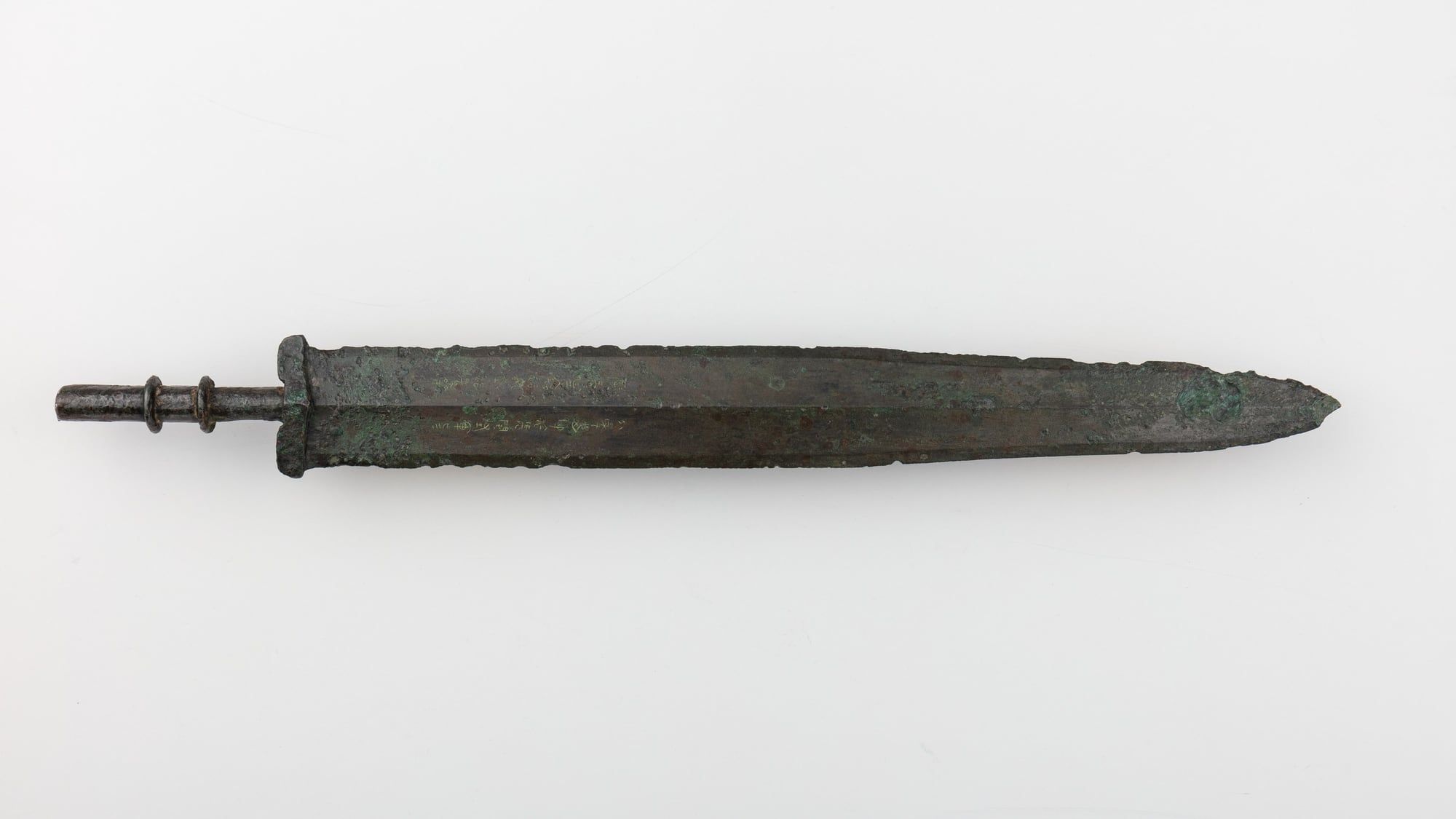
- The earliest jian were short bronze blades of the Western Zhou; the art peaked with Warring States bronze swords like the Sword of Goujian.
- From the Han dynasty on, the single-edged dao replaced the jian on the battlefield, and the jian became a symbol of scholars, officials and Daoist priests.
- Its nickname is 百兵之君, “the gentleman of the hundred weapons”; the dao is 百兵之胆, “the courage”, and the spear 百兵之王, “the king”.
- Jian technique prizes precise thrusts and draw-cuts with the front third of the blade over brute force.
- Type
- Straight, double-edged sword
- Chinese
- 剑 / 劍 · jiàn
- Period
- Western Zhou (c. 11th c. BCE) – present
- Typical blade
- 45–60 cm (bronze); 70–80 cm (Ming–Qing steel)
- Typical weight
- Roughly 700 g – 1.1 kg (later steel jian)
- Used with
- One hand; the free hand forms the “sword finger” (剑指)
- Nickname
- 百兵之君 — gentleman of weapons
A jian 剑 jiànThe straight, double-edged Chinese sword — “gentleman of the hundred weapons”.Glossary → is the Chinese straight sword: a double-edged blade with a sharp point, a compact guard and a one-handed grip. It is one of the oldest weapons in continuous use anywhere — from Bronze Age daggers around 1000 BCE to the steel swords in today’s taiji parks — and it carries more cultural weight than any other Chinese weapon. When a character in a wuxia story draws a slim, glittering blade and fights with impossible lightness, that blade is almost always a jian.
Anatomy of the jian
Every part of a jian has its own name, and most of them have been in use for more than two thousand years. The Kaogong ji, a Zhou-era technical manual, already specifies the proportions of blade, ridge and grip for swords of different sizes.
Anatomy plate
剑首 jiàn shǒuPommel
The cap at the end of the grip. It counterweights the blade and stops the hand sliding off; early bronze swords often carried concentric rings or jade discs here.
剑茎 jiàn jīngGrip & tang
The handle. The tang (part of the blade itself) runs inside, wrapped in cord, wood, rayskin or silk for grip.
剑格 jiàn géGuard
The crossguard between grip and blade. Chinese jian guards are compact — they protect the hand rather than trap blades.
剑脊 jiàn jǐRidge (spine)
The raised centre line of a double-edged blade. It stiffens the sword; on composite bronze swords the ridge was a softer, tougher alloy than the edges.
剑从 jiàn cóngFlats
The bevelled faces between the ridge and each edge, ground at a shallow angle to keep the edge keen.
剑锷 jiàn èEdges
Both cutting edges. Jian technique favours precise cuts and thrusts with the front third of the blade rather than brute chopping.
剑锋 jiàn fēngPoint
The tip. “Feng” is also the root of words for sharpness and vanguard — the point leads.
剑穗 jiàn suìTassel
A later decorative tassel tied through the pommel; in performance forms it trails the blade and distracts the eye.
刀首 dāo shǒuPommel cap
An iron or brass cap that locks the handle onto the tang. Han-dynasty sabres used a ring here instead — the famous ring-pommel dao.
刀柄 dāo bǐngGrip
Usually long enough for one hand and a little extra, wrapped in cord or rayskin. Two-handed long sabres (changdao, miao dao) have much longer grips.
刀镡 dāo tánGuard
A disc or bowl-shaped guard. Qing sabres often carry a pierced, saucer-like iron tan.
刀背 dāo bèiSpine
The thick, unsharpened back edge. It carries weight into a cut and lets the blade survive hard parries.
刀槽 dāo cáoFuller
A groove along the blade that lightens and stiffens it. It is not a “blood groove” — that is a modern myth.
刀刃 dāo rènEdge
The single cutting edge, often of harder steel forged onto or into a softer body (sandwich or wrapped construction).
刀尖 dāo jiānTip
The point. Willow-leaf (liuye) sabres curve gently; oxtail (niuwei) sabres flare into a broad, heavy tip for chopping.
The jian is called the “gentleman of weapons”, the dao the “courage of weapons”. Pick a part to see what it does.
The key distinction is the ridge (剑脊) running down the centre and the flats (剑从) bevelled down to the two edges (剑锷). A jian is designed to cut with its front third and to thrust with its point, so the blade tapers in width and thickness towards the tip, and the balance sits close to the guard.
How big is it? A typical Ming–Qing jian runs about 85–100 cm overall — shorter than the two-handed miao dao, a little shorter than a Japanese katana:
Approximate overall lengths of typical examples; real pieces vary by period, region and maker.
From bronze dagger to steel sword
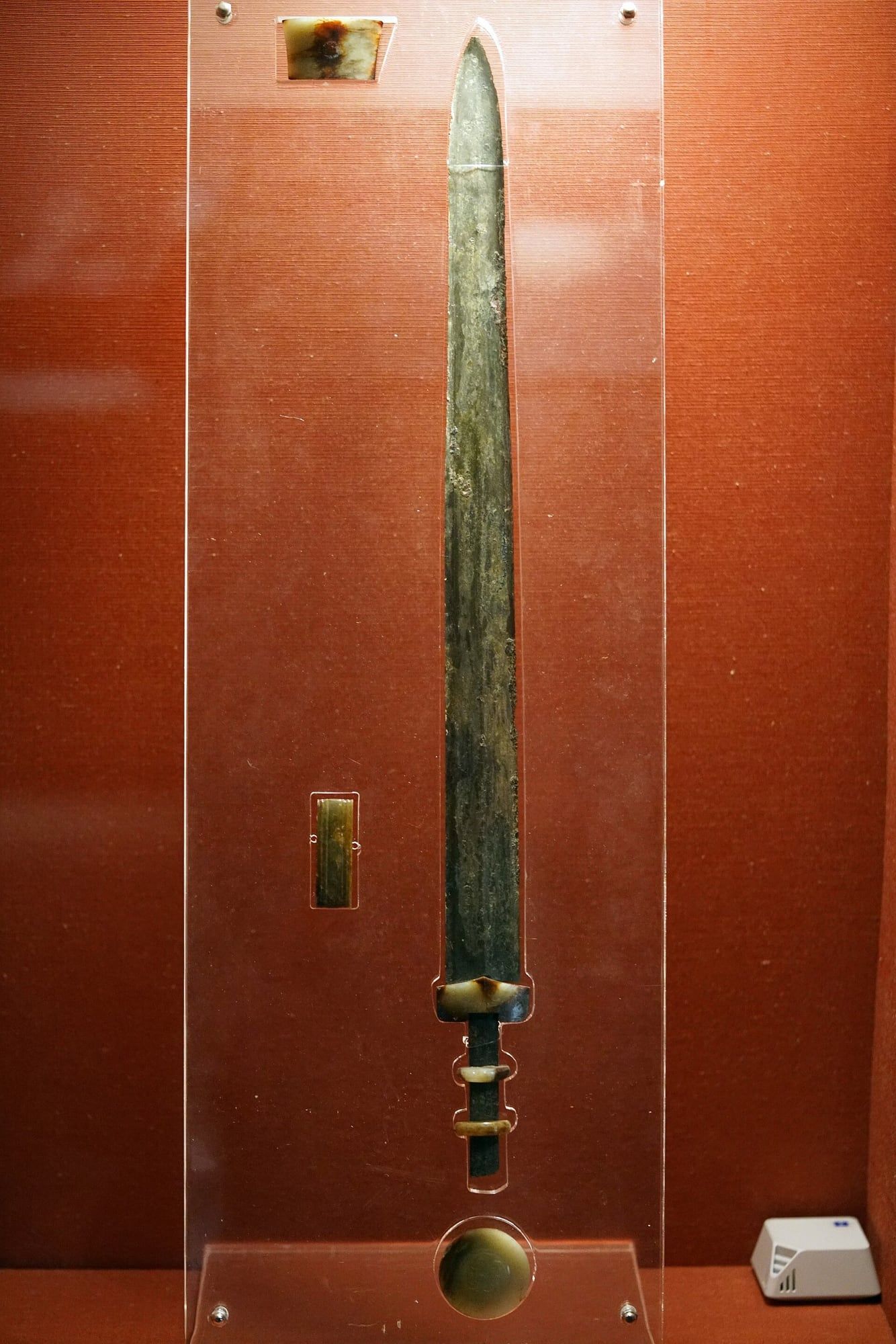
The first Chinese swords, in the Western Zhou period (c. 1046–771 BCE), were short leaf-shaped bronze blades — closer to daggers, meant for the last metre of a fight when the chariot and the dagger-axe could no longer reach.
During the Spring and Autumn and Warring States periods (770–221 BCE), infantry warfare made the sword essential. The southern states of Wu and Yue became famous for bronze swords of astonishing quality: some composite swords were cast in two pours, with a tough, low-tin core and hard, high-tin edges. The era’s most famous survivor, the Sword of Goujian, was excavated in 1965 and is still sharp — although museum research shows it was cast in one piece.
天子之剑,以燕谿石城为锋,齐岱为锷,晋卫为脊,周宋为镡,韩魏为夹。
The Son of Heaven’s sword has Yanxi and Shicheng for its point, Qi and Mount Tai for its edges, Jin and Wey for its ridge, Zhou and Song for its guard, Han and Wei for its hilt.
Bronze swords grew longer as casting improved — swords from the Qin Terracotta Army pits measure over 90 cm. Length had its downside: when the assassin Jing Ke lunged at the King of Qin in 227 BCE, the king’s sword was too long to draw from his belt until an attendant shouted for him to push it onto his back.
The Han dynasty (206 BCE–220 CE) switched to iron and steel. Techniques like puddling and hundred-refined steel produced long, springy steel jian — and also the single-edged ring-pommel dao, which proved tougher and cheaper. Within a few centuries, the dao had replaced the jian as the soldier’s blade.
The gentleman of weapons
Pushed off the battlefield, the jian rose in status. Officials wore swords as badges of rank; poets like Li Bai wrote about wandering swordsmen; Daoist priests used ritual swords, sometimes of peach wood, to command spirits and expel demons. By the late imperial era the jian was firmly the weapon of the scholar-gentleman — which is why Chinese martial culture calls it 百兵之君, “the gentleman of the hundred weapons” — while the dao is 百兵之胆, “the courage of weapons”, and the spear 百兵之王, “the king”.
That reputation shaped how the jian appears in fiction. In wuxia novels and films the jian belongs to cultivated heroes, sect masters and immortals, while heavy sabres and polearms belong to soldiers, bandits and brutes.
How a jian is used
Jian technique is about precision and timing rather than force. Common methods include the thrust (刺), the point-flick (点), the rising cut (撩), the intercept (截) and the draw-cut (抹), usually delivered with the front third of the blade so the forte is never committed to a clash. The empty hand forms the sword finger (剑指) — index and middle fingers extended — for balance and, in Daoist practice, for channelling intent.
Martial artists compress the contrast with the dao into four characters: 刀走黑,剑走青. The dao goes “black” — hard, direct, crashing through. The jian goes “green” (a pun on 轻, light) — evasive, angled, avoiding blade-on-blade contact.
The jian in Phantom Blade Zero
Phantom Blade Zero leans on the jian’s reputation as the weapon of cultivated swordsmen. The most striking example is the Seven Stars Sword Formation boss: seven swordsmen who attack as a single mind, a fight S-GAME shared in its Year of the Snake gameplay trailer. Chinese coverage notes that its offence-defence transitions borrow from Emei-school swordsmanship, and the studio says it brought in sword masters from Mount Emei to get the swordplay right. The swordsman Hua Qianxiao, known as the Sword Fanatic, fights with a drunken sword — a nod to the real drunken-style routines of Chinese martial arts.
 Phantom Blade Zero - Year of the Snake Gameplay Trailer 2025
 Making China's Most Iconic Blade, the Jian
Legendary swords
Chinese legend is full of named swords. Ou Yezi is said to have forged five great swords for the King of Yue, among them Zhanlu and Chunjun. The smith couple Ganjiang and Moye gave their names to a pair of swords — and, in one version of the story, Moye threw herself into the furnace so the metal would fuse. The tiny Yuchang (“fish-gut”) blade was hidden inside a cooked fish so the assassin Zhuan Zhu could kill King Liao of Wu at a banquet in 515 BCE.
These stories — part history, part myth — are the raw material that wuxia fiction, and games like Phantom Blade Zero, keep sharpening.
Names in this article · Codex
Frequently asked
Q01What is the difference between a jian and a dao?
Q02Why did the dao replace the jian in war?
Q03Is a jian heavy?
Q04Why is the jian called the gentleman of weapons?
Sources & further reading
- Kaogong ji (Records of Examination of Craftsmen), “Taoshi” chapter on swordsmiths — Zhou li
- Shiji (Records of the Grand Historian), “Biographies of Assassins” — Sima Qian, c. 94 BCE
- Chinese Martial Arts: From Antiquity to the Twenty-First Century — Peter A. Lorge, Cambridge University Press, 2012
- Chinese Swordsmanship: The Yang Family Taiji Jian Tradition — Scott M. Rodell, Seven Stars Books, 2003
- Phantom Blade Zero — Year of the Snake gameplay trailer — S-GAME
- Sword of Goujian — collection highlight — Hubei Provincial Museum
Cite this page
Wuxiapunk Editors. (2026, October 27). Jian: The Chinese Straight Sword, Explained. Wuxiapunk. https://wuxiapunk.com/weapons/jian/
“Jian: The Chinese Straight Sword, Explained.” Wuxiapunk, 27 Oct. 2026, https://wuxiapunk.com/weapons/jian/.
Keep reading
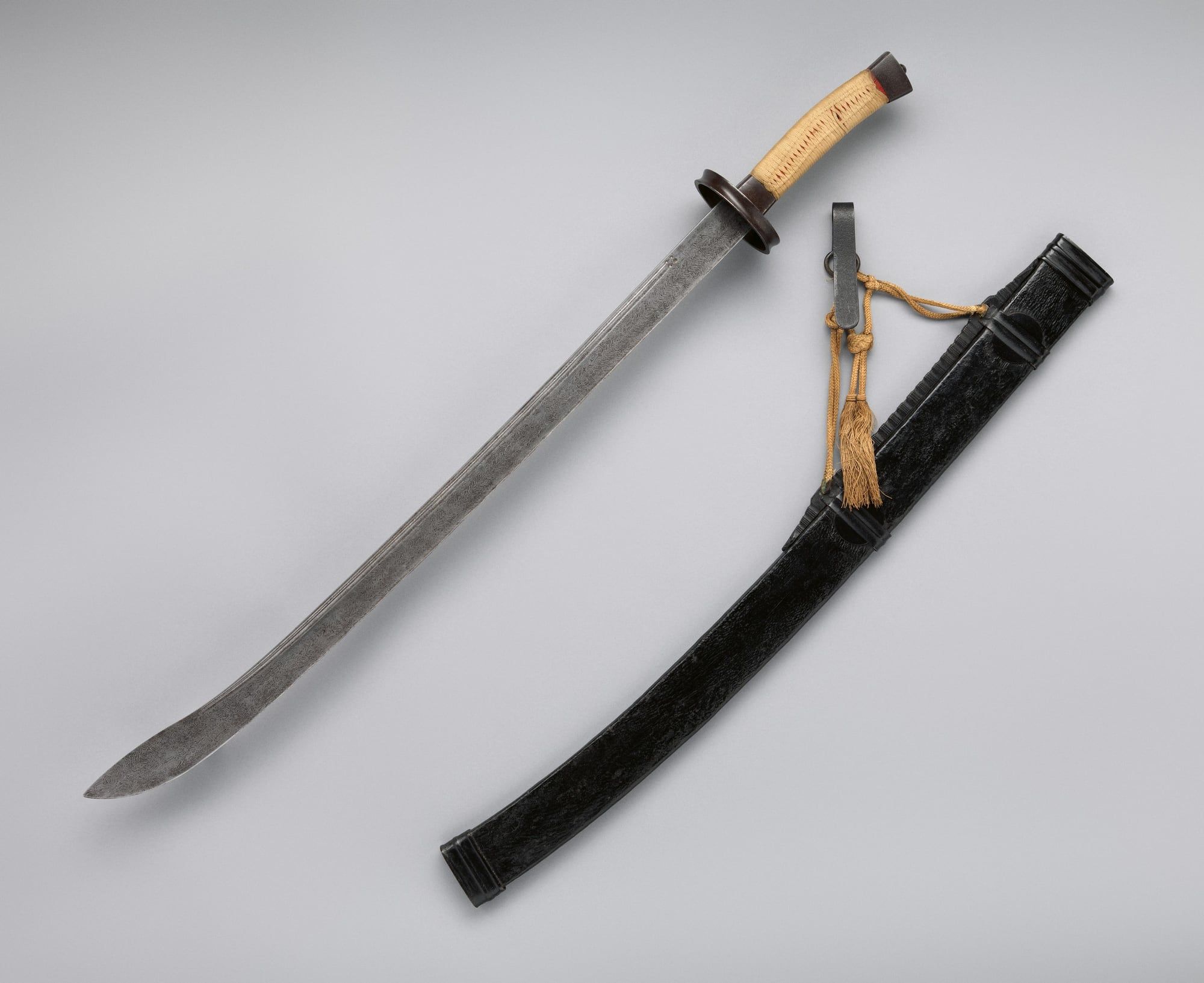
Dao: The Chinese Sabre, From Ring-Pommel to Oxtail
What a dao sword is, how the Chinese sabre evolved from the Han ring-pommel dao to Qing willow-leaf and oxtail sabres, why armies chose it, and how it is used.
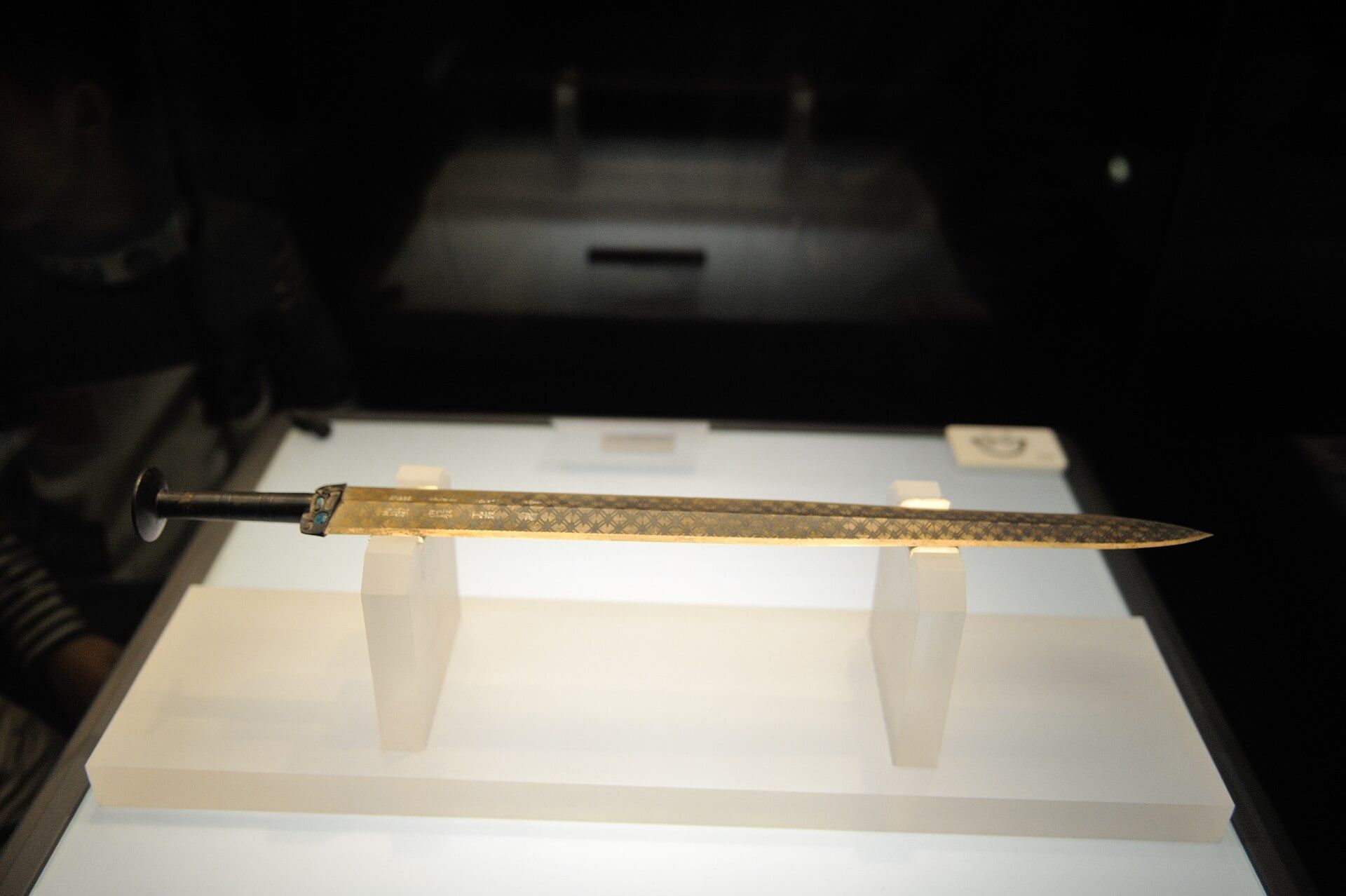
Sword of Goujian: The 2,500-Year-Old Blade Explained
The Sword of Goujian explained: its 1965 discovery in a Chu tomb, exact size, bird-worm inscription, bronze alloy, what really kept it from rusting, and its king.
Hundred-Refined Steel: How Chinese Smiths Folded Steel
Chinese sword forging explained: cast iron, puddled steel, hundred-refined folding, co-fusion steel and composite blades, with original texts, dates and layer maths.