Weapon dossier · Sabres
Dao: The Chinese Sabre, From Ring-Pommel to Oxtail
刀dāo
What a dao sword is, how the Chinese sabre evolved from the Han ring-pommel dao to Qing willow-leaf and oxtail sabres, why armies chose it, and how it is used.
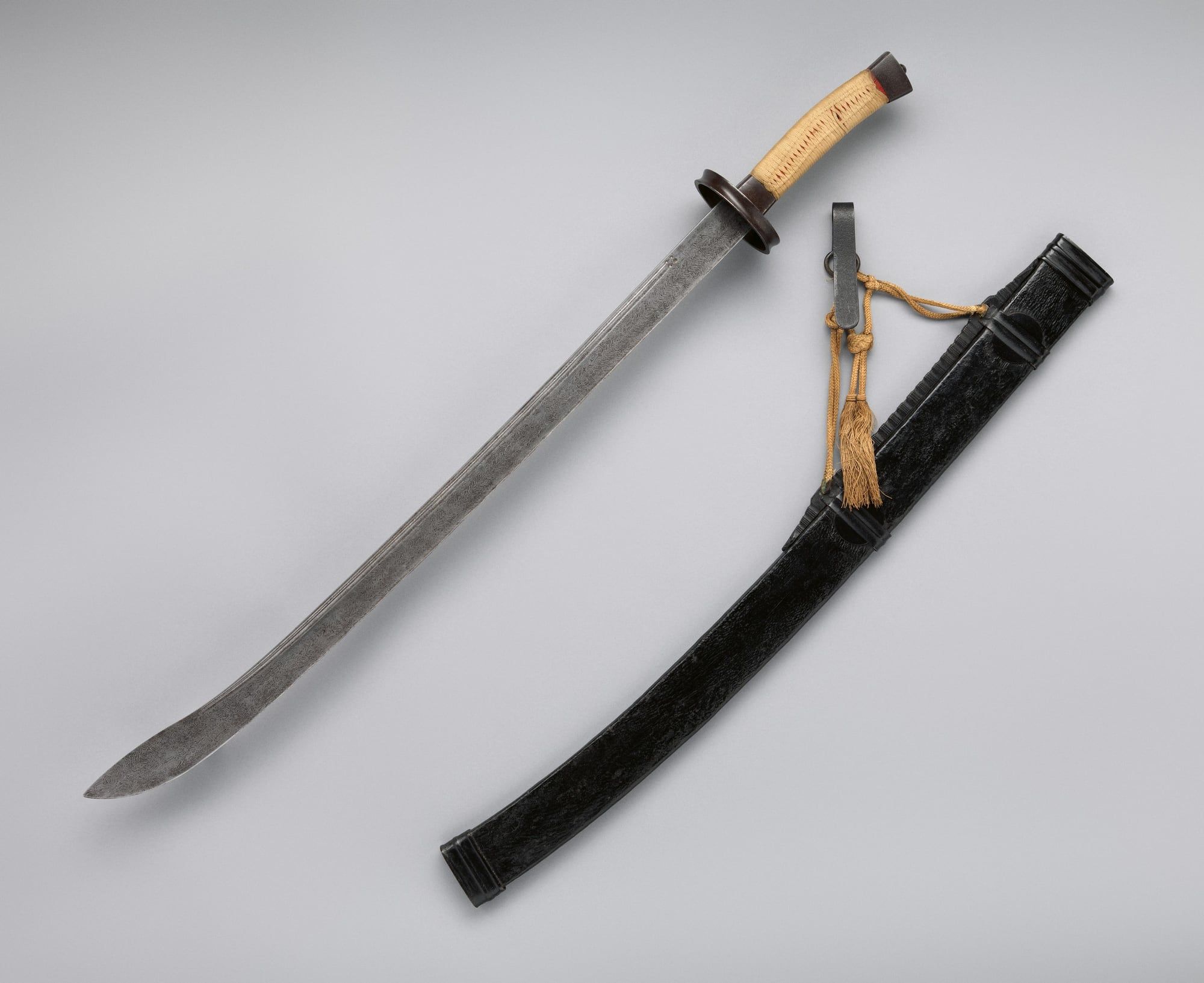
Key facts
- A dao (刀, dāo) is a single-edged Chinese sword, usually lightly curved and built to chop; in English it is called the Chinese sabre or broadsword.
- The dao rose in the Han dynasty as a steel ring-pommel sabre of about 86–114 cm and had largely replaced the jian in battle by the end of the Three Kingdoms.
- Steel, cavalry and cost explain the switch: a thick-backed single edge resists breaking, chops well from the saddle and is quick to learn — “100 days for the dao, 10,000 for the jian”.
- Qing sabres came in four main shapes — yanmaodao, liuyedao, piandao and the civilian niuweidao (oxtail), which never appears in official arms lists.
- The groove on a dao is a fuller that lightens and stiffens the blade; the “blood groove” is a myth.
- Type
- Single-edged sword (sabre)
- Chinese
- 刀 · dāo
- Period
- Han dynasty (206 BCE) – present; bronze knives far earlier
- Typical length
- Han ring-pommel dao 86–114 cm; later one-handed sabres mostly 70–110 cm
- Edge
- One edge, often with the last few inches of the back sharpened
- Signature moves
- 劈 chop · 撩 rising cut · 扎 thrust · 缠头裹脑 head-wrap
- Nickname
- 百兵之胆 — the courage of weapons
A dao 刀 dāoThe single-edged Chinese sabre, the standard military blade from the Han dynasty to the Qing.Glossary → is the Chinese sabre: a single-edged sword, usually with a gentle curve, a thick unsharpened back and a disc-shaped guard, built to chop, slash and draw-cut. For most of the last two thousand years it — not the elegant jian — was the sword Chinese soldiers actually carried, and martial artists call it 百兵之胆, “the courage of all weapons”.
Anatomy of a dao
Anatomy plate
剑首 jiàn shǒuPommel
The cap at the end of the grip. It counterweights the blade and stops the hand sliding off; early bronze swords often carried concentric rings or jade discs here.
剑茎 jiàn jīngGrip & tang
The handle. The tang (part of the blade itself) runs inside, wrapped in cord, wood, rayskin or silk for grip.
剑格 jiàn géGuard
The crossguard between grip and blade. Chinese jian guards are compact — they protect the hand rather than trap blades.
剑脊 jiàn jǐRidge (spine)
The raised centre line of a double-edged blade. It stiffens the sword; on composite bronze swords the ridge was a softer, tougher alloy than the edges.
剑从 jiàn cóngFlats
The bevelled faces between the ridge and each edge, ground at a shallow angle to keep the edge keen.
剑锷 jiàn èEdges
Both cutting edges. Jian technique favours precise cuts and thrusts with the front third of the blade rather than brute chopping.
剑锋 jiàn fēngPoint
The tip. “Feng” is also the root of words for sharpness and vanguard — the point leads.
剑穗 jiàn suìTassel
A later decorative tassel tied through the pommel; in performance forms it trails the blade and distracts the eye.
刀首 dāo shǒuPommel cap
An iron or brass cap that locks the handle onto the tang. Han-dynasty sabres used a ring here instead — the famous ring-pommel dao.
刀柄 dāo bǐngGrip
Usually long enough for one hand and a little extra, wrapped in cord or rayskin. Two-handed long sabres (changdao, miao dao) have much longer grips.
刀镡 dāo tánGuard
A disc or bowl-shaped guard. Qing sabres often carry a pierced, saucer-like iron tan.
刀背 dāo bèiSpine
The thick, unsharpened back edge. It carries weight into a cut and lets the blade survive hard parries.
刀槽 dāo cáoFuller
A groove along the blade that lightens and stiffens it. It is not a “blood groove” — that is a modern myth.
刀刃 dāo rènEdge
The single cutting edge, often of harder steel forged onto or into a softer body (sandwich or wrapped construction).
刀尖 dāo jiānTip
The point. Willow-leaf (liuye) sabres curve gently; oxtail (niuwei) sabres flare into a broad, heavy tip for chopping.
The jian is called the “gentleman of weapons”, the dao the “courage of weapons”. Pick a part to see what it does.
Where a jian is symmetrical, a dao keeps its strength in its back. The thick spine (刀背) adds mass to every cut and lets the blade take hard parries; the single edge (刀刃) is often harder steel forged into or onto a softer body. Ming and later sabres usually have a moderate curve, a disc or cup-shaped guard (刀镡) and a cord-wrapped grip, and many have the last few inches of the back sharpened for thrusts and back-cuts. Two-handed long sabres such as the miao dao simply stretch the same anatomy.
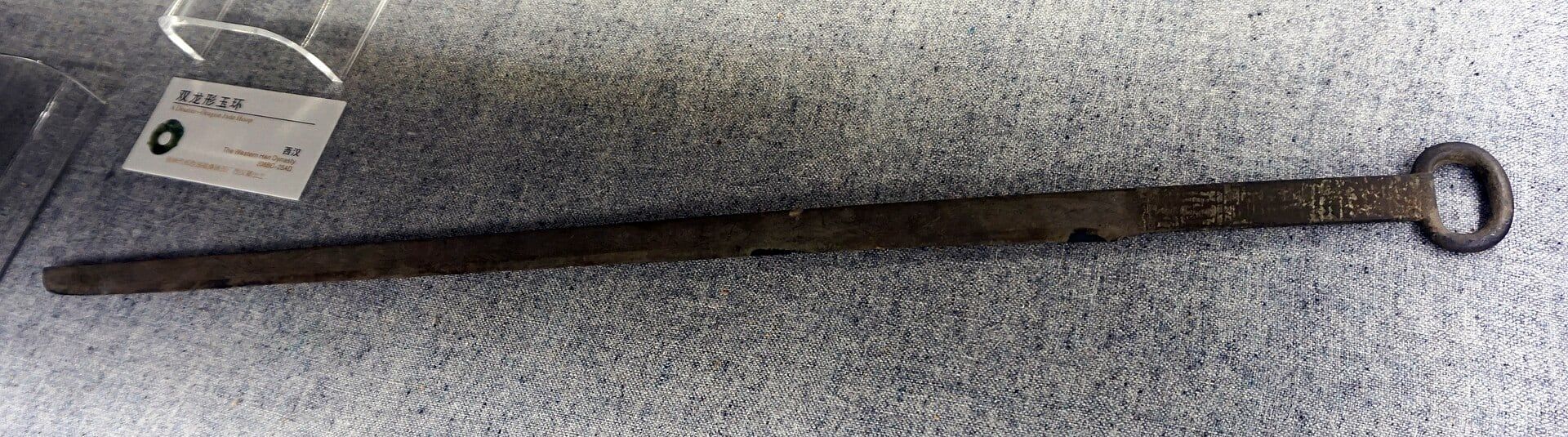
From ring-pommel to willow leaf: the dao through the dynasties
Single-edged bronze knives go back to the Shang, but the dao as a sword is a child of Han steel. A Han-era dictionary, the Shiming, even defines it by the ring at its base:
刀末曰锋,其本曰环。
The end of a dao is called the point; its base is called the ring.
| Era | Main types | What changed |
|---|---|---|
| Han – Six Dynasties (206 BCE–589 CE) | Ring-pommel dao 环首刀 huánshǒudāoThe straight, single-edged Han-dynasty steel sabre with a ring at the end of its grip.Glossary → | Straight steel blade with a ring pommel, 86–114 cm; used with a shield |
| Sui – Tang (581–907) | 横刀, 仪刀, 障刀, 陌刀 | The Tang Liudian names four regulation dao; the hengdao is the soldier’s sidearm |
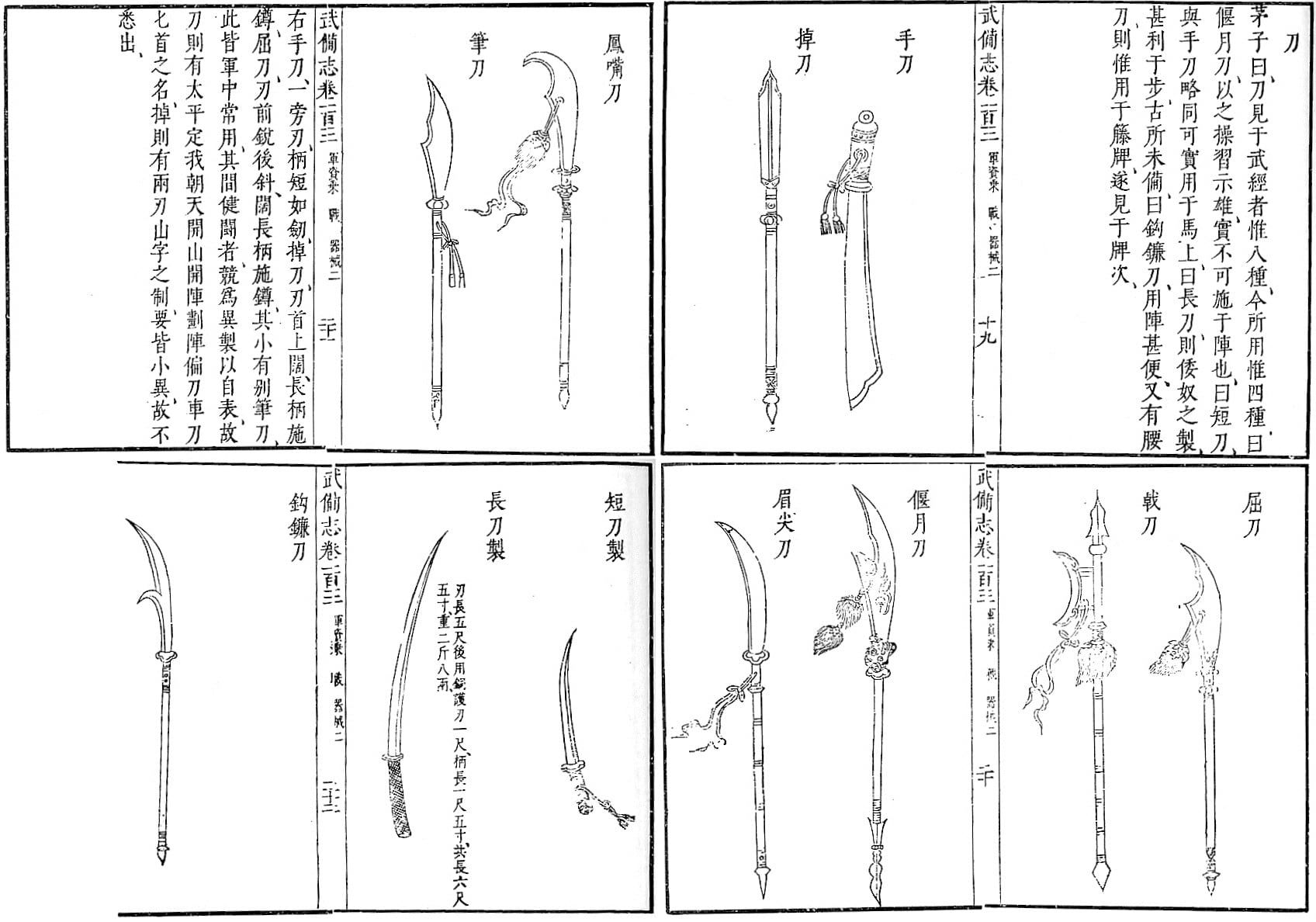
| Song (960–1279) | 手刀, long-hafted dao, 斩马刀 | The Wujing Zongyao (1044) shows a hand dao “with a short hilt like a sword’s”; two-handed great sabres follow in 1072 |
| Yuan – Ming (1271–1644) | 雁翎刀, 腰刀, 长刀 | Steppe influence brings curvature; by the mid-Ming, sabres replace the jian as the issue weapon |
| Qing (1644–1912) | Yanmaodao, liuyedao, piandao; niuweidao (civilian) | The waist sabre is standardised; heavy civilian sabres appear in the 19th century |
| Republic (1912–1949) | 大刀 dadao, 苗刀 miao dao | Short, broad choppers and revived two-handed sabres for a nationalist age |
Two shifts explain the later look. The Mongol-ruled Yuan made the curved steppe sabre its standard sword, and that influence outlasted the dynasty. And from the mid-Ming on, one-handed sabres — not jian — were what armies issued. In General Qi Jiguang’s twelve-man “mandarin duck” squad of the 1560s, two men carried a sabre and a rattan shield to screen the spearmen; Mao Yuanyi’s Wubei zhi (1621) notes that the waist sabre was used only with that shield.
Soldiers also made their sabres personal. The Wujing Zongyao remarks that tough fighters had blades made to their own designs, with names such as “Taiping”, “Kaishan” (mountain-opener) and “Kaizhen” (formation-breaker) — proof that the dao was always a working tool with a personality. For the whole family tree, see types of Chinese swords.
Why armies switched from jian to dao
Three things made the dao the soldier’s sword.
Steel. Han puddling and folding produced good steel in quantity. A single-edged blade puts that steel where it matters — a hard edge backed by a thick spine — so it survives the chopping and blocking that can snap a thin double-edged blade.
Cavalry. Han armies fought steppe horsemen and fielded big cavalry forces of their own. From the saddle a sabre’s draw-cut comes naturally; the dao caught on with cavalry first and was soon issued to infantry, who paired it with a rectangular shield.
Cost and training. A dao is quicker to make and far quicker to learn. Chinese martial lore is blunt about it: 百日刀,千日枪,万日剑 — a hundred days for the dao, a thousand for the spear, ten thousand for the jian. For an army of conscripts, that settles the matter.
By the end of the Three Kingdoms (280 CE) the dao had largely replaced the jian on the battlefield. The jian survived as an officer’s sidearm, a badge of rank and a scholar’s emblem — the story told in the jian dossier.
Qing military sabres and the oxtail myth
Qing soldiers carried the yaodao , or waist sabre. Following the research of Philip Tom and Scott Rodell, collectors sort the late imperial sabres into four main shapes:
| Type | Chinese | Blade | Notes |
|---|---|---|---|
| Yanmaodao, “goose-feather sabre” | 雁毛刀 (the Ming 雁翎刀 profile) | Nearly straight; curve near the tip | Thrusts almost like a jian, still cuts like a dao |
| Liuyedao, “willow-leaf sabre” | 柳叶刀 | Moderate, even curve | The most common Qing sabre, standard for cavalry and infantry |
| Piandao, “slashing sabre” | 片刀 | Deep curve | Built for slashing and draw-cuts; skirmishers paired it with a shield |
| Niuweidao, “oxtail sabre” | 牛尾刀 | Broad, flaring, heavy tip | First recorded in the early 19th century; civilian only |
The oxtail sabre deserves a warning label. It is the archetypal “Chinese broadsword” of kung fu films, often in the hands of characters who lived centuries before it existed — yet there is no record of it being issued to troops, and it appears in no listing of official weapons. The same goes for theatrical oddities such as the nine-ring broadsword, most likely made for street demonstrations and the stage.
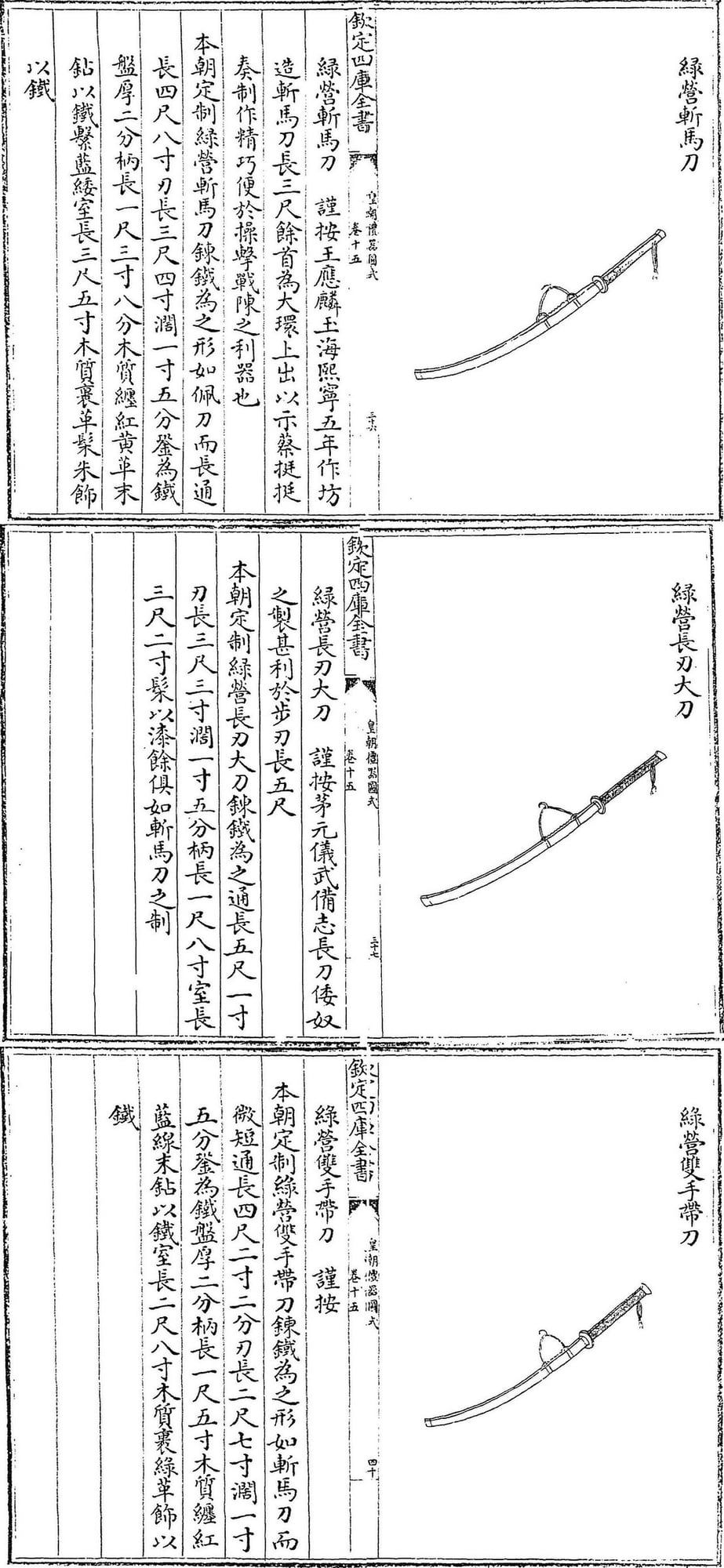
The Qing army also kept two-handed long sabres for its Green Standard troops. The 18th-century illustrated regulations, Huangchao liqi tushi, list a Green Standard zhanmadao 4.8 chi (about 1.5 m) long — the line that leads to the zhanmadao and, later, the miao dao.
How a dao is used: chop, rising cut, thrust and head-wrap
If the jian is a fencer’s weapon, the dao is a brawler’s. Its core methods are the chop (劈, pī), the hack (砍, kǎn), the rising cut (撩, liāo) and the thrust (扎, zhā), driven by the whole body rather than the wrist. Its signature, still a required element of modern competition routines, is chantou guonao , “wrapping the head”: the blade circles close around the head and shoulders, spine first, sweeping attacks aside while the body turns into the next cut.
That is what “the courage of weapons” means in practice. The saying 刀走黑,剑走青 captures the contrast: the dao goes “black” — direct, committed, crashing through — while the jian goes “green”, light and evasive. A dao fighter wins by closing the distance and keeping the blade moving; hesitation is the one thing the weapon does not forgive.
 Why did the CHINESE use FALCHIONS? The purpose of the Dao Sword in the Ming & Qing Dynasties
The “blood groove” myth
Many dao have a groove along the blade, and many people still call it a “blood groove” (血槽, xuècáo) — supposedly to let blood run out, or to break the suction that would trap a blade in a wound. Neither is true. The groove is a fuller (刀槽): by removing metal from the middle of the blade, it makes the sword lighter while keeping it stiff, the same principle as an I-beam. Some Qing blades even carried “rolling pearls”, small metal balls that ran loose in the fuller — decoration, not plumbing.
In Phantom Blade Zero the dao family turns up from the first chapter: Gamersky’s hands-on lists a twin dao and a long dao among the Chapter 1 weapons. Whatever kungfupunk does to them, their ancestors are the ring-pommel sabres of the Han and the willow-leaf sabres of the Qing — plain, hard-working swords that actually fought China’s wars.
Frequently asked
Q01What is a dao sword?
Q02What is the difference between a dao and a jian?
Q03Is a dao a katana?
Q04Why did Chinese armies switch from the jian to the dao?
Q05Do dao have blood grooves?
Sources & further reading
- Some Notable Sabers of the Qing Dynasty at the Metropolitan Museum of Art — Philip M. W. Tom, Metropolitan Museum Journal 36, 2001
- An Introduction to Chinese Single-Edged Hilt Weapons (Dao) and Their Use in the Ming and Qing Dynasties — Philip M. W. Tom & Scott M. Rodell, Kung Fu Tai Chi, February 2005
- Tang Liudian (Six Codes of the Tang), ch. 16: Office of the Armoury — Wikisource (Chinese text)
- Wujing Zongyao (1044), front collection, ch. 13: weapon plates — Wikisource (Chinese text)
- Dao (Chinese sword) — Wikipedia
- Chinese Martial Arts: From Antiquity to the Twenty-First Century — Peter A. Lorge, Cambridge University Press, 2012
Cite this page
Wuxiapunk Editors. (2026, October 27). Dao: The Chinese Sabre, From Ring-Pommel to Oxtail. Wuxiapunk. https://wuxiapunk.com/weapons/dao/
“Dao: The Chinese Sabre, From Ring-Pommel to Oxtail.” Wuxiapunk, 27 Oct. 2026, https://wuxiapunk.com/weapons/dao/.
Keep reading
Jian: The Chinese Straight Sword, Explained
What a jian is, how the double-edged Chinese sword evolved from bronze to steel, its anatomy, how it was used, and why it is called the gentleman of weapons.
Types of Chinese Swords: Jian, Dao, Miao Dao & More
Every major type of Chinese sword, era by era: bronze jian, Han ring-pommel dao, Tang modao, Ming changdao, Qing willow-leaf and oxtail sabres, miao dao and more.
Miao Dao vs Katana: History of China's Long Sabre
Miao dao history, sourced: Qi Jiguang's Ming changdao, Cheng Zongyou's 1621 manual, the 1920s name, measured lengths of 1.4–2 m, and how it compares with the katana.