Weapon dossier · Hub
Types of Chinese Swords: Jian, Dao, Miao Dao & More
中国刀剑zhōngguó dāojiàn
Every major type of Chinese sword, era by era: bronze jian, Han ring-pommel dao, Tang modao, Ming changdao, Qing willow-leaf and oxtail sabres, miao dao and more.
Key facts
- Chinese swords form two families: the straight, double-edged jian (剑) and the single-edged dao (刀), or sabre.
- The jian ruled the Bronze Age; from the Han dynasty the steel ring-pommel dao took over, and by the end of the Three Kingdoms it had largely replaced the jian in battle.
- The Tang code Tang Liudian (738) names four regulation dao — 仪刀, 鄣刀, 横刀, 陌刀 — and calls the infantry modao 'probably the ancient horse-severing sword'.
- Two-handed long sabres returned in the Ming after clashes with Japanese-led raiders; calling them miao dao (苗刀) is a Republican-era, 20th-century habit.
- Kung fu favourites such as the oxtail sabre, hook swords and butterfly swords are late Qing civilian weapons, not ancient military issue.
- Families
- 剑 jiàn (double-edged) · 刀 dāo (single-edged)
- Period covered
- Western Zhou (c. 1000 BCE) – 20th century
- Typical length
- Most one-handed swords 70–110 cm; two-handed long sabres c. 1.4–2.1 m
- Key period sources
- Han shu · Tang Liudian (738) · Wujing Zongyao (1044) · Wubei zhi (1621)
- Confirmed in Phantom Blade Zero
- Jian, dao, miao dao, soft sword, hook blades
Chinese swords come in two families: the jian 剑 jiànThe straight, double-edged Chinese sword — “gentleman of the hundred weapons”.Glossary →, a straight, double-edged sword, and the dao 刀 dāoThe single-edged Chinese sabre, the standard military blade from the Han dynasty to the Qing.Glossary →, a single-edged sabre. Over three thousand years those families branched into dozens of types — from 30 cm Bronze Age blades to two-metre Ming long sabres — and the clearest way to sort them is by era, because almost every type answered a specific military problem: chariots, cavalry, armour, pirates, or plain cost.
This guide walks through the types of Chinese swords dynasty by dynasty, quotes the period sources that name them, and ends with one reference table. Where a type shows up in Phantom Blade Zero, we say so — but only when the developers or the press have confirmed it.
Jian and dao: the two families
Every Chinese sword is a jian or a dao. The jian has two edges, a central ridge and a point; it cuts with its front third and thrusts. The dao has one edge and a thick, unsharpened spine that carries weight into a chop and survives hard parries. The word 刀 still means “knife” in everyday Chinese — the family runs from kitchen cleavers to cavalry sabres.
Martial culture gives each a personality. The jian is 百兵之君, “the gentleman of the hundred weapons”; the dao is 百兵之胆, “the courage of weapons”. Most one-handed examples of either measure about 70–110 cm overall. The outliers — two-handed long sabres and pole-mounted blades — are where the most interesting history happens.
Approximate overall lengths of typical examples; real pieces vary by period, region and maker.
From bronze jian to the ring-pommel dao
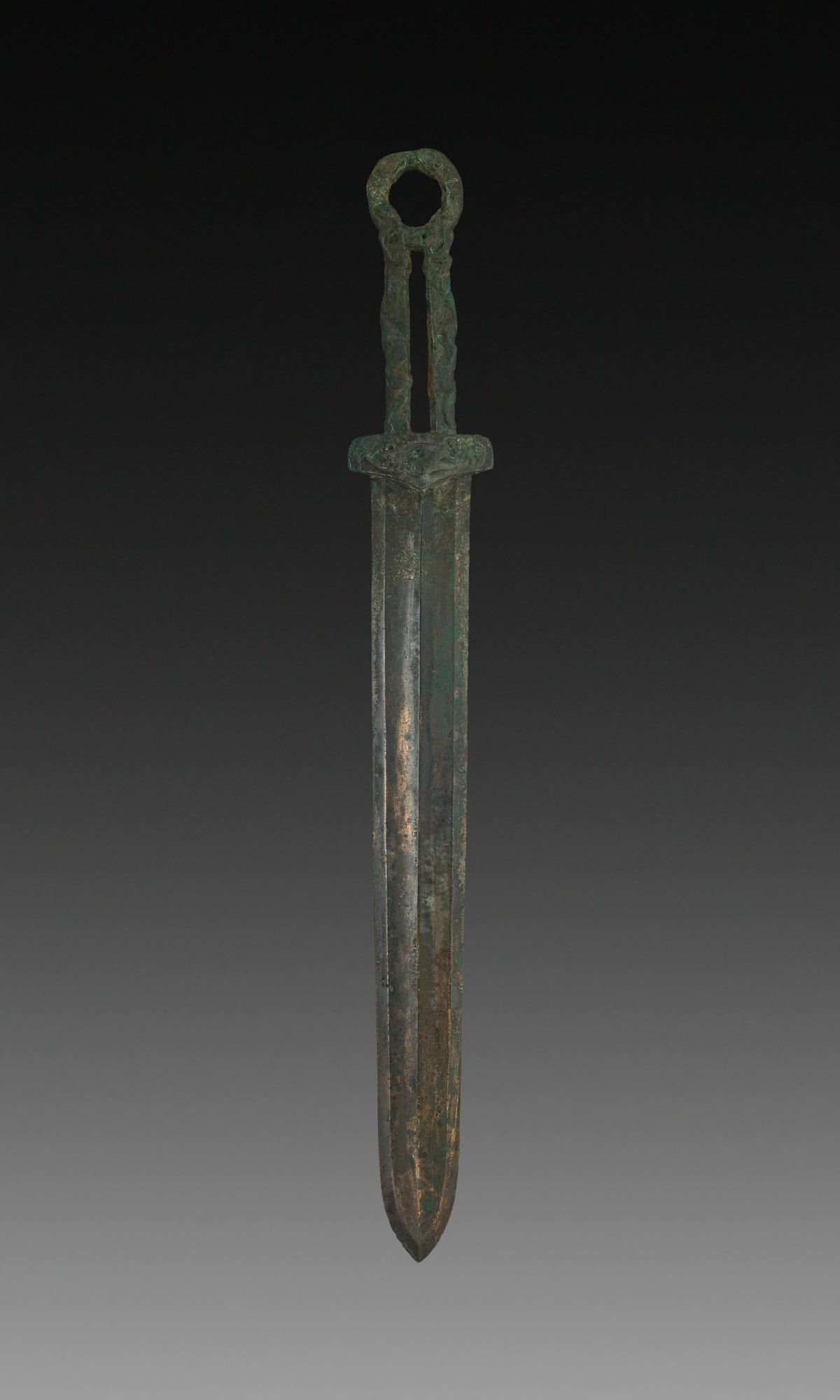
- 01c. 1600–1046 BCEBronze
商Shang
- 戈Ge dagger-axe
- 青铜刀Bronze knife
Bronze age warfare is built around the chariot and the ge — a dagger blade mounted crosswise on a pole for hooking and slashing. Swords barely exist yet.
- 021046–771 BCEBronze
西周Western Zhou
- 柳叶形短剑Willow-leaf short sword
- 戟Ji halberd
The first Chinese swords appear: short, leaf-shaped bronze daggers for close defence. The ji combines a spear point and a ge blade on one shaft.
- 03770–221 BCEBronze
春秋战国Spring & Autumn / Warring States
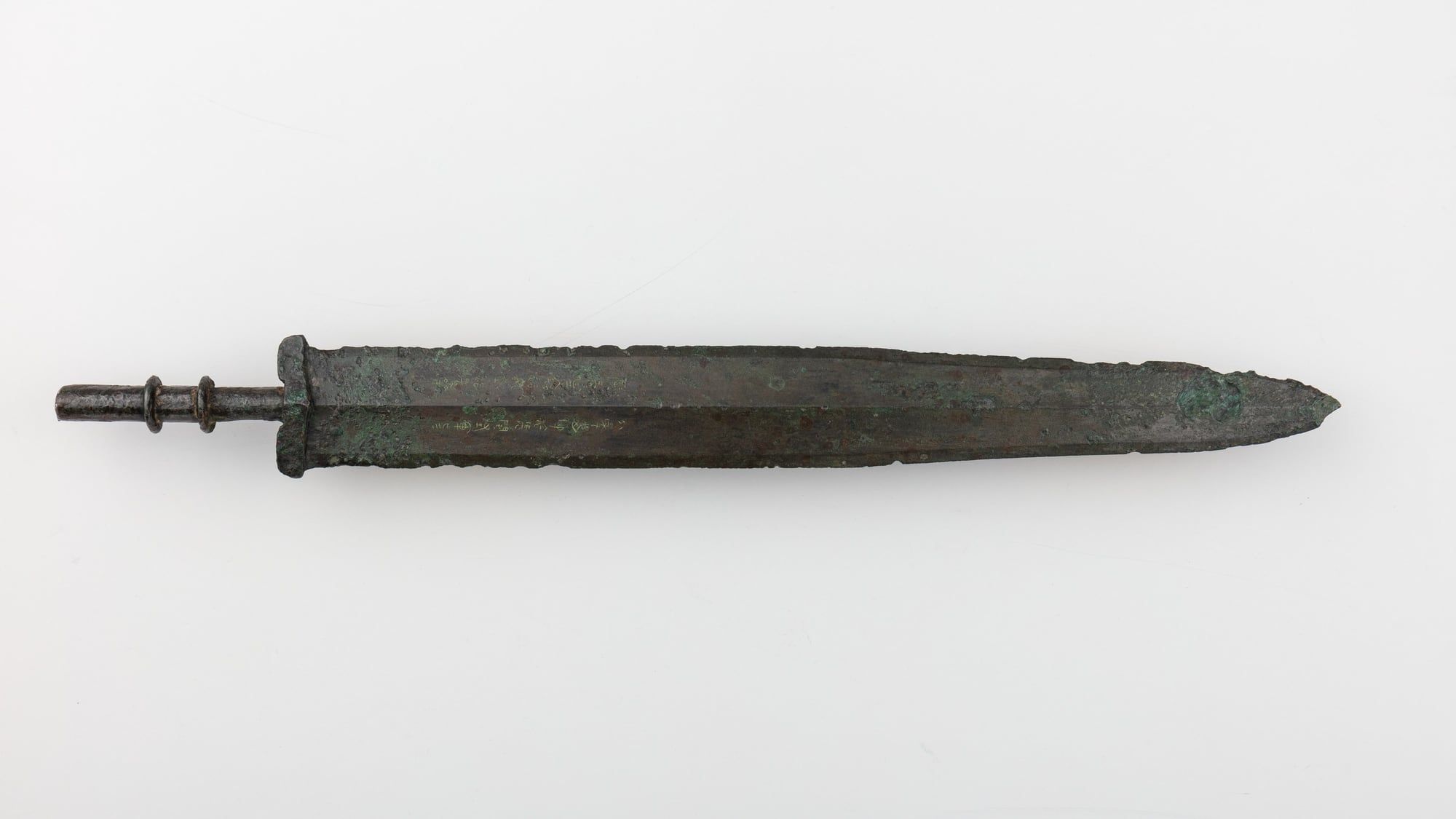
- 青铜剑(越王勾践剑)Bronze jian (Sword of Goujian)
- 弩Crossbow
The golden age of bronze swordsmithing. Wu and Yue smiths cast composite blades — tough low-tin cores, hard high-tin edges. The Sword of Goujian is still sharp after 2,500 years.
Read more → - 04221–206 BCEBronze
秦Qin
- 长铜剑Long bronze sword
- 制式弩机Standardised crossbow
The first empire standardises everything — including weapons. Swords from the Terracotta Army pits run to over 90 cm, long for bronze.
- 05206 BCE–220 CESteel
汉Han
- 环首刀Ring-pommel dao
- 钢剑Steel jian
Steel takes over. Puddled and “hundred-refined” steel makes the single-edged ring-pommel dao — sturdy, cheap, perfect for cavalry — and the dao begins to replace the jian on the battlefield.
Read more → - 06220–589Steel
三国两晋南北朝Three Kingdoms to Northern & Southern
- 刀Dao
- 槊Cavalry lance (shuo)
Centuries of war refine metallurgy: Qiwu Huaiwen’s co-fusion steel (guangang) mixes cast and wrought iron. Armoured cavalry rides with long lances.
- 07618–907Steel
隋唐Sui & Tang
- 横刀Hengdao straight sabre
- 陌刀Modao long blade
Tang sabres are straight, single-edged and elegantly mounted; the style travelled east, and Nara’s Shōsōin still keeps an 8th-century “Tang great sword”. Tang infantry wielded the fearsome two-handed modao.
- 08960–1279Steel
宋Song
- 手刀Shoudao hand sabre
- 火枪Fire lance
The Wujing Zongyao (1044) catalogues the empire’s arsenal in woodblock plates — sabres, polearms, crossbows and the first gunpowder weapons.
- 091368–1644Steel
明Ming
- 长刀Changdao long sabre
- 雁翎刀Yanling “goose-quill” dao
Fighting coastal raiders, general Qi Jiguang adopts the long two-handed sabre — the line that leads to today’s miao dao. The Wubei Zhi (1621) illustrates hundreds of weapons.
Read more → - 101644–1912Steel
清Qing
- 腰刀(柳叶刀)Yaodao (willow-leaf sabre)
- 牛尾刀Niuweidao oxtail sabre
The waist sabre (yaodao) is the standard sidearm; 19th-century civilians favour the heavy oxtail sabre. The jian becomes a gentleman’s and martial artist’s weapon.
Read more → - 111912–todaySteel
武术、武侠与功夫朋克Wushu, wuxia & kungfupunk
- 武术剑与刀Wushu jian & dao
- 《影之刃零》(2026)Phantom Blade Zero (2026)
Blades leave the battlefield for the training hall, the novel and the screen — and, in 2026, for the kungfupunk world of Phantom Blade Zero.
Read more →
The first Chinese swords appeared in the Western Zhou (1046–771 BCE): leaf-shaped bronze blades just 28–46 cm long, a last resort when chariot and dagger-axe could no longer reach. By the late Spring and Autumn period blades reached about 56 cm, and the casters of Wu and Yue produced masterpieces such as the Sword of Goujian. Bronze “long swords” of around a metre followed in the third century BCE.
The Han dynasty (206 BCE–220 CE) changed everything. Puddled and repeatedly folded steel — the origin of hundred-refined steel — made long, springy jian of 70–100 cm possible, and it also made a new weapon: the single-edged ring-pommel dao 环首刀 huánshǒudāoThe straight, single-edged Han-dynasty steel sabre with a ring at the end of its grip.Glossary →. Excavated examples run from about 86 to 114 cm. Its thick back made it harder to break than a jian, it chopped well from the saddle, and with a shield it did the jian’s job more cheaply. By the end of the Three Kingdoms (280 CE) the dao had largely replaced the jian on the battlefield, and the jian became the sword of officials, scholars and Daoist priests (see the jian dossier).
The Han also left a name that echoed for two thousand years. In the Han shu, the official Zhu Yun asks Emperor Cheng for a horse-cutting sword from the imperial workshop so he can behead a corrupt minister — the ancestor, at least in name, of the zhanmadao.
Tang and Song: four regulation dao and an illustrated arsenal
The Tang wrote its sword types into law. The Tang Liudian (738), the dynasty’s administrative code, opens its entry on blades with a four-way division:
刀之制有四:一曰仪刀,二曰鄣刀,三曰横刀,四曰陌刀。
There are four regulation dao: the first is the ceremonial dao, the second the guard dao, the third the cross dao, the fourth the mo dao.
The code’s own notes explain each one. The yidao was a ceremonial blade mounted in gold and silver with dragon-and-phoenix rings, carried by honour guards. The zhangdao (also written 鄣刀) served “to shield the body and resist the enemy”. The hengdao was “the sidearm soldiers wear”, a name first used under the Sui. And the modao was “a long dao carried by infantry — probably the ancient horse-severing sword”. General Li Siye led modao troops to victory at Xiangji Temple in 757; his story is in the zhanmadao dossier.
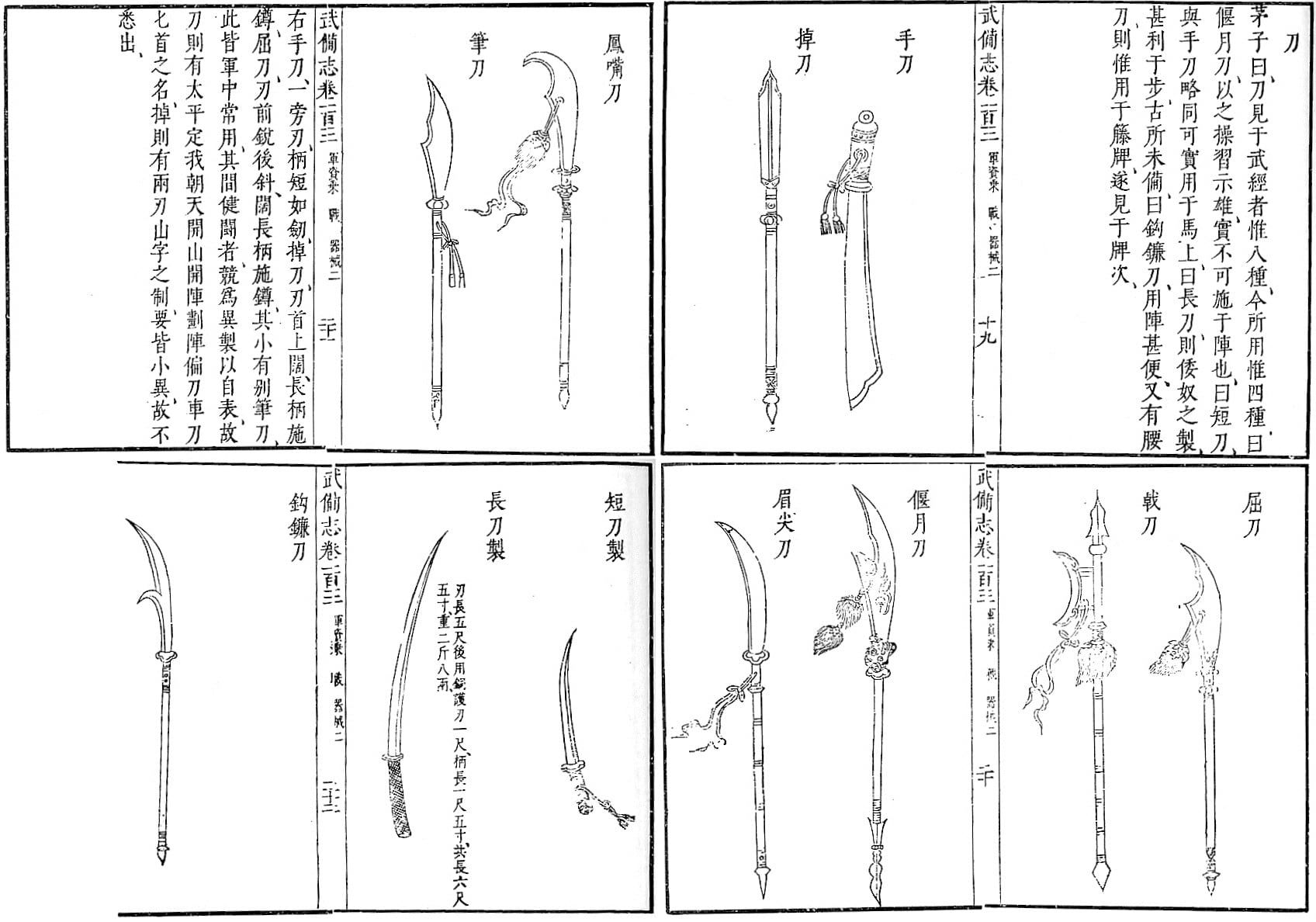
The Song produced the first great illustrated arsenal. The Wujing Zongyao (1044) draws eight dao: one shoudao , or “hand dao” — “one edge, with a short hilt like a sword’s” — and seven long-hafted blades, among them the crescent-bladed 掩月刀 that later legend handed to Guan Yu as the guandao. It also notes that tough fighters had their blades made to their own designs and gave them names such as “Taiping”, “Kaishan” (mountain-opener) and “Kaizhen” (formation-breaker).
One correction to a common claim: the two-handed zhanmadao is not in the Wujing Zongyao. The key Song record is the Song shi’s account of 1072, when Emperor Shenzong had tens of thousands of great sabres made with a large ring pommel.
Ming to Republic: long sabres, waist sabres and the big sword
The Ming fought on two fronts — Mongol cavalry in the north, Japanese-led wokou raiders on the coast — and its swords show both. Curved, steppe-influenced sabres had spread under the Yuan, and by the mid-Ming one-handed sabres had replaced the jian as the issue weapon. The classic Ming profile is the yanling dao , the “goose-quill sabre”: straight-backed, with a curve only near the tip.
On the coast, General Qi Jiguang met Japanese two-handed swords and adopted his own changdao . Mao Yuanyi’s Wubei zhi (1621) is blunt about the origin: the long dao “is a Japanese design, very advantageous for infantry, which the ancients did not have.” The same passage pairs the waist sabre, or yaodao , with the rattan shield. This long-sabre line — Ming changdao, then Qing zhanmadao — is what the 20th century renamed the miao dao.
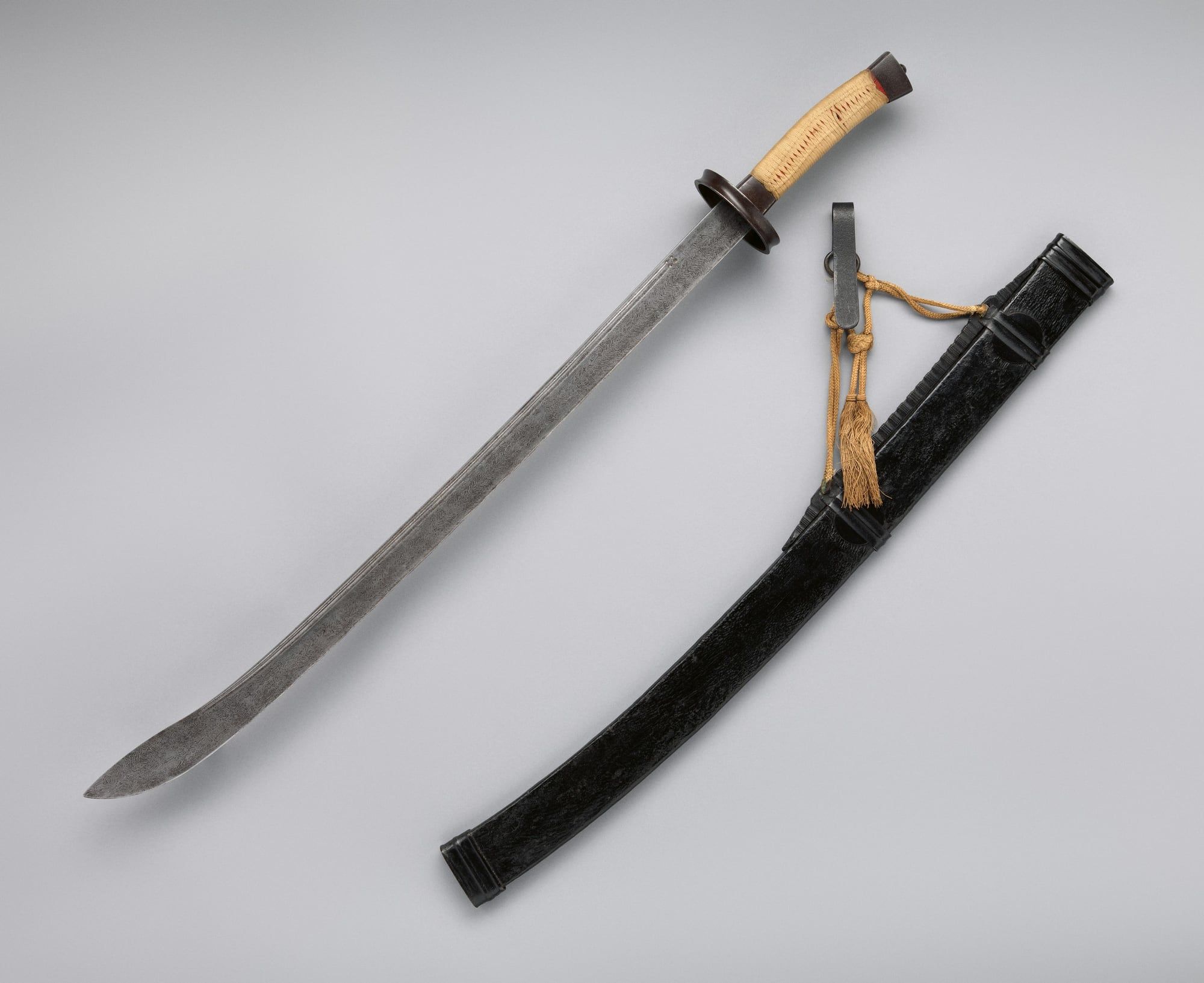
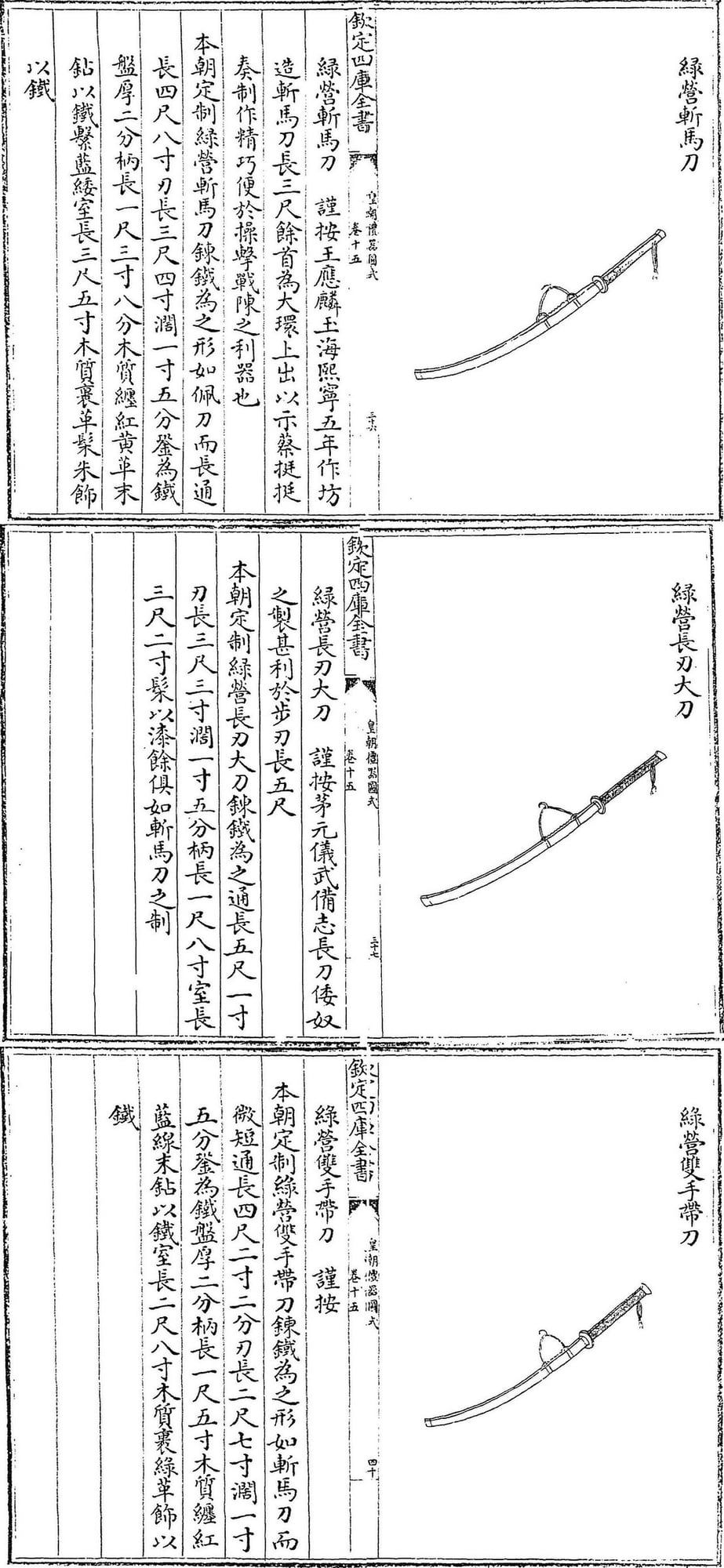
Under the Qing the waist sabre became the standard sidearm, in four shapes collectors still use: the goose-quill yanmaodao; the liuyedao , or willow-leaf sabre, the most common of all; the deeply curved piandao for slashing; and the heavy, flared niuweidao , or oxtail sabre. The oxtail is the “Chinese broadsword” of kung fu films, yet it is first recorded only in the early 19th century, as a civilian weapon that never appears in official arms lists. Qing regulations also kept two-handed long sabres for the Green Standard Army. The dao dossier covers them all.
The last chapter belongs to the dadao , a short, broad, long-hilted chopper of the late Qing that Chinese troops carried against Japan in the 1930s — and to the name miao dao itself, which, as historian Benjamin Judkins notes, never appears before the Republican period.
Soft swords, hooks, twins and butterflies
Some of the most famous “Chinese swords” were never battlefield weapons.
- Soft sword (ruanjian ): a jian thin enough to bend. The Song scholar Shen Kuo recorded swords that bent “like a hook” and sprang back straight, but the belt sword worn round the waist belongs mostly to folklore and wuxia. See soft sword.
- Hook swords (shuanggou ): paired swords with a crook at the tip and crescent guards. Despite claims of great age, surviving examples and pictures are late Qing or later, and they appear in no official arms list. See hook swords.
- Twin swords (shuangjian ): two jian wielded at once, a staple of wushu routines.
- Butterfly swords (hudie shuangdao ): short, broad paired dao from southern China, probably early 19th century. English accounts from the 1840s describe Guangdong militia drilling with “double swords”; today they are best known from Wing Chun, with blades of about 29 cm.
Types of Chinese swords at a glance
| Type | 汉字 / pinyin | Era | Edge | Typical length | Notes | Dossier |
|---|---|---|---|---|---|---|
| Bronze jian | 青铜剑 qīngtóng jiàn | Western Zhou – Qin | Double | 28–46 cm blades early; c. 1 m by the 3rd c. BCE | Cast bronze; Wu and Yue masterpieces | Sword of Goujian |
| Steel jian | 剑 jiàn | Han – today | Double | Mostly 70–100 cm (Han) | Sidearm and status symbol after the Han | Jian |
| Horse-cutting sword | 斩马剑 zhǎnmǎ jiàn | Han | Double (by name) | Not recorded | Imperial-workshop blade in the Han shu | Zhanmadao |
| Ring-pommel dao | 环首刀 huánshǒu dāo | Han – Six Dynasties | Single, straight | 86–114 cm (excavated) | First mass-issue steel sabre | Dao |
| Ceremonial and guard dao | 仪刀 yídāo · 障刀 zhàngdāo | Sui – Tang | Single | Not recorded | Honour-guard and body-shield blades | Dao |
| Cross dao | 横刀 héngdāo | Sui – Tang | Single, straight | Not recorded | The soldier’s sidearm | Dao |
| Modao | 陌刀 mòdāo | Tang | Debated | Long; not recorded | Elite infantry blade; Li Siye | Zhanmadao |
| Hand dao | 手刀 shǒudāo | Song | Single | One-handed | “Short hilt like a sword’s” | Dao |
| Song zhanmadao | 斩马刀 zhǎnmǎdāo | Song (1072) | Single | Blade over 3 chi (c. 94 cm) | Two-handed, large ring pommel | Zhanmadao |
| Changdao | 长刀 chángdāo | Ming | Single, curved | 6.5 chi in the Wubei zhi (c. 2 m) | Qi Jiguang; Japanese-inspired | Miao dao |
| Goose-quill sabre | 雁翎刀 yànlíng dāo | Ming – Qing | Single, tip curve | One-handed | Classic Ming profile | Dao |
| Willow-leaf sabre | 柳叶刀 liǔyè dāo | Ming – Qing | Single, even curve | One-handed | The most common Qing sabre | Dao |
| Slashing sabre | 片刀 piàndāo | Qing | Single, deep curve | One-handed | Used with a shield | Dao |
| Oxtail sabre | 牛尾刀 niúwěi dāo | 19th c. | Single, flared tip | One-handed | Civilian only | Dao |
| Big sword | 大刀 dàdāo | Late Qing – 1940s | Single, broad | 58 cm blade (1930s spec) | Weapon of the “Big Sword” units | Zhanmadao |
| Miao dao | 苗刀 miáodāo | Name from the 1920s | Single, long | 138–153 cm (modern) | Two-handed; modern design c. 2000 | Miao dao |
| Soft sword | 软剑 ruǎnjiàn | Recorded c. 1088; modern form | Double | Varies | Springy blade; performance weapon | Soft sword |
| Hook swords | 双钩 shuānggōu | Late Qing | Hooked tip | Varies | Civilian, paired | Hook swords |
| Butterfly swords | 蝴蝶双刀 húdié shuāngdāo | Early 19th c. | Single | c. 29 cm blade (modern) | Paired; Wing Chun | — |
“Not recorded” means the period texts name the weapon without giving dimensions. Lengths in chi (尺) are converted at roughly 31–32 cm per Song or Ming chi.
 The Chinese Sword That Ruled for 2,500 Years | Forged in Fire
Seen in Phantom Blade Zero
S-GAME says the prototypes for its weapons are drawn “from the vast arsenal of traditional Chinese weaponry”, and that it sometimes has master swordsmiths forge real replicas. Here is what has been confirmed for the sword types above:
No source yet confirms butterfly swords or an oxtail sabre in the game. For the full weapon list, including the guandao and the Phantom Edges, see Phantom Blade Zero weapons and their real origins.
That is the pattern across three millennia: a real blade answers a real problem, and then legend, wuxia fiction and now kungfupunk sharpen it into something larger than life.
Names in this article · Codex
Frequently asked
Q01What are the main types of Chinese swords?
Q02What is the most famous Chinese sword?
Q03Is a dao a katana?
Q04Is the jian better than the katana?
Q05Which Chinese swords appear in Phantom Blade Zero?
Sources & further reading
- Tang Liudian (Six Codes of the Tang), ch. 16: Office of the Armoury — Wikisource (Chinese text)
- Wujing Zongyao (1044), front collection, ch. 13: weapon plates — Wikisource (Chinese text)
- Wubei zhi (Mao Yuanyi, 1621), section on dao, as reproduced in the Gujin tushu jicheng — Wikisource (Chinese text)
- An Introduction to Chinese Single-Edged Hilt Weapons (Dao) and Their Use in the Ming and Qing Dynasties — Philip M. W. Tom & Scott M. Rodell, Kung Fu Tai Chi, February 2005
- Old or New? The Miaodao and Invention in Chinese Martial Arts — Benjamin Judkins, Kung Fu Tea, 2021
- Chinese Martial Arts: From Antiquity to the Twenty-First Century — Peter A. Lorge, Cambridge University Press, 2012
Cite this page
Wuxiapunk Editors. (2026, October 27). Types of Chinese Swords: Jian, Dao, Miao Dao & More. Wuxiapunk. https://wuxiapunk.com/weapons/types-of-chinese-swords/
“Types of Chinese Swords: Jian, Dao, Miao Dao & More.” Wuxiapunk, 27 Oct. 2026, https://wuxiapunk.com/weapons/types-of-chinese-swords/.
Keep reading
Jian: The Chinese Straight Sword, Explained
What a jian is, how the double-edged Chinese sword evolved from bronze to steel, its anatomy, how it was used, and why it is called the gentleman of weapons.
Dao: The Chinese Sabre, From Ring-Pommel to Oxtail
What a dao sword is, how the Chinese sabre evolved from the Han ring-pommel dao to Qing willow-leaf and oxtail sabres, why armies chose it, and how it is used.
Miao Dao vs Katana: History of China's Long Sabre
Miao dao history, sourced: Qi Jiguang's Ming changdao, Cheng Zongyou's 1621 manual, the 1920s name, measured lengths of 1.4–2 m, and how it compares with the katana.