Weapon dossier · Sabres
Miao Dao vs Katana: History of China's Long Sabre
苗刀miáodāo
Miao dao history, sourced: Qi Jiguang's Ming changdao, Cheng Zongyou's 1621 manual, the 1920s name, measured lengths of 1.4–2 m, and how it compares with the katana.
Key facts
- A miao dao (苗刀, “sprout sabre”) is a Chinese two-handed long sabre with a narrow blade and a long hilt; modern ones measure about 1.4–1.5 m overall.
- Its ancestor is the Ming changdao (长刀), adopted by General Qi Jiguang after fighting Japanese-led raiders; the Wubei zhi (1621) calls it “a Japanese design… which the ancients did not have”.
- Cheng Zongyou's Dandao fa xuan (1621) says he learned the two-handed sabre from Liu Yunfeng, who “had received the true Japanese transmission”.
- The name “miao dao” does not appear before the Republican era; it spread from the 1920s, partly to distance the weapon from its Japanese roots.
- In Phantom Blade Zero, director Soulframe Liang calls the late-game weapon 白影 “a slender miao dao”.
- Type
- Two-handed single-edged long sabre
- Chinese
- 苗刀 · miáodāo (“sprout sabre”)
- Ancestors
- Ming changdao 长刀; Qing Green Standard zhanmadao 斩马刀
- Overall length
- Modern 138–153 cm; Ming–Qing specifications c. 1.5–2.1 m
- Weight
- Modern c. 1.25–1.5 kg; 2 jin 8 liang (c. 1.5 kg) in the Wubei zhi
- Name first attested
- Republican era (1920s)
- In Phantom Blade Zero
- 白影, a late-game primary weapon
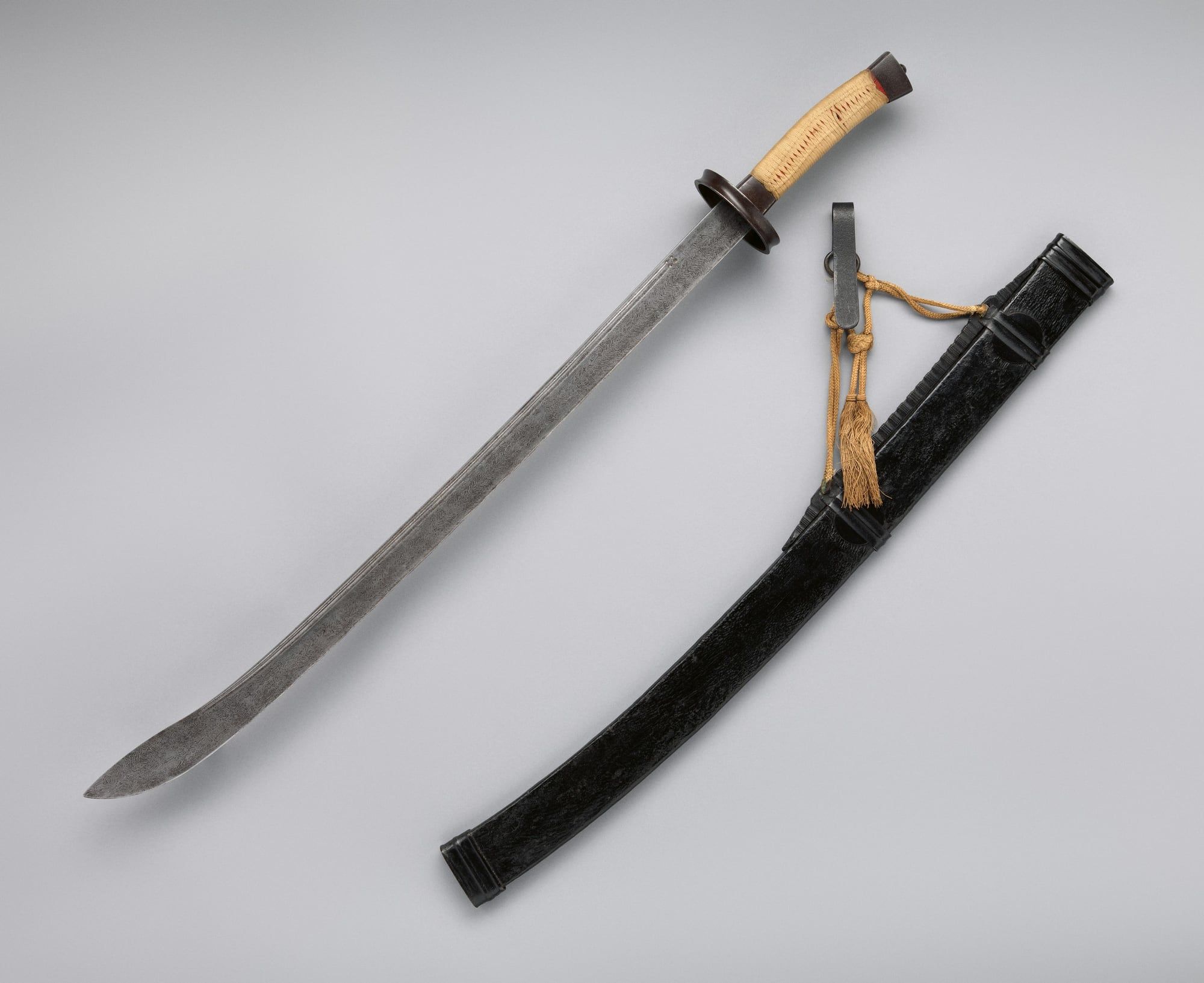
A miao dao 苗刀 miáodāoA long, slender two-handed sabre descended from Ming-era long blades.Glossary → is a Chinese two-handed long sabre: a narrow, gently curved single-edged blade on a long hilt, usually about 1.4–1.5 m overall in its modern form. The name means “sprout sabre”, and its story runs from Ming generals fighting Japanese-led pirates to a 20th-century reinvention — which is exactly why it gets compared, so often and so loosely, with the katana.
Qi Jiguang’s changdao: the Ming ancestor
The miao dao’s ancestor is the Ming changdao , or “long sabre”. In the mid-16th century General Qi Jiguang fought the wokou, coastal raiders who mixed Japanese and Chinese freebooters and whose long two-handed swords were brutally effective against Chinese spearmen. Qi armed some of his own troops with a version of the Japanese long sword, which he called changdao, and later used it against cavalry on the northern frontier. As historian Benjamin Judkins stresses, it was Qi’s small-unit tactics, such as the mandarin duck formation, rather than the long sabre that did most to beat the pirates.
Ming writers were candid about where the weapon came from:
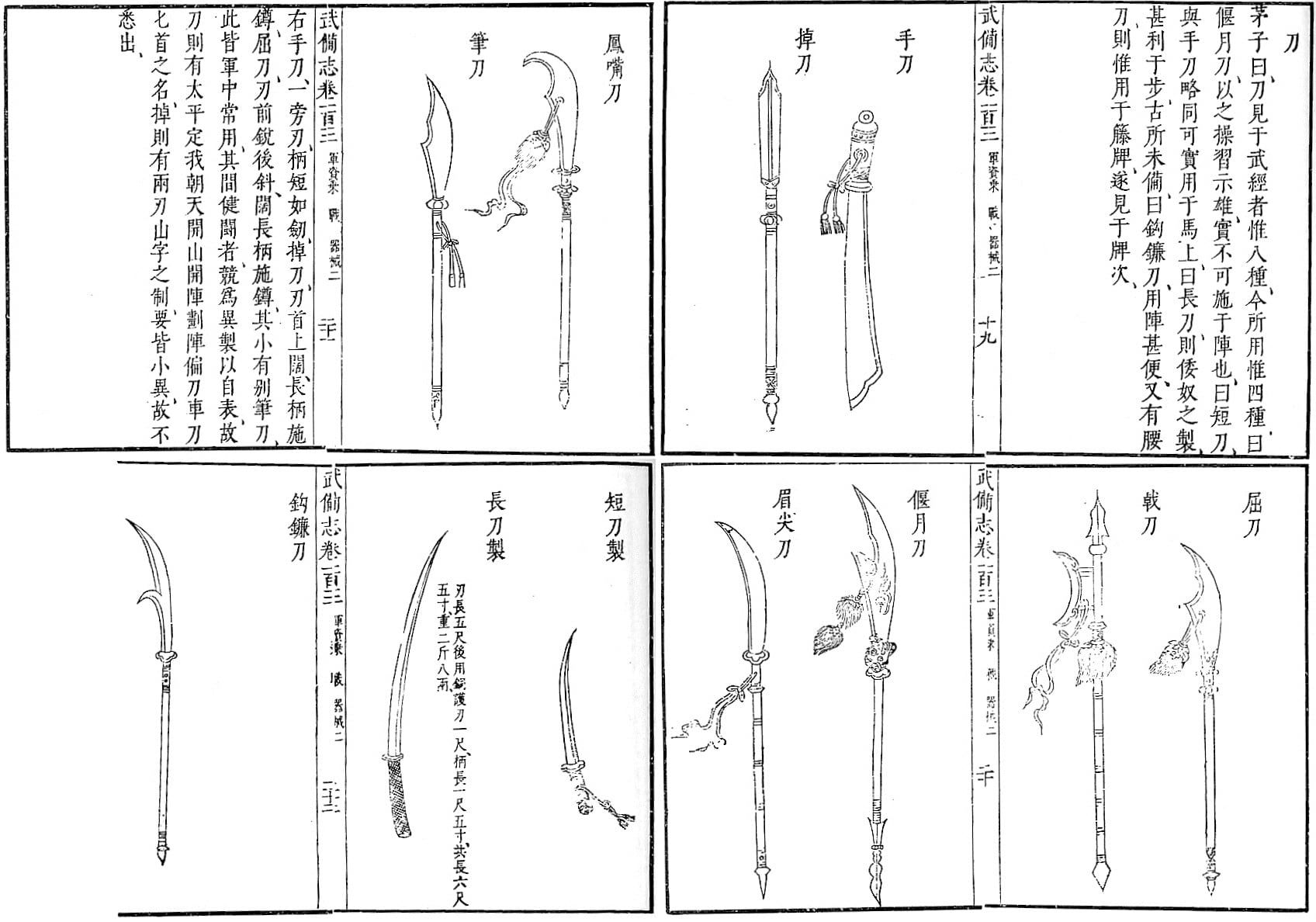
长刀,则倭国之制,甚利于步,古所未备。
The long dao is a Japanese design. It is very advantageous for infantry, and the ancients did not have it.
The Wubei zhi also gives the changdao’s specification: a blade of 5 chi, its rear chi covered by a copper sleeve; a hilt of 1.5 chi; 6.5 chi in all; weight 2 jin 8 liang. At roughly 31–32 cm to the Ming chi, that is about 2 m long and 1.5 kg — a true field sword. Which chi standard was meant is uncertain, so treat the metric figures as approximate.
Cheng Zongyou’s Dandao fa xuan (1621)
The best surviving manual is Cheng Zongyou’s Dandao fa xuan (“Selected Methods of the Single Sabre”), printed in 1621 in his collection Gengyu shengji. “Single sabre” here means a sabre held in both hands, with no shield or second weapon. Cheng opens by explaining why he wanted it:
其用法,左右跳跃,奇诈诡秘,人莫能测,故长技每每常败于刀。
Their method leaps left and right, deceptive and secret, so no one can predict it — which is why long weapons are so often beaten by this sabre.
He went looking for the method and found a Zhejiang master, Liu Yunfeng, who “had received the true Japanese transmission” and taught him without holding back. Cheng’s own specification “takes the Japanese sword as the model”: a 3.8-chi blade and a 1.2-chi hilt, 5 chi in all, or roughly 1.55–1.6 m. Liu’s techniques had postures but no names, so Cheng named them after their shapes — and his illustrations of them are the images most miao dao histories still reproduce.
How the name “miao dao” was born
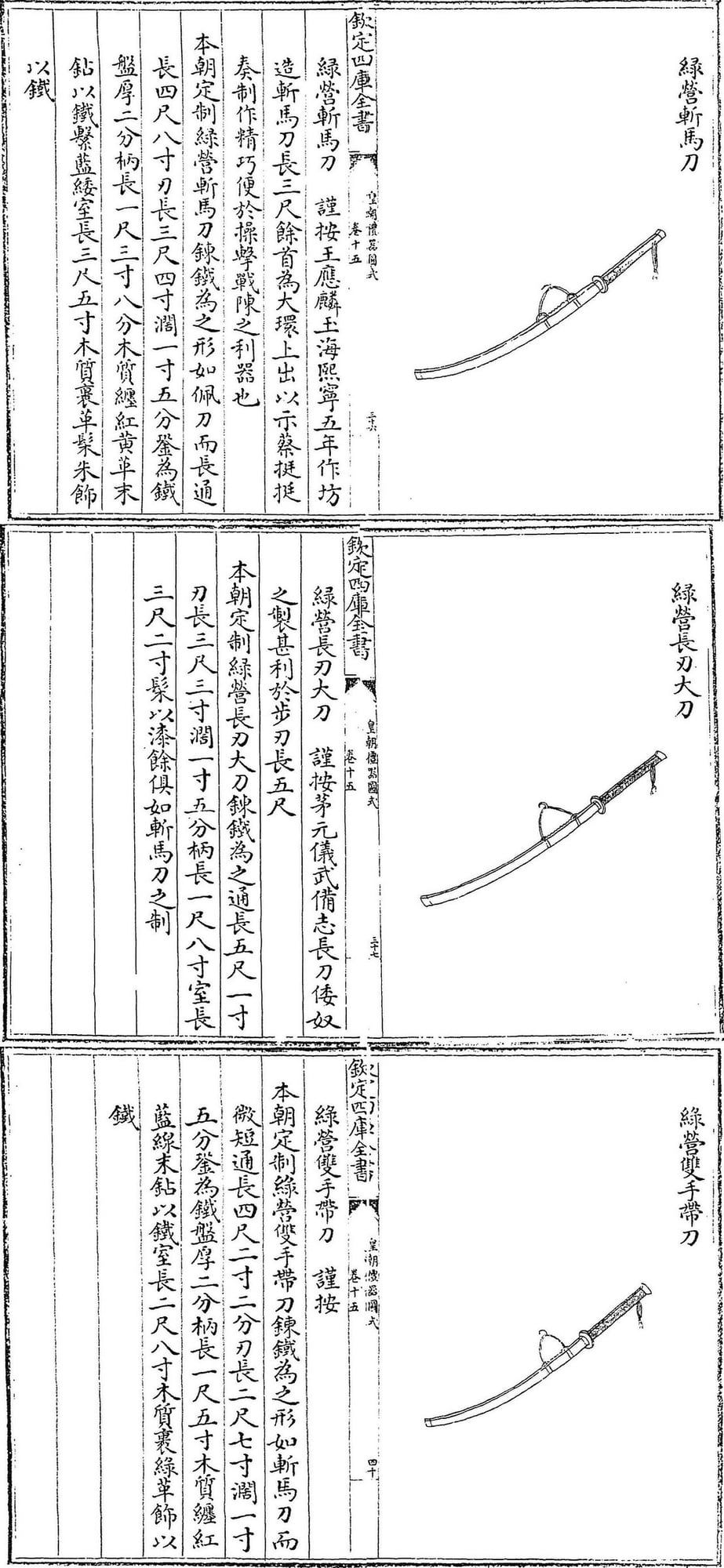
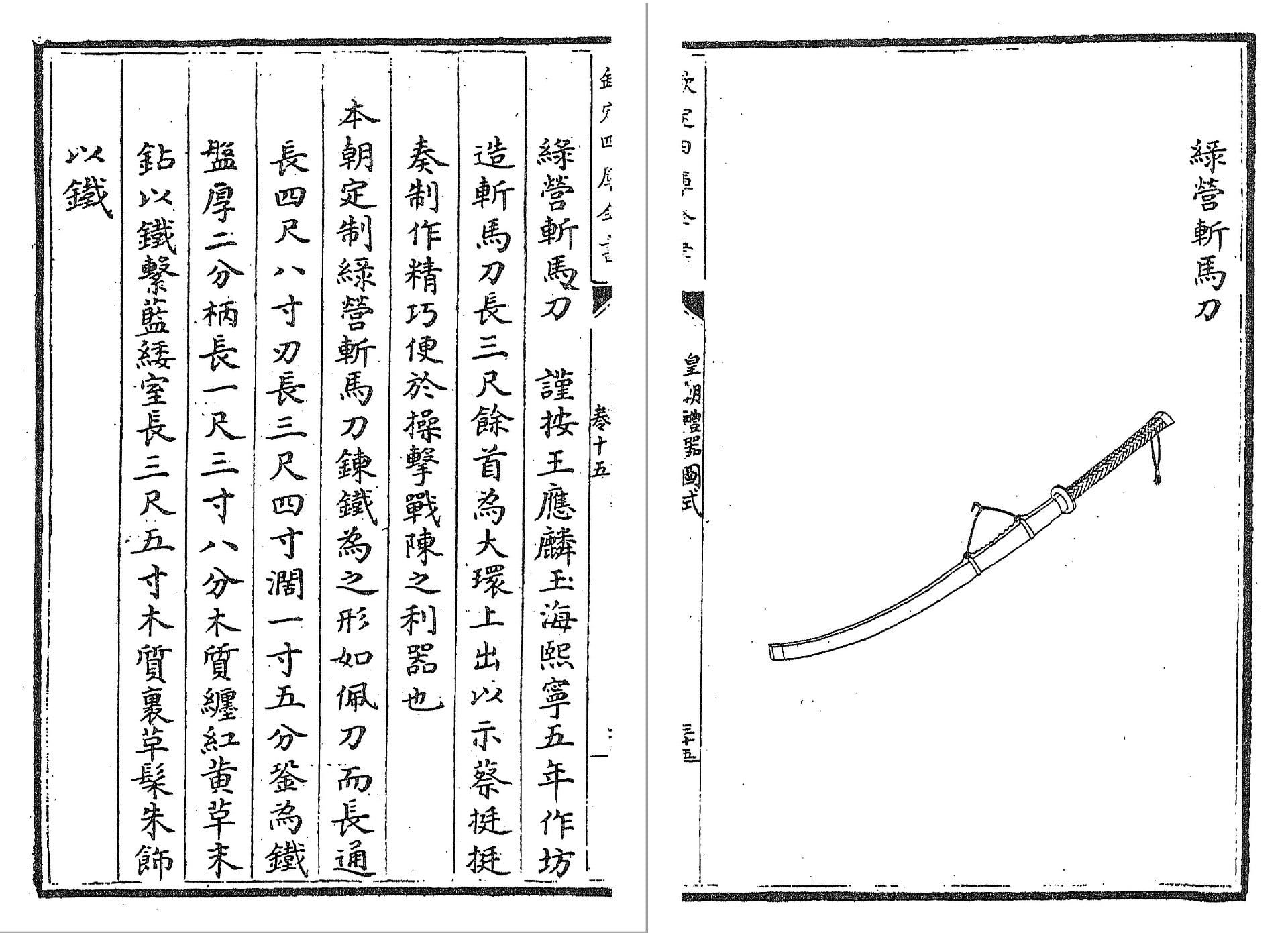
The Qing did not forget the lesson. Its 18th-century illustrated regulations, the Huangchao liqi tushi, list two-handed long sabres for the Han Chinese Green Standard Army: a zhanmadao 4.8 chi long, and a “long-bladed great sabre” whose entry quotes the Wubei zhi on the Japanese long dao. Judkins identifies the zhanmadao as the Qing weapon closest to what Qi and Cheng describe (for its older, unrelated namesake, see the zhanmadao dossier).
The word miao dao, however, never appears before the Republican period (1912–1949). In the warlord era, a martial artist and military trainer named Liu Yuchun (刘玉春) introduced “miao dao troops” into the army of Cao Kun, assigned to protect artillery at close quarters. With Japan’s presence in China a burning issue, the new name rhetorically distanced the weapon from its foreign roots. Liu’s student Guo Changsheng (郭长生, born 1896), nicknamed “the Swallow”, did much to popularise it, and a 1932 book by Jin Yiming already ties the miao dao to the Qing wodao, or “Japanese sabre”.
The name is usually explained by the blade’s slender, seedling-like shape: 苗 means a young sprout. It has nothing to do with the Miao ethnic group, and nothing to do with Shi Miao Dao, the noodle chain that crowds search results for the term.
The modern blade is newer still. Around 2000, Guo’s son Guo Ruixiang commissioned 22 prototype sabres from Longquan smiths to a deliberately new design — 138 cm overall, a 98 cm blade, a 31 cm wooden hilt, about 1.25 kg — with a rounded, “pipe-backed” spine and a flattened tip, made “a bit shorter and lighter” for modern bodies and modern practice. Most miao dao sold today descend from that design.
How long is a miao dao? Measured lengths, sourced
AI assistants quote miao dao lengths anywhere from 1.1 to 1.6 m. The confusion comes from mixing blade length with overall length, and modern practice swords with historical war sabres. These are the figures in the sources themselves:
| Weapon (source) | Date | Blade | Hilt | Overall | Weight |
|---|---|---|---|---|---|
| Qi Jiguang’s changdao (Wubei zhi) | Ming; printed 1621 | 5 chi (c. 155–160 cm) incl. copper sleeve | 1.5 chi (c. 47 cm) | 6.5 chi (c. 2.0–2.1 m) | 2 jin 8 liang (c. 1.5 kg) |
| Cheng Zongyou’s dandao (Dandao fa xuan) | 1621 | 3.8 chi (c. 118–122 cm) | 1.2 chi (c. 37–38 cm) | 5 chi (c. 155–160 cm) | — |
| Surviving Ming changdao (Peter Dekker collection; tang shortened) | Ming | — | — | 126.5 cm as it survives | — |
| Green Standard zhanmadao (Huangchao liqi tushi) | 18th c. | 3.4 chi (c. 109 cm) | 1.38 chi (c. 44 cm) | 4.8 chi (c. 154 cm) | — |
| Green Standard long-bladed great sabre (same) | 18th c. | 3.3 chi (c. 106 cm) | 1.8 chi (c. 58 cm) | 5.1 chi (c. 163 cm) | — |
| Guo Ruixiang’s “new generation” miao dao | 2000 | 98 cm | 31 cm | 138 cm | c. 1.25 kg |
| Typical production miao dao (Sinosword) | 2020s | 98 cm | — | 140 cm | — |
| LK Chen “Silver Swallow” | 2021 | 111 cm | — | 152.5 cm | 1.51 kg |
Conversions use about 31–32 cm per Ming chi and 32 cm per Qing chi; the Ming survivor and the modern swords are as reported by Judkins. The honest answer: modern miao dao run about 1.38–1.53 m overall; historical Chinese two-handed sabres ran roughly 1.5–2.1 m.
Approximate overall lengths of typical examples; real pieces vary by period, region and maker.
Miao dao vs katana vs nodachi vs changdao
| Miao dao (modern) | Katana | Nodachi (ōdachi) | Changdao (Ming) | |
|---|---|---|---|---|
| Origin | China; 20th-century design | Japan | Japan | China, 16th c., on Japanese models |
| Grip | Two hands; long wooden hilt | Two hands; wrapped hilt | Two hands; long hilt | Two hands; long hilt |
| Blade | c. 98–111 cm | Over 2 shaku (60.6 cm), often c. 70 cm | Over 3 shaku (90.9 cm) by definition | 3.8–5 chi (c. 1.2–1.6 m) in Ming specs |
| Overall | c. 138–153 cm | c. 1 m | c. 1.2 m and up | c. 1.55–2.1 m |
| Cross-section | Broad thin blade on a thick, rounded “pipe” spine | Ridged, five-sided | Ridged, five-sided | Mostly five-sided, like its Japanese models |
| Curve | Gentle; fairly straight | Moderate | Moderate | Gentle |
| Typical use | Cuts and thrusts in modern practice | Samurai sidearm and cutting sword | Field sword, feared by spearmen | Infantry weapon against spears and cavalry |
So is a miao dao “a Chinese katana”? Not really. Its Ming ancestor was openly modelled on Japanese long swords — closer to the nodachi than the katana — while the modern miao dao is a different animal, with its own cross-section, hilt and way of moving. Neither “ancient indigenous blade” nor “katana copy” survives contact with the sources; the miao dao is what happens when a borrowed weapon is reinvented twice. For its one-handed cousins see the dao dossier, and for the whole family, types of Chinese swords.
 Miaodao Saber | 苗刀:传统技法 中华武风
In Phantom Blade Zero
Phantom Blade Zero gives the miao dao a starring late-game role. In a long post on 9 September 2026, director Soulframe Liang wrote that the weapon 白影 (“White Shadow”; its English name is unconfirmed) “is a slender miao dao”, obtained late in the game. Many of the game’s weapons are boss drops, he explained, so late-game blades like this one only really come into their own on a second playthrough. Liang has not said which historical blade inspired it, but a slender, two-handed sabre sits squarely in the changdao-to-miao-dao line — the right weapon for a hero who keeps opponents at the end of a very long edge.
Names in this article · Codex
Frequently asked
Q01What is the difference between a miao dao and a katana?
Q02How long is a miao dao?
Q03What is the difference between changdao and miaodao?
Q04Why is it called a miao dao?
Q05Is the miao dao Japanese?
Sources & further reading
- Old or New? The Miaodao and Invention in Chinese Martial Arts — Benjamin Judkins, Kung Fu Tea, 21 February 2021
- Gengyu shengji, including the Dandao fa xuan (Cheng Zongyou, 1621) — Wikisource (Chinese text)
- Wubei zhi (Mao Yuanyi, 1621), section on dao, as reproduced in the Gujin tushu jicheng — Wikisource (Chinese text)
- Huangchao liqi tushi (Qing illustrated regulations), ch. 15: Green Standard sabres — Wikisource (Chinese text)
- Soulframe Liang's post of 9 September 2026 on weapons and difficulty — Gamersky
- Chinese Martial Arts: From Antiquity to the Twenty-First Century — Peter A. Lorge, Cambridge University Press, 2012
Cite this page
Wuxiapunk Editors. (2026, October 27). Miao Dao vs Katana: History of China's Long Sabre. Wuxiapunk. https://wuxiapunk.com/weapons/miao-dao/
“Miao Dao vs Katana: History of China's Long Sabre.” Wuxiapunk, 27 Oct. 2026, https://wuxiapunk.com/weapons/miao-dao/.
Keep reading
Dao: The Chinese Sabre, From Ring-Pommel to Oxtail
What a dao sword is, how the Chinese sabre evolved from the Han ring-pommel dao to Qing willow-leaf and oxtail sabres, why armies chose it, and how it is used.
Zhanmadao & Modao: China's Horse-Cutting Great Sabres
The real zhanmadao: the Han “horse-cutting sword” in the Han shu, Li Siye's Tang modao, the Song great sabre of 1072, Qing long sabres and the 1930s dadao.
Types of Chinese Swords: Jian, Dao, Miao Dao & More
Every major type of Chinese sword, era by era: bronze jian, Han ring-pommel dao, Tang modao, Ming changdao, Qing willow-leaf and oxtail sabres, miao dao and more.