Weapon dossier · Hidden weapons
Flying Guillotine, Flying Daggers & China's Hidden Weapons
暗器 · 血滴子ànqì · xuèdīzǐ
Was the flying guillotine real? The Yongzheng legend, the Shaw Brothers and Jimmy Wang Yu films, and the real history of Chinese sleeve arrows, darts and flying knives.
Key facts
- Hidden weapons (暗器, ànqì) are small thrown, sprung or concealed weapons — darts, sleeve arrows, flying knives, piercers — built for surprise rather than open battle.
- The flying guillotine (血滴子, xuèdīzǐ) is a legend: a bladed, hat-like device said to belong to the Yongzheng Emperor's secret agents, with no surviving example or reliable record.
- Its modern image comes from film: Shaw Brothers' The Flying Guillotine (1975) and Jimmy Wang Yu's Master of the Flying Guillotine (1976) — an independent production, not a Shaw Brothers film.
- Some hidden weapons are well documented: a 1336 Yuan decree banned sleeve arrows (袖箭) along with pellet bows and crossbow bolts.
- Phantom Blade Zero's Flying Daggers and Heartrend Pipa are fan readings of menu names, and 血滴子 appears only on a fan list — none is officially confirmed.
- Type
- Concealed, thrown and spring-launched weapons
- Chinese
- 暗器 ànqì — “dark” or hidden weapons
- Documented examples
- Sleeve arrow 袖箭 (banned 1336), darts 飞镖, flying knives 飞刀
- Legendary
- Flying guillotine 血滴子, tied to the Yongzheng reign (1723–1735)
- Key films
- The Flying Guillotine (1975); Master of the Flying Guillotine (1976)
- Wuxia icon
- Little Li's Flying Dagger 小李飞刀 (Gu Long, 1968–70)
- In Phantom Blade Zero
- “Flying Daggers” (fan reading); 血滴子 unconfirmed
Hidden weapons 暗器 ànqìSmall concealed projectiles and tools — darts, needles, sleeve arrows — beloved by assassins in fiction.Glossary →, literally “dark weapons”, are the small arms of surprise in Chinese martial culture: darts flicked from the hand, arrows sprung from a sleeve, knives thrown from a belt, piercers palmed out of sight. They are real, and some are well documented. The most famous of all, the flying guillotine , almost certainly never existed.
The flying guillotine: legend of the Yongzheng spies
The story goes like this. The Yongzheng Emperor (r. 1723–1735), who took the throne amid rumours of a stolen succession, built a squad of secret assassins inside a real palace office, the 尚虞备用处 — better known by its nickname, the “sticky-pole office” (粘竿处). Their weapon was the 血滴子, “blood drops”: a hat- or bell-shaped cage with a ring of blades around its rim, attached to a chain. Thrown spinning like a discus, it dropped over a victim’s head; a pull on the chain closed the inner blades and took the head clean off, at up to a hundred paces.
There is no evidence for any of it. No example has ever been found, no reliable Qing document describes such a device, and the mechanics — a thrown cage that lands squarely over a moving head and then decapitates on a tug — are improbable at best. The 血滴子 lives in what Chinese calls 稗官野史, “unofficial histories” and folk tales, where Yongzheng’s ruthless reputation made him the perfect owner for a perfect murder weapon. Even the name drifted: in later fiction and television, “the 血滴子” can mean the assassins themselves rather than their device.
On screen: from Shaw Brothers to Tarantino
The flying guillotine’s real birthplace is 1970s Hong Kong and Taiwan cinema.
| Year | Film | Studio and director | Notes |
|---|---|---|---|
| 1975 | The Flying Guillotine (血滴子) | Shaw Brothers; Ho Meng-hua | Chen Kuan-tai stars; the film that launched the craze |
| 1976 | Master of the Flying Guillotine (独臂拳王大破血滴子) | First Films / Cheng Ming; Jimmy Wang Yu | Sequel to One-Armed Boxer (1972); a blind lama assassin wields the weapon |
| 1977 | The Fatal Flying Guillotines (阴阳血滴子) | Independent | A prequel made without Wang Yu |
| 1978 | The Flying Guillotine 2 (清宫大刺杀) | Shaw Brothers | The studio’s own sequel |
| 2012 | The Guillotines (血滴子) | Andrew Lau, produced by Peter Chan | A big-budget revisionist take |
Note the common mix-up: Master of the Flying Guillotine was not a Shaw Brothers film. It was Jimmy Wang Yu’s own production, and its tournament of exotic fighters and its hat-shaped killing machine made it a cult classic abroad. Quentin Tarantino has named it among his favourite films.
Real hidden weapons: what history records
Strip away the guillotine and a solid history remains.
Sleeve arrows (xiujian ) are the best documented. In 1336 a Yuan imperial decree, recorded in the History of Yuan, banned pellet bows, crossbow bolts and sleeve arrows together (禁弹弓、弩箭、袖箭) — proof that the weapon existed and worried the authorities. The Ming encyclopedia Wubei zhi (1621) describes it as a short, heavy-headed arrow loosed suddenly from the sleeve, good to about thirty paces. Later designs put a spring in a tube strapped to the forearm, and some “plum-blossom” versions fired six bolts at once.
Darts (feibiao ) are pointed metal spikes thrown by hand — the untethered cousin of the rope dart.
Flying knives (feidao ) are balanced throwing knives. Their most famous early appearance is fictional but telling: in chapter 90 of Romance of the Three Kingdoms, Lady Zhurong, wife of the southern chief Meng Huo, rides into battle armed with them.
夫人世居南蛮,乃祝融氏之后;善使飞刀,百发百中。
The lady’s family had lived among the southern tribes for generations, descendants of Zhurong; she was skilled with flying knives and never missed in a hundred throws.
In the same scene she carries five flying knives on her back, and one of them brings down the Shu general Zhang Ni.
Emei piercers and the judge’s brush
Two more “hidden” weapons are really close-range tools that are easy to conceal.
Emei piercers (emeici ) are a pair of iron rods about 30 cm long, pointed at both ends and mounted on a ring worn on the middle finger, so they can be spun to distract and then reversed to stab. The name points to Mount Emei, but the story that Emei’s Daoists invented them has no documentary basis; another theory derives them from water-fighting spikes. Their classic literary appearance is in the late-Qing novel Three Heroes and Five Gallants (三侠五义, 1879), where Jiang Ping, the “River-Overturning Rat”, fights with “water-parting Emei piercers” (分水峨眉刺).
The judge’s brush (panguan bi ) is a short iron weapon shaped after a writing brush, named for the judge of the underworld who records every soul’s fate with his brush. In wuxia novels it is the classic tool for striking acupoints; as a historical weapon it is thinly documented.
Hidden weapons in wuxia fiction
Wuxia turned hidden weapons into status symbols. Gu Long’s Li Xunhuan carries a plain throwing knife three cun seven fen long, and the rule of his novels is simple: 小李飞刀,例不虚发 — “Little Li’s flying dagger never misses.” In the novel’s fictional ranking of the world’s weapons, the 兵器谱, it stands third. Gu Long also popularised the poison-dart specialists of the Tang clan of Sichuan (蜀中唐门), and Jin Yong gave the villainess Li Mochou her Ice-Soul Silver Needles (冰魄银针).
The genre’s rule is consistent: hidden weapons belong to assassins, women warriors, secret clans and the morally ambiguous — fighters who win by surprise rather than by facing you blade to blade.
Hidden weapons: history vs legend
| Weapon | Chinese | What it is | Evidence |
|---|---|---|---|
| Sleeve arrow | 袖箭 xiùjiàn | Short arrow sprung from a sleeve tube | Yuan ban of 1336; described in the Wubei zhi (1621) |
| Throwing dart | 飞镖 fēibiāo | Hand-thrown metal spike | Long martial-arts tradition |
| Flying knife | 飞刀 fēidāo | Balanced throwing knife | Fiction from the 14th-century novel to Gu Long |
| Emei piercers | 峨眉刺 éméicì | Paired finger-ring spikes | Wushu weapon; late-Qing novel (1879) |
| Judge’s brush | 判官笔 pànguān bǐ | Brush-shaped iron rod | Wuxia staple; thin history |
| Flying guillotine | 血滴子 xuèdīzǐ | Bladed cage on a chain | Legend and 1970s film; no physical evidence |
In Phantom Blade Zero
Hidden weapons are exactly the kind of thing fans hope to find in Phantom Blade Zero, so caution matters. Fans reading the game’s menus report Phantom Edges they call Flying Daggers and Heartrend Pipa — the second apparently a weaponised lute, which would echo the sonic attacks of the 六指琴魔 (“six-fingered zither demon”) that Soulframe Liang has mentioned when describing the game’s weapons as a form of emotional expression. Neither name is officially confirmed, and 血滴子 appears only on a Chinese fan list.
What is confirmed is Liang’s taste. He has said he loves the “inner madness, outer coldness” of Gu Long’s characters, and the China-only Collector’s Edition includes a weapon compendium titled 兵器谱 — the same word Gu Long used for his ranked list of weapons. Whether that is a deliberate nod is our observation, not a developer statement. Either way, a game soaked in Gu Long is a natural home for a little flying dagger.
Names in this article · Codex
Frequently asked
Q01Was the flying guillotine a real weapon?
Q02What movie has the flying guillotine?
Q03What are Chinese hidden weapons called?
Q04What is Little Li's Flying Dagger?
Q05Are there flying daggers in Phantom Blade Zero?
Sources & further reading
- History of Yuan, “Annals of Emperor Shun” II (1336 ban on sleeve arrows) — Yuanshi · Wikisource
- Romance of the Three Kingdoms, chapter 90 (Lady Zhurong's flying knives) — Attributed to Luo Guanzhong · Wikisource
- 血滴子 — Chinese Wikipedia
- Master of the Flying Guillotine — Wikipedia
- 袖箭 (sleeve arrow) — Chinese Wikipedia
- 多情劍客無情劍 (The Sentimental Swordsman, Ruthless Sword) — Chinese Wikipedia
Cite this page
Wuxiapunk Editors. (2026, October 27). Flying Guillotine, Flying Daggers & China's Hidden Weapons. Wuxiapunk. https://wuxiapunk.com/weapons/hidden-weapons/
“Flying Guillotine, Flying Daggers & China's Hidden Weapons.” Wuxiapunk, 27 Oct. 2026, https://wuxiapunk.com/weapons/hidden-weapons/.
Keep reading
Rope Dart, Meteor Hammer & Chain Sickle: China's Chain Weapons
How the rope dart, meteor hammer, chain sickle, nine-section whip and three-section staff really work, what history records, and which appear in Phantom Blade Zero.
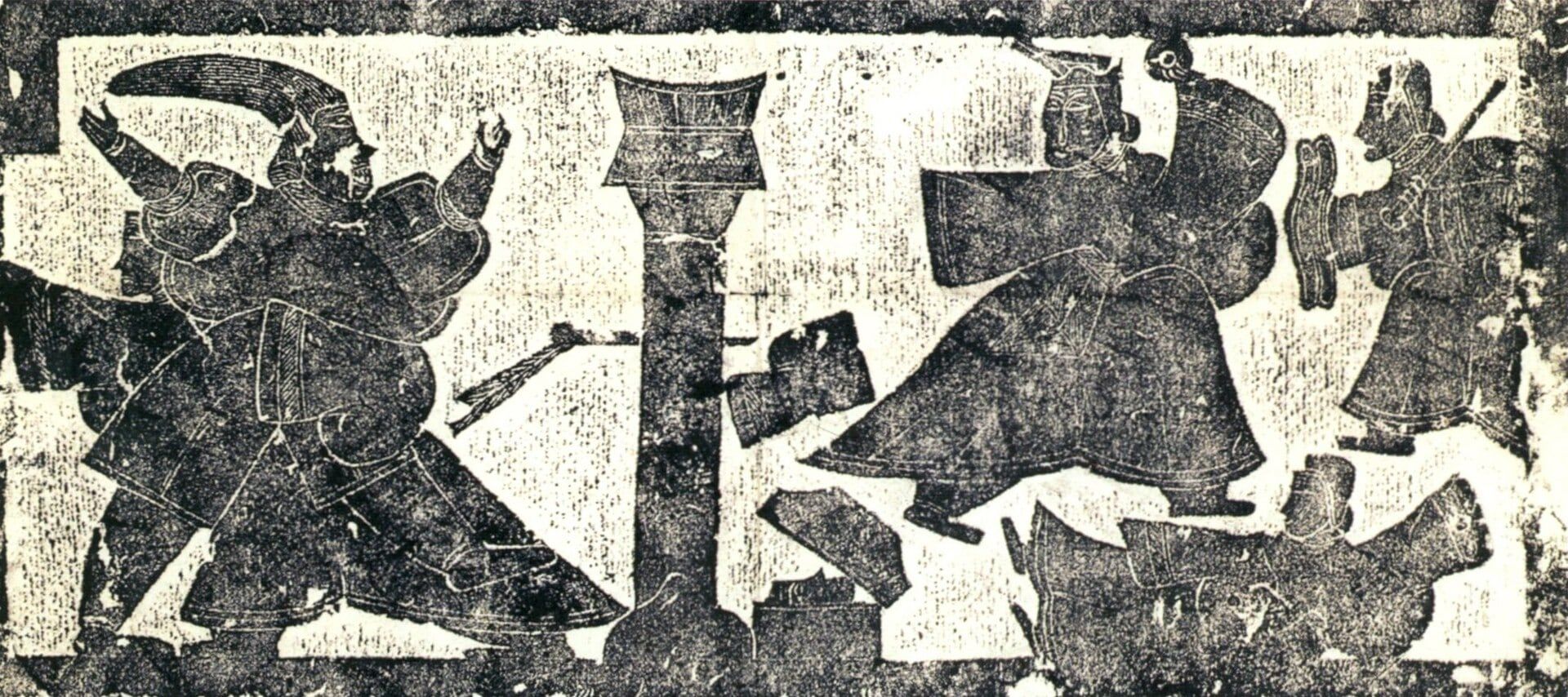
Assassins in Chinese History: Jing Ke, Zhuan Zhu & More
Ancient China's real assassins — Cao Mo, Zhuan Zhu, Yu Rang, Nie Zheng and Jing Ke — from Sima Qian's Shiji, plus Tang assassin tales, ninja and hashashin compared.
The Kung Fu Films That Inspired Phantom Blade Zero
The wuxia and kung fu films Phantom Blade Zero's makers cite — Once Upon a Time in China III, Crouching Tiger, Bruce Lee, Donnie Yen — and what each gave its combat.