History dossier · Assassins
Assassins in Chinese History: Jing Ke, Zhuan Zhu & More
刺客cìkè
Ancient China's real assassins — Cao Mo, Zhuan Zhu, Yu Rang, Nie Zheng and Jing Ke — from Sima Qian's Shiji, plus Tang assassin tales, ninja and hashashin compared.
Key facts
- A cike (刺客, cìkè, “stabbing retainer”) was an assassin who killed for a patron; Sima Qian's Shiji ch. 86 (c. 94 BCE) profiles five of them.
- The five span 681–227 BCE: Cao Mo (a dagger at a duke's throat), Zhuan Zhu (a dagger in a fish), Yu Rang (lacquered skin, swallowed charcoal), Nie Zheng (killed a chancellor, then erased his own face) and Jing Ke (a dagger rolled inside a map).
- Only Zhuan Zhu and Nie Zheng killed their targets, yet Sima Qian honoured all five because they “never betrayed their resolve”.
- Their creed is Yu Rang's line 士为知己者死: “a man dies for the one who truly knows him”.
- Phantom Blade Zero's hero Soul was introduced in 2023 as “an elite assassin” serving a shadowy organization called the Order.
- Chinese
- 刺客 · cìkè
- Primary source
- Shiji ch. 86, “Biographies of Assassins” (c. 94 BCE)
- The five
- Cao Mo · Zhuan Zhu · Yu Rang · Nie Zheng · Jing Ke
- Span
- 681–227 BCE
- Signature weapon
- The bishou 匕首, a short dagger
- Idioms they left
- 图穷匕见 · 士为知己者死 · 风萧萧兮易水寒
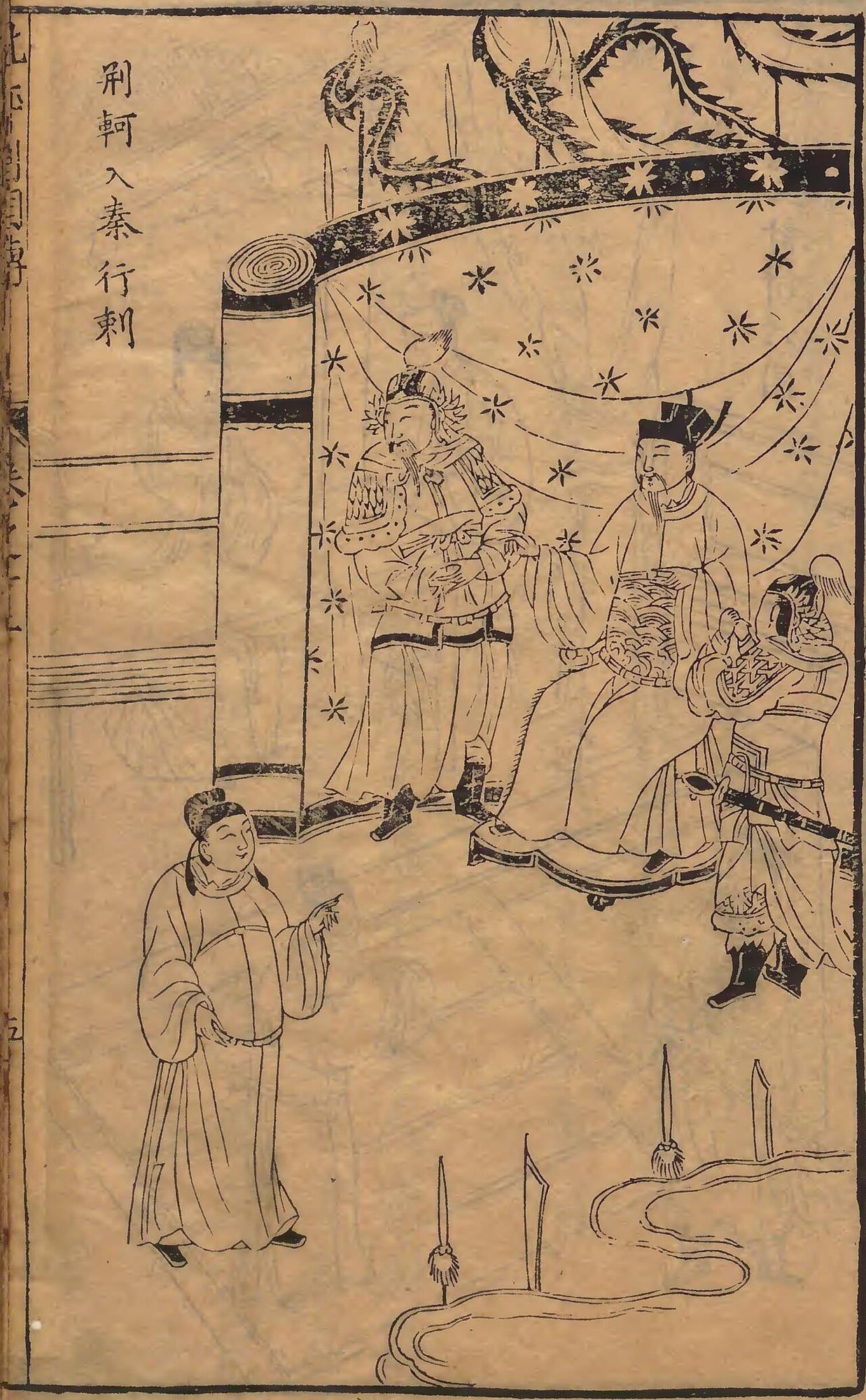
A cike 刺客 cìkèIn Chinese history, a retainer who kills a powerful target on behalf of a patron; Sima Qian’s “Biographies of Assassins” (c. 94 BCE) made five of them famous.Glossary → — literally a “stabbing retainer” — was an assassin in ancient China: usually a man who killed for a patron who had honoured him, repaying a debt of gratitude with his life. The classic list comes from Sima Qian’s Records of the Grand Historian (Shiji, c. 94 BCE), whose chapter 86, “Biographies of Assassins” (刺客列传), profiles five men between 681 and 227 BCE. The most famous is Jing Ke, who came within a sleeve’s length of killing the man who became China’s First Emperor.
The five assassins of the Shiji
Sima Qian links the stories with a chain of dates — “167 years later…”, “more than 70 years later…” — so the chapter reads like a 450-year relay of daggers.
| Assassin | Date | Patron → target | Method | Outcome |
|---|---|---|---|---|
| Cao Mo 曹沫 | 681 BCE | Duke Zhuang of Lu → Duke Huan of Qi | Seized Duke Huan with a dagger on the altar of a peace treaty at Ke | Lu’s lost land returned; no one killed |
| Zhuan Zhu 专诸 | 515 BCE | Prince Guang of Wu → King Liao of Wu | Dagger hidden inside a roast fish at a banquet | King killed; Zhuan Zhu cut down; Guang becomes King Helü |
| Yu Rang 豫让 | after 453 BCE | His dead lord Zhi Bo → Zhao Xiangzi | Hid in a palace privy; later lacquered his skin and swallowed charcoal to become unrecognizable | Caught twice; struck Zhao’s robe, then fell on his sword |
| Nie Zheng 聂政 | 397 BCE | Yan Zhongzi → Xia Lei, chancellor of Han | Walked alone into the chancellor’s hall with a sword | Killed Xia Lei and dozens of guards, then destroyed his own face |
| Jing Ke 荆轲 | 227 BCE | Crown Prince Dan of Yan → King Zheng of Qin | Poisoned dagger rolled inside a map | Failed; killed in the throne hall |
Lists online often add Yao Li (要离), the retainer of Wu who let his own wife and children be burned so that the exiled Prince Qingji would trust him. His story is real classical lore, but it comes from the Lüshi chunqiu (c. 239 BCE), not Sima Qian’s chapter.
Only Zhuan Zhu and Nie Zheng actually killed their targets. Sima Qian honoured all five anyway:
自曹沫至荆轲五人,此其义或成或不成,然其立意较然,不欺其志,名垂后世,岂妄也哉!
From Cao Mo to Jing Ke, five men: some achieved their righteous aim and some did not. But their purpose was plain and they never betrayed their resolve. That their names have come down to later ages — how could that be for nothing?
Zhuan Zhu and the fish-gut dagger
In 515 BCE Prince Guang of Wu wanted his cousin King Liao’s throne. The refugee general Wu Zixu introduced him to Zhuan Zhu. Guang hid armoured men in a cellar and invited the king, who came ringed by kinsmen with long blades. Midway through the feast, Guang pleaded a sore foot and slipped out — and the fish course came in:
使专诸置匕首鱼炙之腹中而进之。
He had Zhuan Zhu place a dagger inside the belly of a roast fish and serve it.
Zhuan Zhu tore the fish open and stabbed the king dead; the guards killed him, and Guang took the throne as King Helü.
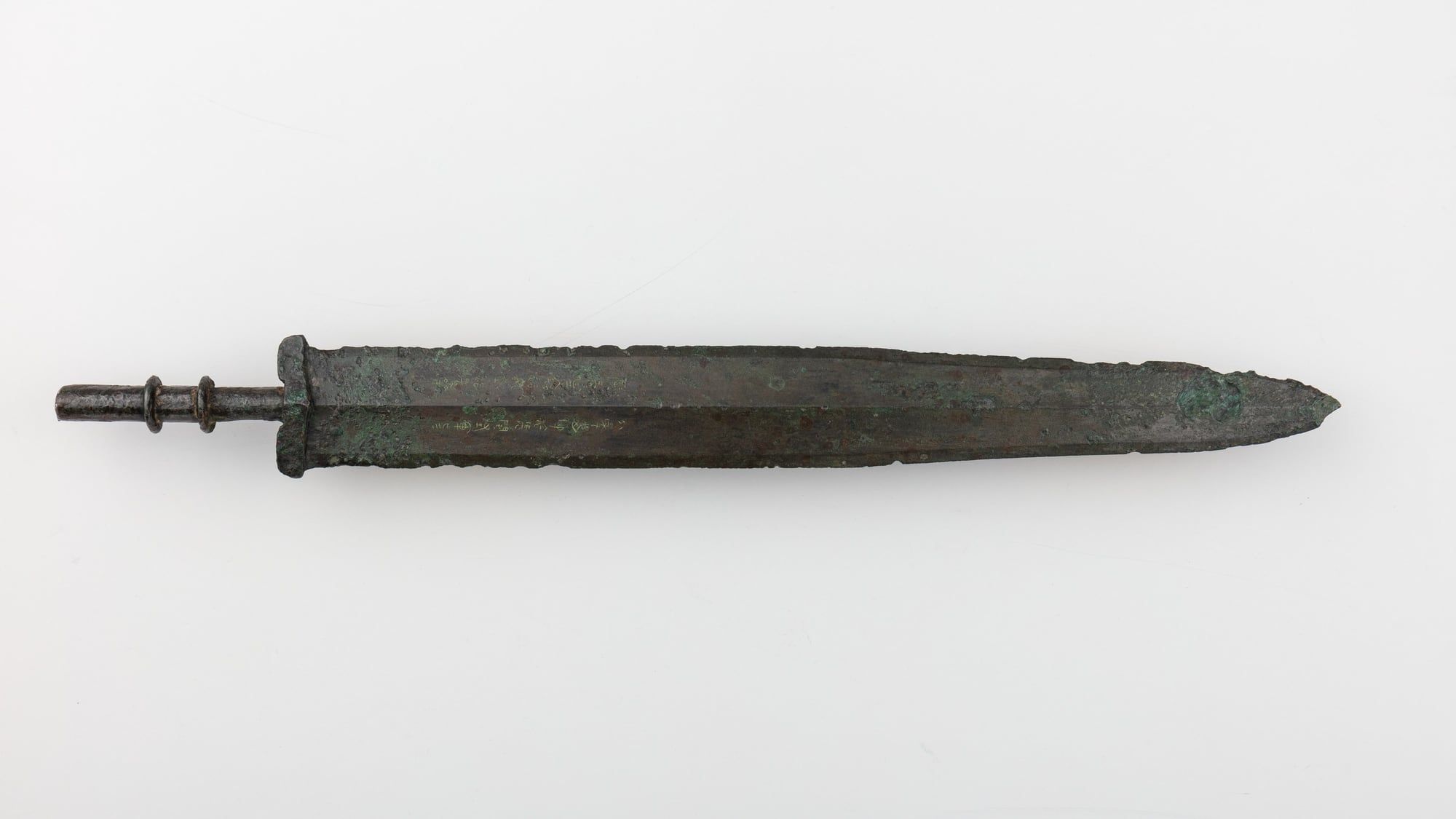
Legend vs history. The Shiji calls the weapon simply a 匕首, a dagger. The name Yuchang (鱼肠, “fish-gut”) first appears in the Western Han Huainanzi as a famous sword, and Han commentators — later joined by the 11th-century polymath Shen Kuo — explained it as the twisting, gut-like pattern on the blade. It was the Eastern Han Yuejue shu that listed Yuchang among five swords forged by the legendary smith Ou Yezi and said King Helü used it to kill King Liao. The “fish-gut sword hidden in a fish” is a later merger of two stories; Chinese opera went further and renamed it 鱼藏剑, the “fish-hidden sword”. See our jian and hidden weapons pages.
Yu Rang and Nie Zheng: dying for the one who knows you
Yu Rang served two noble houses of Jin without recognition, then found a lord, Zhi Bo, who honoured him. When Zhao Xiangzi destroyed Zhi Bo in 453 BCE — and lacquered his skull into a drinking vessel — Yu Rang fled to the mountains and swore revenge in words every Chinese schoolchild knows:
士为知己者死,女为说己者容。
A man dies for the one who truly knows him; a woman makes herself beautiful for the one who delights in her.
Disguised as a convict, he plastered the palace privy with a dagger hidden on him; Zhao, uneasy, had him seized, then freed him as a righteous man. Yu Rang lacquered his body until it broke out in sores and swallowed charcoal to ruin his voice, then lay in wait under a bridge; Zhao’s horse shied and he was caught again. Granted a last wish, he asked for Zhao’s robe, leapt three times and struck it with his sword, and fell on his blade.
Nie Zheng was a dog-butcher hiding from a vendetta with his mother and sister. The minister Yan Zhongzi, feuding with Xia Lei, chancellor of Han, offered a hundred yi of gold for his mother’s birthday; Nie Zheng refused while she lived. When she died, he went alone, climbed the steps of the chancellor’s hall and stabbed Xia Lei, then killed dozens of guards. To protect his family he “flayed his face, gouged out his eyes and cut open his belly” (自皮面决眼,自屠出肠). Han exposed the faceless corpse and offered a thousand gold for a name. His sister Nie Rong came, named him so his deed would not be lost, cried out to heaven three times and died beside his body.
Jing Ke and the dagger in the map
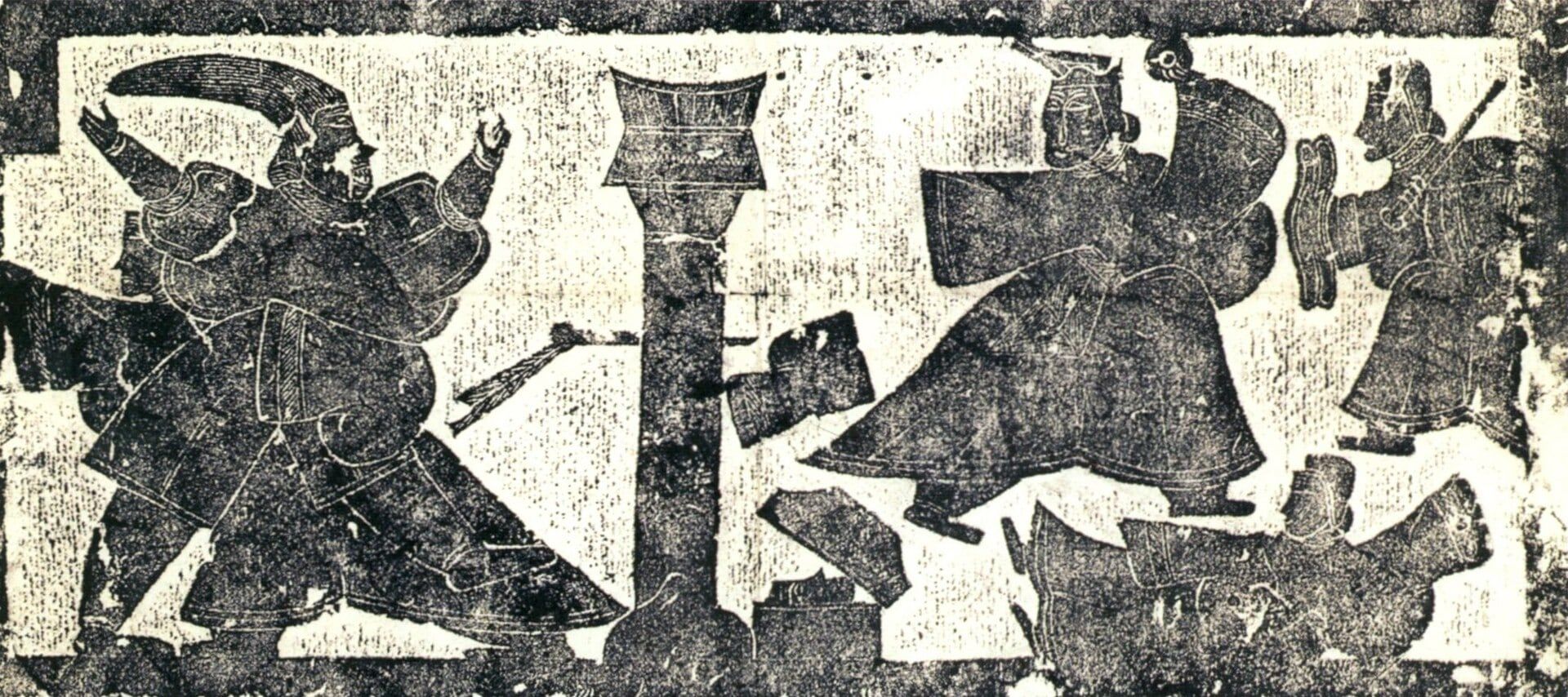
By 228 BCE Qin had swallowed Han and Zhao and stood on the border of Yan. Crown Prince Dan of Yan, once a hostage in Qin, recruited Jing Ke, a sword-loving scholar from Wey. The plan needed bait the King of Qin could not refuse: the head of Fan Yuqi, a Qin general who had defected — Fan cut his own throat to supply it — and a map of Dukang, Yan’s richest land. Rolled inside the map was a dagger from a man of Zhao named Xu Furen, bought for a hundred gold and tempered in poison: any cut that drew a thread of blood killed instantly.
At the Yi River, his friends dressed in mourning white, Gao Jianli played the zhu zither and Jing Ke sang:
风萧萧兮易水寒,壮士一去兮不复还!
The wind howls, the Yi River is cold; the hero, once gone, will not return.
In the Qin throne hall the king unrolled the map, and “when the map was fully unrolled, the dagger appeared” (图穷而匕首见) — the source of the idiom 图穷匕见, “the hidden truth comes out at the end”. Jing Ke seized the king’s sleeve and stabbed; the sleeve tore away. The king’s sword was too long to draw, and Qin law barred courtiers from carrying any weapon in the hall. As the king ran round a pillar, the physician Xia Wuju hurled his medicine bag at Jing Ke and attendants shouted, “Push the sword onto your back!” The king drew and cut Jing Ke’s thigh. Jing Ke threw the dagger, struck a pillar, and, with eight wounds, sat laughing: he had failed, he said, only because he had tried to take the king alive.
Sima Qian adds a historian’s note: tales that Jing Ke wounded the king are false — his account came, through two intermediaries, from Xia Wuju himself. Five years later Qin destroyed Yan. Gao Jianli, blinded by the First Emperor for the sake of his music, later filled his zhu with lead and swung it at the emperor — and missed.
After the Shiji: Li Bai and the Tang assassin tales
The Tang turned the cike into poetry and fantasy. Li Bai’s “Ode to the Knight-Errant” (侠客行), written about two retainers who helped Lord Xinling save the state of Zhao, supplied the most quoted assassin lines in Chinese:
十步杀一人,千里不留行。事了拂衣去,深藏身与名。
One kill every ten paces; across a thousand li, none can stop him. The deed done, he shakes out his robe and leaves, hiding both his body and his name.
Tang chuanqi stories then invented the professional killer. In Pei Xing’s ninth-century tale Nie Yinniang (聂隐娘), an officer’s daughter is abducted at ten by a Buddhist nun, trained for five years in swordplay and stealth, and sent by the military governor of Weibo to kill a rival governor, Liu Changyi — who wins her over instead. The fiction had real roots: Tang warlords kept assassins, and on 13 July 815 agents of the Pinglu governor Li Shidao murdered the chancellor Wu Yuanheng in Chang’an as he rode to court. Hou Hsiao-hsien’s The Assassin (2015), based on Pei Xing’s tale, won Best Director at Cannes.
Cike vs ninja vs hashashin
| Chinese cike 刺客 | Japanese ninja (shinobi) | Hashashin (Nizari Ismaili fida’i) | |
|---|---|---|---|
| Era | 7th–3rd c. BCE in the Shiji; Tang tales | c. 15th–17th c., peaking in the Sengoku wars | 1090–1256 |
| Who | A retainer bound to one patron | Spies and mercenaries, famously from Iga and Kōka | Devotees of a religious state ruled from mountain castles such as Alamut |
| Main job | One political killing | Espionage, infiltration, sabotage — little evidence of assassination | Public assassination of rulers and commanders |
| Method | A dagger at arm’s length, after a long con | Stealth, disguise, arson, intelligence | A dagger at close range, often in public; attackers rarely survived |
| Motive | Gratitude and honour | Pay and local self-defence leagues | Strategy of a small, besieged state |
| Myth | Superhuman Tang heroines | Black suits and throwing stars, largely from Edo theatre | “Hashish-eaters”, a hostile label Marco Polo spread in Europe |
| End | Most died on the mission | Faded after Tokugawa unification | Crushed by the Mongols, who took Alamut in 1256 |
The English word assassin comes from the Nizaris’ Arabic nickname. The Shiji’s killers worked alone for one patron; wuxia’s shadowy assassin orders owe more to later secret police and secret societies — see The Order and real Chinese secret societies.
Soul, the Order’s assassin
 Phantom Blade Zero - Announce Trailer
One reading: Yu Rang and Nie Zheng died for the masters who knew them, while Soul’s story begins by inverting that bargain — he stands accused of killing his. His countdown also echoes the cike’s defining trait, a man who sets out knowing he will probably not come back. More in why 66 days.
Jing Ke never came home from Qin, and Sima Qian made sure no one forgot him. Two thousand years on, the cike’s code — repay the one who knows you, finish the job, expect to die — is still the engine of wuxia, and the reason a hunted assassin with sixty-six days on the clock makes such a natural hero.
Names in this article · Codex
Frequently asked
Q01Who was the most famous assassin in Chinese history?
Q02Did Jing Ke kill the King of Qin?
Q03What was the fish-gut sword?
Q04Were there ninjas in ancient China?
Q05Is Soul an assassin in Phantom Blade Zero?
Sources & further reading
- Shiji (Records of the Grand Historian), ch. 86 “Biographies of Assassins” (刺客列传) — Sima Qian, c. 94 BCE
- Yuejue shu, ch. 11, “Record of Precious Swords” (越绝书·外传记宝剑) — Eastern Han compilation (Wikisource)
- Lüshi chunqiu, “Loyalty and Integrity” (忠廉), on Yao Li — Lü Buwei (ed.), c. 239 BCE (Wikisource)
- Ode to the Knight-Errant (侠客行) — Li Bai, 8th c. (Wikisource)
- The Assassin Legends: Myths of the Isma'ilis — Farhad Daftary, I.B. Tauris, 1994
- Phantom Blade Zero announcement post by Soulframe Liang — PlayStation Blog, 24 May 2023
- Ninja — Wikipedia
Cite this page
Wuxiapunk Editors. (2026, October 27). Assassins in Chinese History: Jing Ke, Zhuan Zhu & More. Wuxiapunk. https://wuxiapunk.com/history/chinese-assassins/
“Assassins in Chinese History: Jing Ke, Zhuan Zhu & More.” Wuxiapunk, 27 Oct. 2026, https://wuxiapunk.com/history/chinese-assassins/.
Keep reading
The Order & Real Chinese Secret Societies, Explained
Is Phantom Blade Zero's Order real? No — but Ming China had secret police (Jinyiwei), banned sects (White Lotus) and sworn brotherhoods that became triads.
Jian: The Chinese Straight Sword, Explained
What a jian is, how the double-edged Chinese sword evolved from bronze to steel, its anatomy, how it was used, and why it is called the gentleman of weapons.
Flying Guillotine, Flying Daggers & China's Hidden Weapons
Was the flying guillotine real? The Yongzheng legend, the Shaw Brothers and Jimmy Wang Yu films, and the real history of Chinese sleeve arrows, darts and flying knives.