History · Cinema
The Kung Fu Films That Inspired Phantom Blade Zero
功夫片 / 武侠电影gōngfu piàn / wǔxiá diànyǐng
The wuxia and kung fu films Phantom Blade Zero's makers cite — Once Upon a Time in China III, Crouching Tiger, Bruce Lee, Donnie Yen — and what each gave its combat.
Key facts
- Phantom Blade Zero's developers name a short list of film influences: Hong Kong golden-age kung fu cinema, Tsui Hark's Once Upon a Time in China III, Ang Lee's Crouching Tiger, Hidden Dragon, and the screen work of Bruce Lee, Jackie Chan and Donnie Yen.
- Soulframe Liang told GameSpot the core of the combat comes from Hong Kong films whose heroes are “all attacking while defending” — written in the game's Chinese store text as 连消带打.
- Lead combat action director Yang Liu cites Crouching Tiger, Hidden Dragon and keeps wirework “within the limits of human ability”, the line he draws between wuxia and xianxia.
- Donnie Yen, creative consultant since 2023, plays Mó Yuan; his career runs from Once Upon a Time in China II and Iron Monkey to Ip Man and John Wick: Chapter 4.
- Genre classics such as King Hu's Dragon Inn (1967) and Chang Cheh's One-Armed Swordsman (1967) are not developer-cited, but they are essential further viewing.
- Developer-cited films
- HK golden-age kung fu · Once Upon a Time in China III · Crouching Tiger, Hidden Dragon
- Developer-cited stars
- Bruce Lee · Jackie Chan · Donnie Yen
- Other cited sources
- Chinese opera · Jin Yong · Gu Long
- Core combat idea
- Attacking while defending (连消带打)
- Action team
- Yang Liu (lead); Kenji Tanigaki (2023); Donnie Yen with Yan Hua
- Mocap rule
- Real speed, real wires, human limits
A wuxia film is a Chinese martial-arts movie about swordsmen and heroes of the jianghu; the kung fu film is its bare-knuckled, more modern cousin. Phantom Blade Zero’s developers have named a short, specific list of both as influences — Hong Kong’s golden-age kung fu cinema, Tsui Hark’s Once Upon a Time in China III, Ang Lee’s Crouching Tiger, Hidden Dragon, and the screen work of Bruce Lee, Jackie Chan and Donnie Yen. This page sticks to what they actually said before suggesting further viewing.
What the developers actually cited
The game’s Steam page promises that “the golden age of wuxia cinema collides with punk fantasy”. Interviews make that concrete. The last column is our reading of what each source feeds into the game.
| Influence | Year | Director / star | Cited by | What it feeds into the game |
|---|---|---|---|---|
| Hong Kong golden-age kung fu cinema | — | — | Soulframe Liang (GameSpot) | Attack and defence in one motion |
| Once Upon a Time in China III | 1992–93 | Tsui Hark; Jet Li | Liang (Jiefang Daily) | The lion-dance boss |
| Crouching Tiger, Hidden Dragon | 2000 | Ang Lee; fights by Yuen Woo-ping | Yang Liu (Inverse; CGTN) | Wirework kept within human limits |
| Bruce Lee’s films | 1971–73 | Bruce Lee | Liang (PC Gamer, IGN, PlayStation Blog) | Kung fu as a world language |
| Jackie Chan’s films | from 1978 | Jackie Chan | Liang (PC Gamer) | Opera acrobatics and comic timing |
| Chinese traditional opera | — | — | Liang (PC Gamer) | Stage combat, masks, percussion |
| Donnie Yen’s career | 1980s – today | Donnie Yen | S-GAME (cast and credits) | Choreography; the boss Mó Yuan |
| Everything Everywhere All at Once / John Wick: Chapter 4 | 2022 / 2023 | Daniels / Chad Stahelski | PlayStation Blog (2023) | Kung fu in global pop culture |
| Jin Yong and Gu Long | — | Novelists | Liang (PlayStation Blog; Gamersky) | Characters and side-quest storytelling |
Hong Kong’s golden age: attacking while defending
Asked what makes the combat tick, Liang went straight to the movies: “If you watch a lot of Hong Kong Golden Age kung fu movies… They are all attacking while defending, so it happens at the same time.” The Chinese store text puts it in four characters, lian xiao dai da 连消带打 lián xiāo dài dǎClassical martial principle of defending and attacking in one motion — the core of the game’s combat design.Glossary →, “deflect and strike in one motion” — a phrase southern kung fu schools, Wing Chun among them, teach as a principle.
The game turns that into rules. Blue-glowing “Brutal” attacks can be parried, and a parry triggers a Ghostep that slips Soul behind the enemy; a perfect parry costs nothing and drains the attacker’s Sha-Chi. Liang’s tuning target is that roughly 70% of a boss’s Sha-Chi loss should come from your offence and only 30% from parries, so defence is a way into attack rather than a turtle shell. Combat director Qianli Ma put the feeling more simply: “The whole concept is the wuxia, kung fu style — you want to dance.”
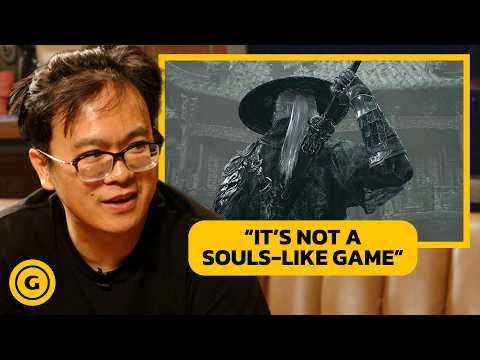 Phantom Blade Zero Devs Explain Why It Isn't a Souls-Like OR Hack n Slash
The genre’s two biggest stars come up again and again. “Nowadays there are too many Souls games,” Liang told PC Gamer; Bruce Lee and Jackie Chan, he argued, mixed Hollywood, Chinese kung fu culture and Chinese traditional opera “to make something new”, and Phantom Blade Zero wants to do the same as “a kung fu action game”. Bruce Lee’s run — The Big Boss (1971), Fist of Fury (1972), The Way of the Dragon (1972), Enter the Dragon (1973) — took kung fu worldwide, and Liang told IGN in 2023 that he hopes to do for “Kung-Fu Punk” what Lee did for kung fu. Jackie Chan came from the opera stage itself: as a child he trained at a Peking opera school alongside Sammo Hung and Yuen Biao, and the acrobatics, prop gags and percussion-timed beats of opera combat run through his films, from Drunken Master (1978) onward. Players who meet Hua Qianxiao, the game’s drunken-sword master, will recognise that lineage.
Once Upon a Time in China III and the lion-dance contest
Tsui Hark’s Once Upon a Time in China series (1991–1997) made Jet Li’s Wong Fei-hung — the real Foshan martial artist and physician (1847–1925) — the face of 1990s kung fu cinema. The third film, Once Upon a Time in China III (黄飞鸿之三:狮王争霸), premiered abroad in December 1992 and opened in Hong Kong in February 1993. Its plot is a lion-dance contest in Beijing, staged by the Empress Dowager Cixi and Li Hongzhang to show off Chinese martial arts; rival troupes brawl before it begins, and the climax is a battle up a scaffold through dozens of lions.
Liang told Jiefang Daily that this film came back to him while the team was researching lion-dance troupes, and the game’s lion-dance boss is the result. The full story of the tradition — eye-dotting, plucking the greens, plum-blossom poles — is on our lion dance page.
Crouching Tiger, Hidden Dragon and the wire-work line
Ang Lee’s Crouching Tiger, Hidden Dragon (2000), with fights choreographed by Yuen Woo-ping, won the Academy Award for Best Foreign Language Film and showed a global audience that wuxia could float — duels across rooftops and through a bamboo forest, held up by wires. Yang Liu, the in-house action director whose team has run Phantom Blade Zero’s motion capture since 2023, cites it as a touchstone.
He also explains where the game draws the line on flight. “Wuxia is different from another Chinese genre called Xianxia — the key difference lies in the boundaries: how far can a hero go, how high can they leap?” Even with wires, he says, heroes “must still stay within the limits of human ability”. Moves were performed at real speed on pulley-and-harness rigs and never sped up afterwards. His other rule could be a screenwriting maxim: “Who you are defines how you fight.” For the genre boundary itself, see wuxia vs xianxia.
Donnie Yen: from Wong Fei-hung’s world to Mó Yuan
Donnie Yen has been Phantom Blade Zero’s creative consultant since 2023. He did facial and motion capture for Mó Yuan, lord of the Bastion of Mó, voiced him in English, and brought in choreographer Yan Hua for the most complex fights. The 2023 action director, Kenji Tanigaki, is a long-time member of Yen’s stunt team; S-GAME described his job as demonstrating each designed move for a camera matrix to capture.
Yen’s filmography reads like a tour of the genre:
- New Dragon Gate Inn (1992) — the eunuch villain in the remake of King Hu’s classic.
- Once Upon a Time in China II (1992) — General Lan, the Qing officer who duels Jet Li’s Wong Fei-hung.
- Iron Monkey (1993) — Wong Kei-ying, Wong Fei-hung’s father, under director Yuen Woo-ping.
- Fist of Fury (1995, TV) — Liang says Yen’s non-mocap sword footage was shot at the former ATV site where this series was made.
- Hero (2002), Ip Man (2008), Wu Xia (2011) — the arthouse wuxia, the Wing Chun biopic and the detective twist.
- John Wick: Chapter 4 and Sakra (both 2023) — Caine, and the Jin Yong hero Qiao Feng, roles Liang singles out alongside Ip Man.
More on the role is in Donnie Yen as Mó Yuan, explained.
Jin Yong, Gu Long and the page behind the screen
Most classic wuxia films are adaptations, and Liang cites the novelists directly. The 2023 PlayStation Blog post that coined “kungfupunk” opens with “Louis Cha’s Wuxia stories” — Jin Yong’s — before Bruce Lee. In 2025 Liang told Gamersky he loves Gu Long’s characters for being “mad inside, cold outside” (内心是癫的,但外表是冷的), a temperament that shaped the Seven Stars’ Chief Disciple, and that the side quests are written like small Gu Long-style biographies. His Chinese delay letter even opened with 他强由他强,清风拂山岗 — a verse Jin Yong readers know from The Heaven Sword and Dragon Saber.
On screen, the purest Gu Long is in director Chor Yuen’s Shaw Brothers adaptations such as Killer Clans (1976) and The Magic Blade (1976); for Jin Yong, Tsui Hark produced Swordsman II (1992). Those are our suggestions, not developer citations.
 Yuen Woo-ping on Mastering Martial Arts Choreography and His Extraordinary Career
Further viewing: classic wuxia films the developers didn’t name
None of these were cited by S-GAME, but they built the genre the game is riffing on:
| Film | Year | Director | Why watch it |
|---|---|---|---|
| Dragon Inn | 1967 | King Hu | An isolated-inn standoff between swordsmen and eunuch agents, remade in 1992 with Donnie Yen |
| One-Armed Swordsman | 1967 | Chang Cheh | A maimed hero and bloody climaxes that set the tone for a harder, darker wuxia |
| A Touch of Zen | 1971 | King Hu | King Hu’s epic with its famous bamboo-grove fight; honoured at Cannes in 1975 |
| Killer Clans | 1976 | Chor Yuen | A Gu Long story of hired killers and shifting loyalties — Soul’s line of work |
Watch them back to back with Phantom Blade Zero and the inheritance is obvious: the masked killers, the inns and temples, the duels decided in a single exchange. The game’s wuxia is new clothing on a very old frame.
Names in this article · Codex
Frequently asked
Q01What movies inspired Phantom Blade Zero?
Q02Is Donnie Yen in Phantom Blade Zero?
Q03What does “attacking while defending” mean in Phantom Blade Zero?
Q04What wuxia films should I watch after Phantom Blade Zero?
Q05Is Phantom Blade Zero based on a Jin Yong or Gu Long novel?
Sources & further reading
- Phantom Blade Zero: a new beginning in a long journey — PlayStation Blog (Soulframe Liang), 24 May 2023
- Report on Phantom Blade Zero's combat detail (Liang on “attacking while defending”) — GameSpot, Oct 2026
- Phantom Blade Zero preview and developer interview (Bruce Lee, Jackie Chan, Chinese opera) — PC Gamer, Mar 2025
- Behind-the-scenes report on Phantom Blade Zero's wuxia motion capture (Yang Liu) — Inverse
- Interview with Soulframe Liang (Once Upon a Time in China III and lion-dance research) — Jiefang Daily (解放日报), 21 Feb 2025
- Once Upon a Time in China III — Wikipedia
- Wong Fei-hung — Wikipedia
Cite this page
Wuxiapunk Editors. (2026, October 27). The Kung Fu Films That Inspired Phantom Blade Zero. Wuxiapunk. https://wuxiapunk.com/history/kung-fu-films/
“The Kung Fu Films That Inspired Phantom Blade Zero.” Wuxiapunk, 27 Oct. 2026, https://wuxiapunk.com/history/kung-fu-films/.
Keep reading
What Is Wuxia? Meaning, Pronunciation & Phantom Blade Zero
Wuxia (武侠, wǔxiá) means “martial chivalry”: Chinese tales of wandering sword-heroes. Its meaning, pronunciation, 2,000-year history and place in Phantom Blade Zero.
Donnie Yen as Mó Yuan in Phantom Blade Zero, Explained
Donnie Yen plays Mó Yuan in Phantom Blade Zero: who the gold-masked lord is, what 魔渊 means, the wuxia roles behind the casting and what he did as consultant.
Lion Dance in Phantom Blade Zero: The Real Roots
What lion dance really is: Northern vs Southern lions, eye-dotting, plucking the greens and plum-blossom poles — and how Phantom Blade Zero turned it into a boss.