Weapon dossier · Sabres
Zhanmadao & Modao: China's Horse-Cutting Great Sabres
斩马刀 / 陌刀zhǎnmǎdāo / mòdāo
The real zhanmadao: the Han “horse-cutting sword” in the Han shu, Li Siye's Tang modao, the Song great sabre of 1072, Qing long sabres and the 1930s dadao.
Key facts
- The zhanmadao (斩马刀, “horse-cutting sabre”) is a Chinese two-handed great sabre; its name goes back to the Han zhanmajian (斩马剑), a sword “sharp enough to cut a horse”.
- The Tang code calls the infantry modao (陌刀) “a long dao… probably the ancient horse-severing sword”, and general Li Siye led modao troops to victory at Xiangji Temple in 757.
- In 1072 Emperor Shenzong of Song had tens of thousands of zhanmadao made, with blades over 3 chi (about 94 cm), grips over 1 chi and a large ring pommel.
- Despite a common claim, the Wujing Zongyao (1044) does not list a zhanmadao; the key Song record is in the Song shi.
- Qing regulations still listed a Green Standard zhanmadao about 1.5 m long, and in the 1930s the short, broad dadao became the emblem of China's “Big Sword” units.
- Type
- Two-handed great sabre (anti-cavalry)
- Chinese
- 斩马刀 zhǎnmǎdāo · Tang 陌刀 mòdāo · Han 斩马剑 zhǎnmǎjiàn
- Period
- Han – Qing; the related dadao into the 1940s
- Song specification (1072)
- Blade over 3 chi (c. 94 cm), grip over 1 chi (c. 31 cm), ring pommel
- Qing specification
- 4.8 chi overall (c. 154 cm), blade 3.4 chi (c. 109 cm)
- Famous user
- Li Siye (d. 759), Tang modao general
A zhanmadao , or “horse-cutting sabre”, is a Chinese two-handed great sabre: a long single-edged blade on a grip long enough for both hands, made to stop cavalry. Its name is older than any surviving example — it reaches back to a Han-dynasty sword in an imperial workshop — and its battlefield cousin, the Tang modao , carried one of the most famous charges in Chinese military history.
The Han “horse-cutting sword” and Zhu Yun’s broken railing
The story starts with a name, not a weapon. In the Han shu, the outspoken official Zhu Yun confronts Emperor Cheng (r. 33–7 BCE) in open court and asks for a zhanmajian :
臣愿赐尚方斩马剑,断佞臣一人以厉其余。
I ask to be granted a horse-cutting sword from the imperial workshop, to behead one sycophantic minister as a warning to the rest.
The minister he meant was the emperor’s own tutor, Zhang Yu. The furious emperor ordered Zhu Yun dragged away; he clung to the palace railing until it snapped, and was saved only when a general beat his head on the floor until he bled. The emperor later had the broken railing kept unrepaired “to honour an upright minister” — the origin of the idiom 朱云折槛.
The Tang commentator Yan Shigu explains that the imperial workshop “had horse-cutting swords — swords so sharp they could cut a horse”. What they looked like, nobody knows. As a jian, the zhanmajian was presumably double-edged, and some historians read it as a ceremonial or execution blade rather than a battlefield weapon.
Tang modao: Li Siye’s wall of blades
The Tang turned the name into an infantry arm. The Tang Liudian (738) lists the modao as the fourth of its regulation dao and glosses it as “a long dao carried by infantry — probably the ancient horse-severing sword”. It gives no dimensions, and the modao’s exact form is still debated.
Its most famous wielder was Li Siye (d. 759), a towering soldier from near Chang’an. When the Anxi frontier armies first took up the modao, the Old Book of Tang says, everyone agreed he was its master: “he always led the squad, and wherever he went the enemy broke.” In the late 740s, when Gao Xianzhi marched over the Pamirs against Little Bolü, Li Siye and Tian Zhen served as his left and right modao generals.
His great day came in 757, during the An Lushan rebellion, at the Battle of Xiangji Temple outside Chang’an. Rebel cavalry broke into the Tang lines, and Li Siye told Guo Ziyi that only a fight to the death could save the army:
嗣业乃脱衣徒搏,执长刀立于阵前大呼,当嗣业刀者,人马俱碎。
Siye threw off his coat and, long blade in hand, stood before the line roaring. Whoever met his blade — man and horse alike — was smashed to pieces.
The line re-formed. According to the New Book of Tang, two thousand infantry with modao and long-handled axes then “advanced like a wall, and nothing could stand before them”. The battle ran from noon to dusk, the rebels fled east, and Chang’an was retaken.
Song zhanmadao: a great sabre by imperial order
The zhanmadao proper is a Song weapon. In 1072, the Song shi records, Emperor Shenzong showed a boxed zhanmadao to the official Cai Ting, who praised it as finely made and easy to wield. Shenzong had eunuchs supervise the making of tens of thousands for his border commanders: a grip over 1 chi, a blade over 3 chi — about 31 and 94 cm in Song measure — and a large ring pommel. The court even ran a dedicated zhanmadao workshop, which a censor grumbled about a few years later.
Song strategists knew exactly where the idea came from. A memorial preserved in the Song shi proposes that the strongest infantrymen be armed with zhanmadao under their own commander, “like Li Siye’s modao method”, to charge the heavy “iron hawk” cavalry of the Western Xia.
One correction to a claim repeated online: the zhanmadao is not in the Wujing Zongyao (1044). That encyclopedia draws a hand dao and seven long-hafted dao, but no zhanmadao.
Long blades against horses were not just theory. At Yancheng in 1140, according to the accounts compiled by his grandson Yue Ke, Yue Fei ordered his infantry to go in with long-handled mazha blades (麻札刀), “not look up, and only chop at the horses’ legs” — and the chained heavy cavalry of the Jin went down. Four centuries later, Qi Jiguang cited the same trick in his Lianbing shiji. The weapon also turns up in a darker story: Lu You records that a palace-army soldier, Shi Quan, ambushed the chancellor Qin Hui — the man blamed for Yue Fei’s death — with a zhanmadao at Wangxian Bridge, and managed only to cut through one pole of his sedan chair.
Ming and Qing: from mass orders to Green Standard regulation
The Ming kept making them. The Da Ming huidian records a 1500 order for “zhanma great sabres” from six provinces — about 14,500 blades, including 4,000 from Zhejiang — and in 1509 the Liaodong garrisons used their old crossbows and zhanmadao “to teach the ancient methods of shooting horses and cutting horses”.
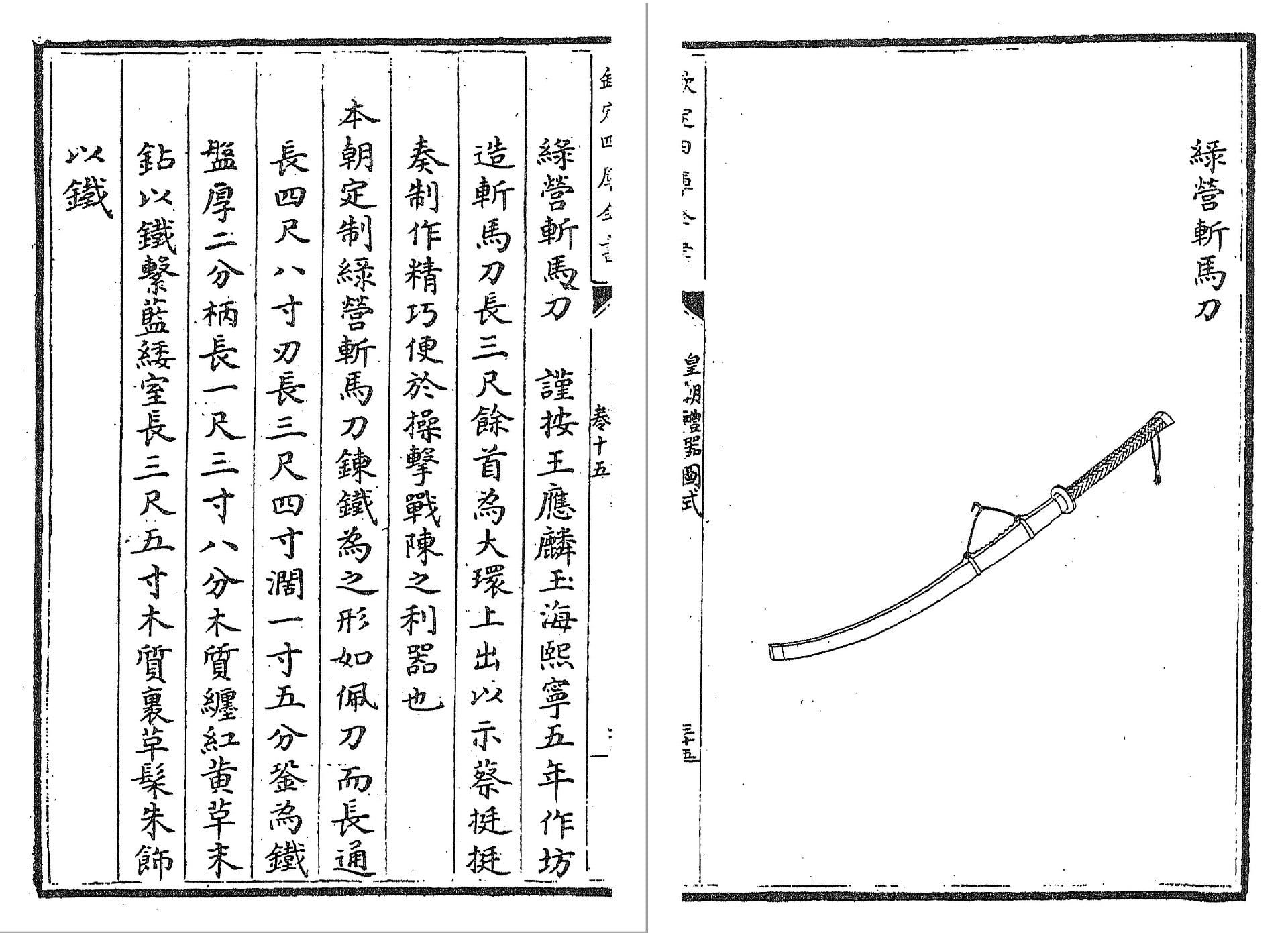
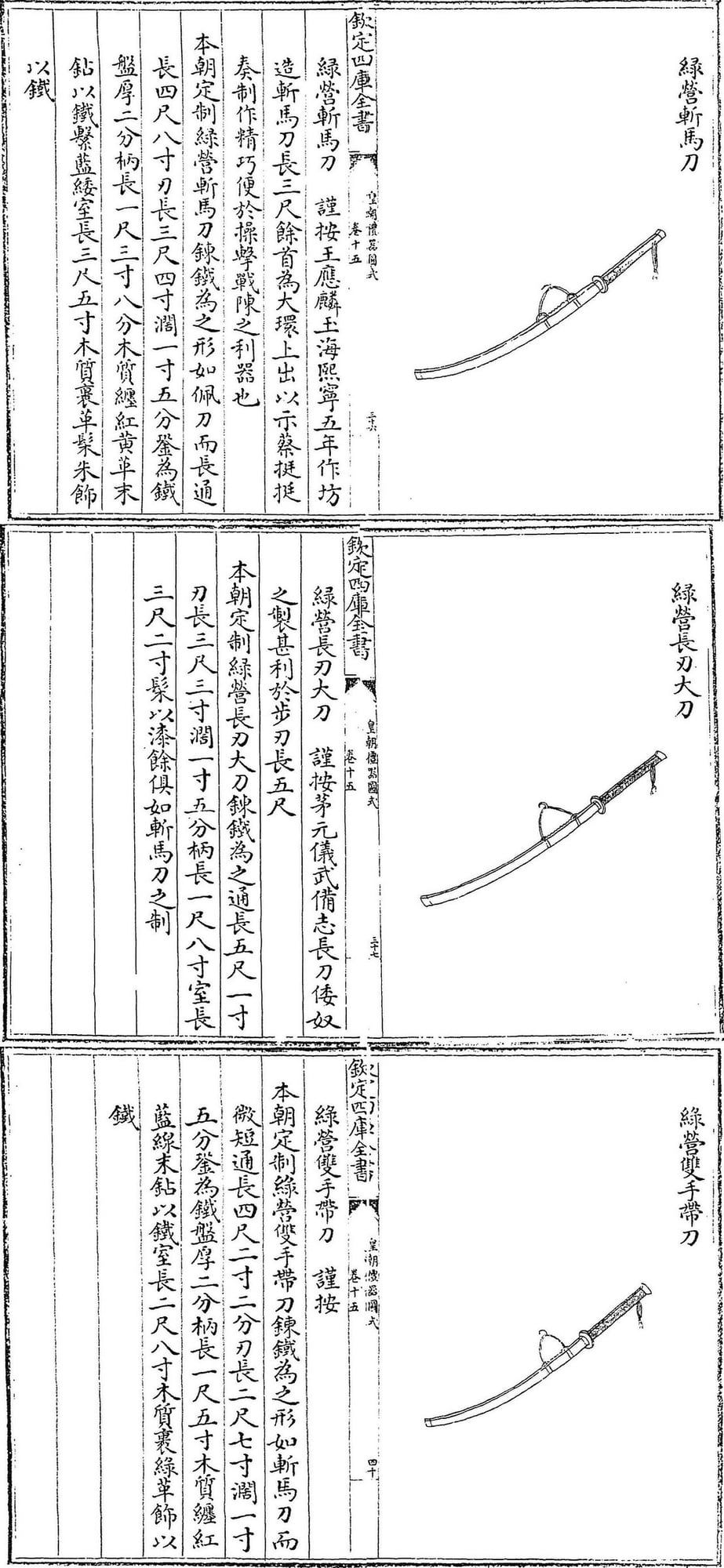
The Qing wrote the weapon into its regulations. The 18th-century Huangchao liqi tushi describes the Green Standard zhanmadao as “shaped like a sidearm sabre but long”: 4.8 chi overall (about 154 cm), with a 3.4-chi blade (about 109 cm) and a grip of 1.38 chi (about 44 cm). Its entry cites the 1072 Song zhanmadao as precedent. By then the zhanmadao had merged with the Japanese-inspired long sabre that Ming general Qi Jiguang adopted — the line that leads to the modern miao dao.
The 1930s dadao and the Big Sword units
The last horse-cutters fought no horses at all. The dadao , or “big sword”, is a short, broad chopping sword of the late Qing with a grip long enough for two hands; 1930s writers specified a 58 cm blade and a weight of about 3.5 lb (1.6 kg), though real examples vary wildly. In 1933, Chinese troops defending the Great Wall passes against Japan were often armed with little more than pistols, grenades and traditional swords, and sword-armed soldiers repelled repeated close assaults.
In 1937 the composer Mai Xin honoured the 29th Army with “The Sword March”, whose first line — 大刀向鬼子们的头上砍去, “let our big swords hack at the devils’ heads” — became a national rallying cry.
 Chinese Zhanmadao is the LONGEST Blade They've Ever Made (S7) | Forged in Fire
Zhanmadao, modao and dadao compared
| Weapon | Era | Form | Recorded size | Key source |
|---|---|---|---|---|
| Zhanmajian 斩马剑 | Han | Presumably double-edged | Not recorded | Han shu, ch. 67 |
| Modao 陌刀 | Tang | Long infantry blade; form debated | Not recorded | Tang Liudian; Li Siye’s biographies |
| Zhanmadao 斩马刀 | Song, 1072 | Two-handed sabre, ring pommel | Blade 3+ chi (c. 94 cm), grip 1+ chi | Song shi, ch. 197 |
| Zhanma great sabre 斩马大刀 | Ming, 1500 | Issued in bulk | Not recorded | Da Ming huidian |
| Green Standard zhanmadao | Qing, 18th c. | Long sabre, like a peidao | 4.8 chi (c. 154 cm) | Huangchao liqi tushi |
| Dadao 大刀 | Late Qing – 1940s | Short, broad, hand-and-a-half | Blade c. 58 cm (1930s spec) | Period specifications |
| Miao dao 苗刀 | 20th c. – today | Long, narrow two-hander | 138–153 cm (modern) | See miao dao |
Phantom Blade Zero has its share of huge two-handed blades, from the parry-charging Juggernaut to the heavy weapons fans spotted on State of Play menus. None is officially labelled a zhanmadao or modao, so treat any match as a comparison, not a developer statement. But whenever Soul swings something long enough to clear a horse, he is fighting in Li Siye’s tradition — the wall of blades that held when the cavalry came. For the wider family, see types of Chinese swords and the pole-mounted guandao.
Names in this article · Codex
Frequently asked
Q01What is a zhanmadao?
Q02Could a zhanmadao really cut a horse in half?
Q03What is the difference between a zhanmadao and a modao?
Q04What is the difference between a dadao and a zhanmadao?
Q05Is the zhanmadao in the Wujing Zongyao?
Sources & further reading
- Han shu (History of the Former Han), ch. 67: Biography of Zhu Yun — Wikisource (Chinese text)
- Tang Liudian (Six Codes of the Tang), ch. 16: Office of the Armoury — Wikisource (Chinese text)
- Jiu Tang shu (Old Book of Tang), ch. 109: Biography of Li Siye — Wikisource (Chinese text)
- Song shi (History of Song), ch. 197: Treatise on Military Affairs — Wikisource (Chinese text)
- Huangchao liqi tushi (Qing illustrated regulations), ch. 15: Green Standard sabres — Wikisource (Chinese text)
- The Sword March — Wikipedia
- Phantom Blade Zero preview — PC Gamer, 2025
Cite this page
Wuxiapunk Editors. (2026, October 27). Zhanmadao & Modao: China's Horse-Cutting Great Sabres. Wuxiapunk. https://wuxiapunk.com/weapons/zhanmadao/
“Zhanmadao & Modao: China's Horse-Cutting Great Sabres.” Wuxiapunk, 27 Oct. 2026, https://wuxiapunk.com/weapons/zhanmadao/.
Keep reading
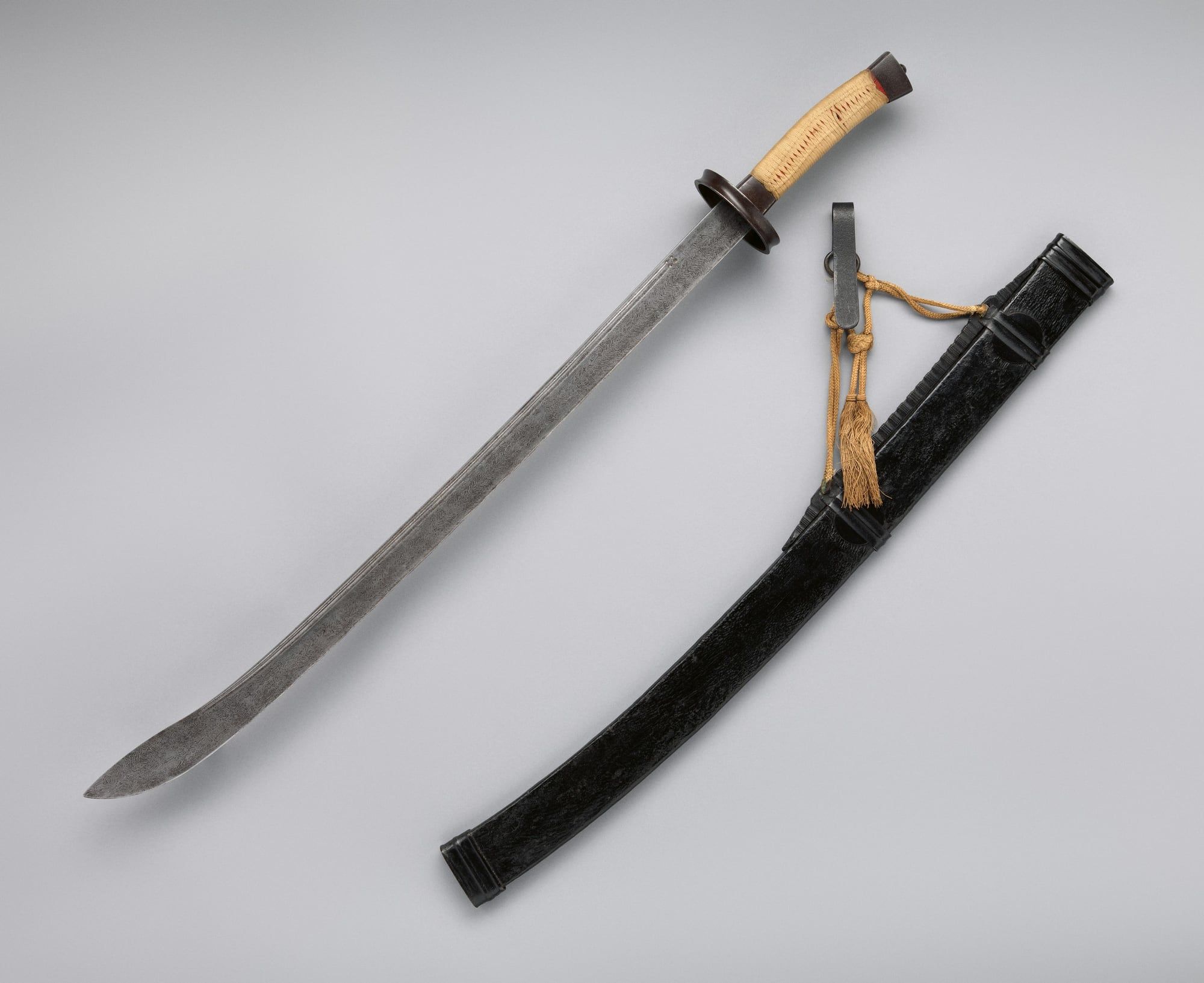
Miao Dao vs Katana: History of China's Long Sabre
Miao dao history, sourced: Qi Jiguang's Ming changdao, Cheng Zongyou's 1621 manual, the 1920s name, measured lengths of 1.4–2 m, and how it compares with the katana.
Dao: The Chinese Sabre, From Ring-Pommel to Oxtail
What a dao sword is, how the Chinese sabre evolved from the Han ring-pommel dao to Qing willow-leaf and oxtail sabres, why armies chose it, and how it is used.
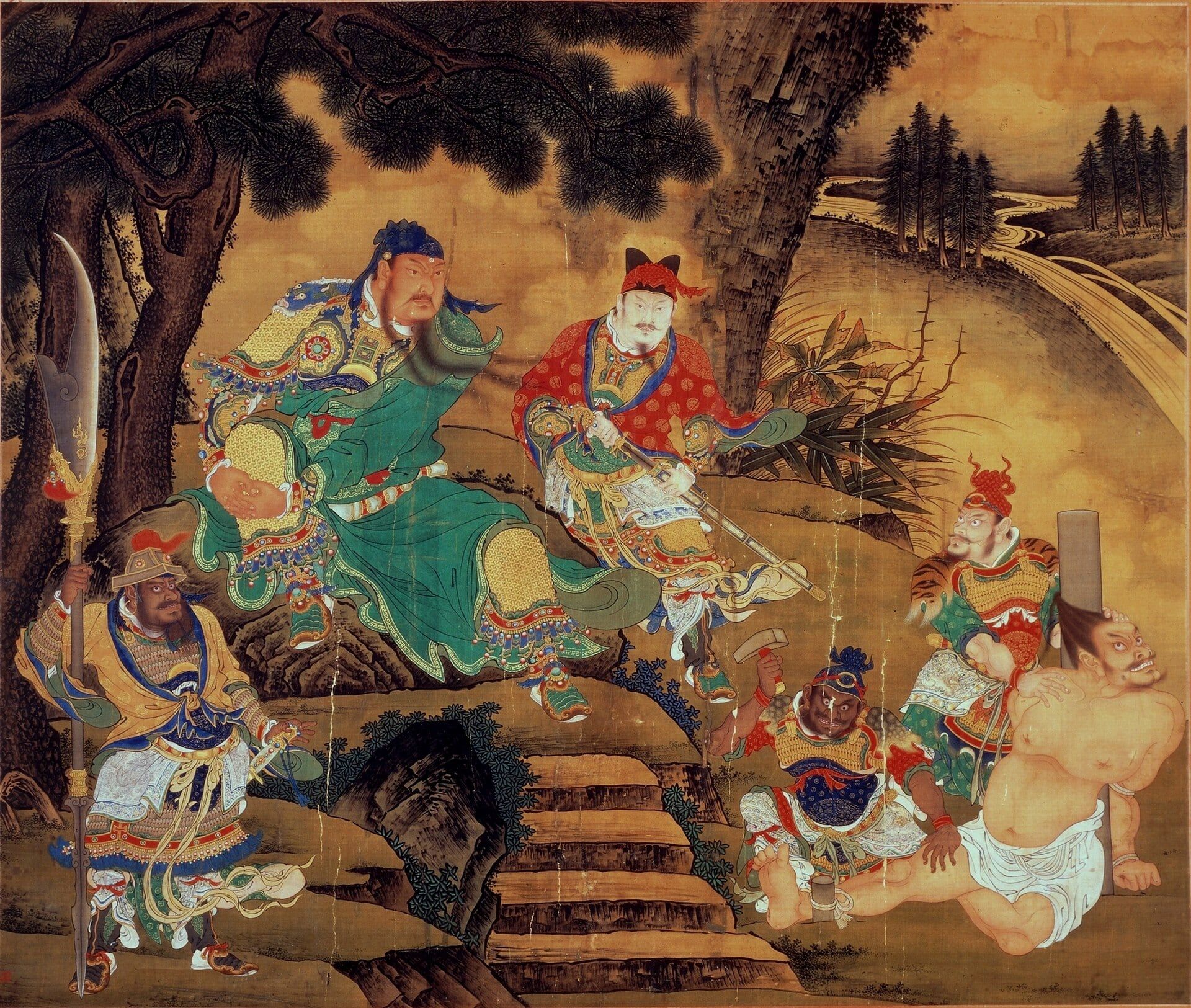
Guandao: Guan Yu's Crescent Blade, Myth vs History
What a guandao is: Guan Yu's legendary Green Dragon Crescent Blade, the 82-jin myth, its Song-dynasty origins, Qing exam blades and its place in Phantom Blade Zero.