Weapon dossier · Polearms
Guandao: Guan Yu's Crescent Blade, Myth vs History
关刀 / 偃月刀guāndāo / yǎnyuèdāo
What a guandao is: Guan Yu's legendary Green Dragon Crescent Blade, the 82-jin myth, its Song-dynasty origins, Qing exam blades and its place in Phantom Blade Zero.
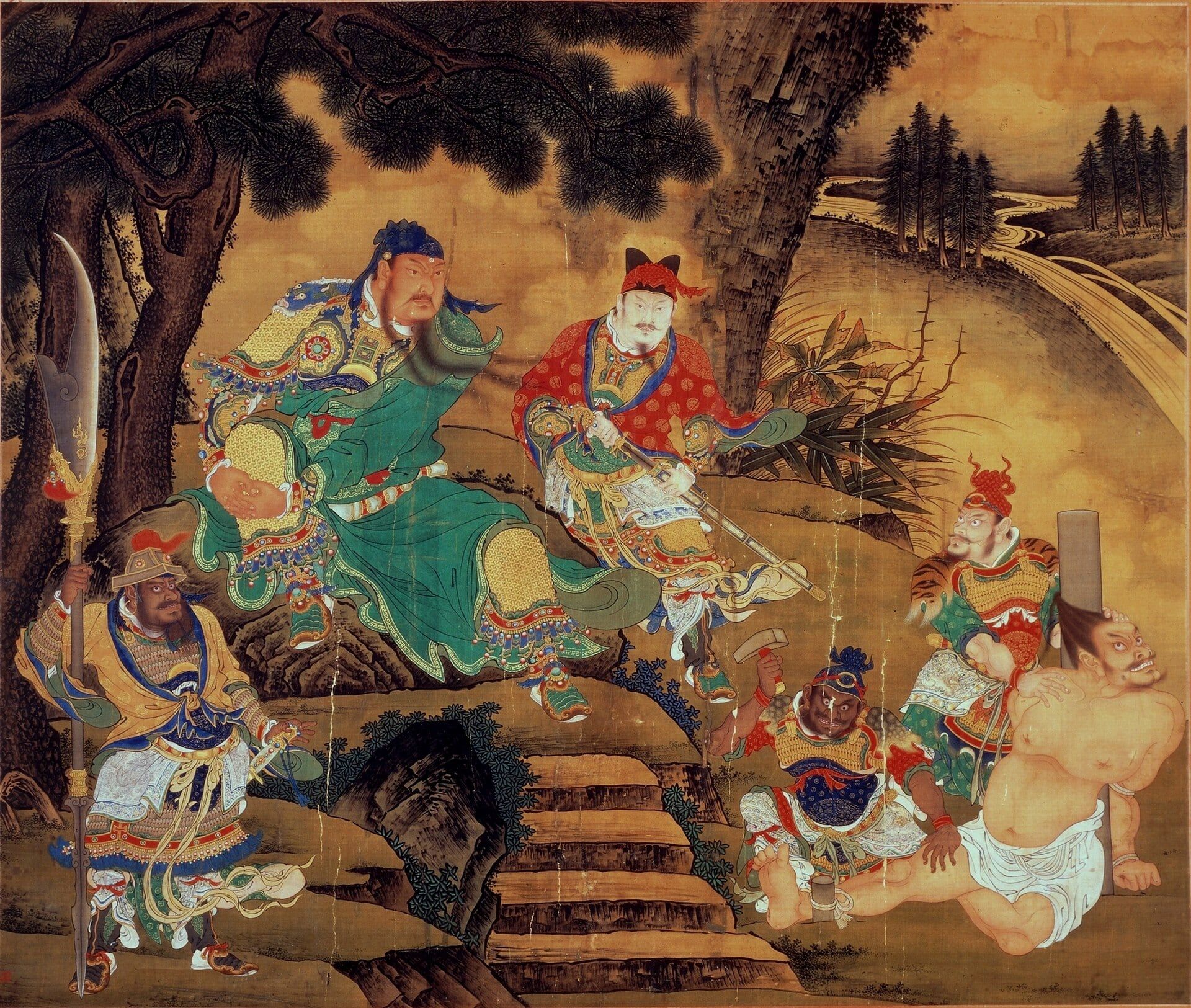
Key facts
- A guandao (关刀, guāndāo) is a Chinese polearm with a broad, curved, single-edged blade on a pole; period texts call it the yanyue dao (偃月刀), the “reclining-moon blade”.
- Its fame comes from Romance of the Three Kingdoms (14th c.), where Guan Yu wields the 82-jin Green Dragon Crescent Blade — but the history written in his own century says he stabbed his famous victim and never names such a weapon.
- The form is first documented more than 800 years after Guan Yu's death, in the Song military compendium Wujing Zongyao (1040–1044), where it is written 掩月刀.
- By the Qing it was mostly a parade weapon and a strength test: military-exam candidates had to twirl iron blades of 80, 100 or 120 jin (roughly 48–72 kg).
- Guan Yu himself became Guandi (关帝), god of war and loyalty — which is why the blade is still called the guandao, “Guan's blade”.
- Type
- Polearm with a curved, single-edged blade
- Chinese
- 关刀 guāndāo · period name 偃月刀 yǎnyuèdāo
- First documented
- Wujing Zongyao, 1040–1044 (written 掩月刀)
- Overall length
- About 1.8–2.3 m (pole roughly 1.5–1.8 m)
- Weight
- Wushu versions about 2–10 kg; Qing exam blades 80–120 jin (≈48–72 kg)
- Other names
- 大刀 (Ming); 春秋刀 (Qing regulations)
- Legend
- Guan Yu's 青龙偃月刀, “82 jin”
A guandao 关刀 guāndāoA heavy glaive with a crescent blade, linked by legend to the general Guan Yu (also called yanyuedao, “reclining moon blade”).Glossary → is a Chinese polearm: a broad, single-edged blade that sweeps up into a crescent tip, mounted on a wooden pole, with a spike on the back of the blade and a pointed metal butt at the other end. Period texts call it the yanyue dao , the “reclining-moon blade”. The popular name means “Guan’s blade”, after the general Guan Yu (died 220 CE), whose legend fused with the weapon so completely that most people assume he invented it. The historical record says otherwise.
The legend: Guan Yu’s Green Dragon Crescent Blade
The blade owes its fame to Romance of the Three Kingdoms, the 14th-century novel attributed to Luo Guanzhong and first printed in 1522. In its opening chapter, right after the Peach Garden oath, the three sworn brothers have their weapons forged: Liu Bei a pair of swords, Zhang Fei an eighteen-chi steel-tipped spear, and Guan Yu the Green Dragon Crescent Blade .
云长造青龙偃月刀,又名“冷艳锯”,重八十二斤。
Yunchang [Guan Yu] had the Green Dragon Crescent Blade made, also called “Cold Beauty Saw”; it weighed eighty-two jin.
Everything else grew from that line: the red-faced, long-bearded general on his horse Red Hare, the blade raised over the battlefield, the image repeated in opera, temple statues, comics and games. In temples the blade is often held for him by his attendant Zhou Cang, a character the storytellers invented.
Myth vs history: what the sources say
The history written in Guan Yu’s own century tells a plainer story. Chen Shou’s Records of the Three Kingdoms (三国志), compiled in the late 3rd century, describes his most famous feat — killing Yuan Shao’s general Yan Liang at Baima in 200 CE — like this:
羽望见良麾盖,策马刺良于万众之中,斩其首还。
Guan Yu saw Yan Liang’s command canopy, spurred his horse, stabbed Liang in the midst of ten thousand men, cut off his head and rode back.
The verb is 刺, to stab or thrust — the natural action of a spear or lance from horseback, not of a broad cleaving blade. The text never names his weapon. In the same history, Guan Yu’s tense meeting with the Wu commander Lu Su in 215 CE has the troops halted a hundred paces back while the generals meet “each with a single dao” (单刀俱会), the root of the later idiom 单刀赴会. That dao was a sidearm sabre, not a polearm.
Nothing like a guandao has turned up from the Han or Three Kingdoms periods, whose soldiers fought with ring-pommel sabres, halberds (戟) and spears. The type is first documented more than 800 years after Guan Yu’s death, so historians treat the Green Dragon Crescent Blade as a literary anachronism: a Song-dynasty weapon handed to a Han-dynasty hero by Ming-dynasty storytellers.
From Song manual to Qing exam hall
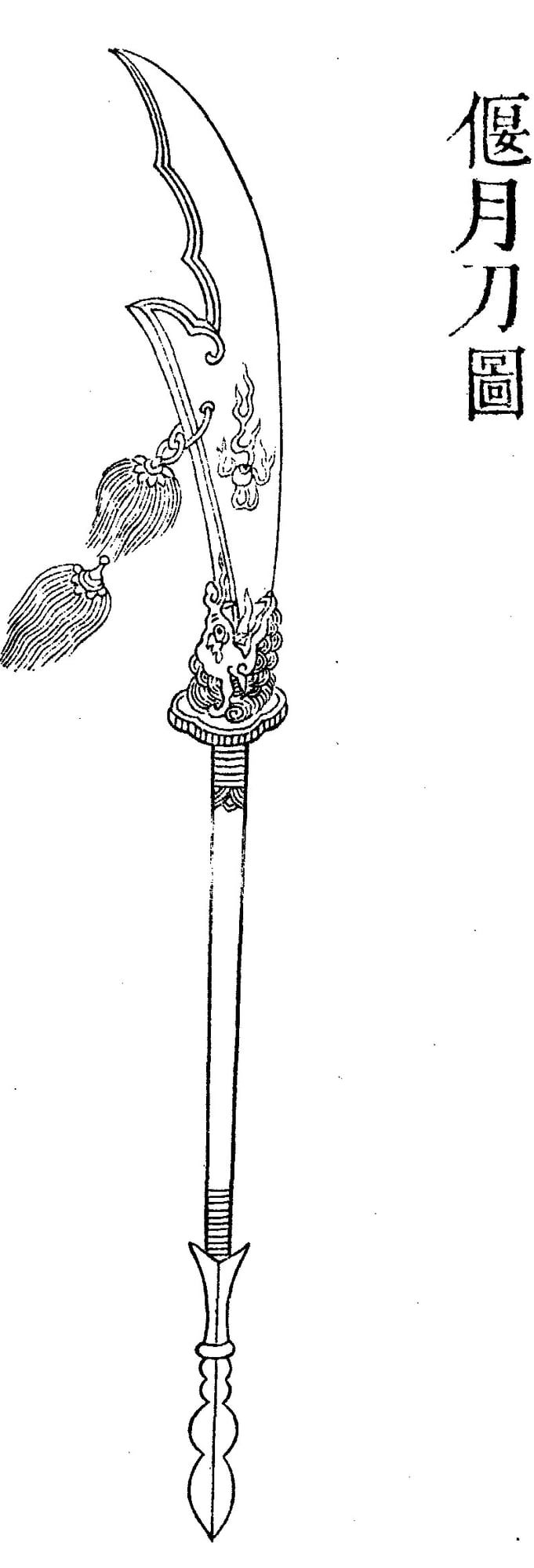
The weapon’s real history begins in the Song dynasty. The Wujing Zongyao (武经总要, “Complete Essentials for the Military Classics”, 1040–1044), compiled for Emperor Renzong, lists eight kinds of dao (刀八色): 手刀, 掉刀, 屈刀, 掩月刀, 戟刀, 眉尖刀, 凤嘴刀 and 笔刀, most of them long-hafted. The fourth is our weapon, written 掩月刀, “covered-moon blade”; the character 掩 later gave way to 偃, “reclining”. Its woodcut already shows the inward-curving blade and the notched back.
The name 关刀 itself appears in a Ming military source of the 1570s, Liu Xiaozu’s Record of Four Towns and Three Passes (四镇三关志), written on the Great Wall frontier. Ming officers were cool on the weapon. Cheng Ziyi’s Wubei yaolüe (1636) called it a general’s weapon for horseback that demanded great strength and a fast horse; Mao Yuanyi’s encyclopedic Wubei zhi (1621) was blunter — imposing when shown off in drill, of little real use in battle.
Under the Qing it lived on in two forms. Court regulations such as the Huangchao liqi tushi (皇朝礼器图式, 1766) list it for the Green Standard Army, and 19th-century rules also call it 春秋刀, “Spring and Autumn blade” — a name popularly linked to the image of Guan Yu reading the Spring and Autumn Annals. In practice it was carried mostly in parades and official retinues.
Its second life was as gym equipment. The military examinations (武举) used oversized iron exam blades (武科刀), and the Draft History of Qing records the standard: candidates drew bows of 8, 10 or 12 li, twirled blades of 80, 100 or 120 jin and lifted stones of 200, 250 or 300 jin. The blade had to be spun in flourishes; the stone had to leave the ground by a foot. In 1901 the court scrapped the tests, noting that hard bows, blades and stones “had nothing to do with warfare” (无与兵事).
Anatomy of a guandao
| Part | Chinese | What it does |
|---|---|---|
| Blade | 刀身 | Broad and single-edged, nearly straight at the base, then curving sharply to the tip — the crescent that “yanyue” describes |
| Back spike and notch | 刀背 | A spur on the spine, often with a notch at its base that can catch an opponent’s shaft or blade |
| Mouth collar | 吞口 | The collar where blade meets pole, often a beast’s or dragon’s mouth that “swallows” the blade |
| Pole | 杆 | Hardwood, roughly 1.5–1.8 m; Qing regulations call for vermilion lacquer |
| Butt spike | 鐏 | A pointed metal cap that balances the heavy head and strikes on the reverse |
With the weight concentrated so far forward, the guandao fights in big arcs: chopping down, sweeping across, hooking with the back spike, then reversing to strike with the butt. Modern wushu keeps it as a standard heavy-weapon routine, often simply called 大刀; southern Chinese schools also know it as 春秋大刀.
Approximate overall lengths of typical examples; real pieces vary by period, region and maker.
How heavy is a guandao?
| Guandao | Stated weight | In kilograms | What it was |
|---|---|---|---|
| Guan Yu’s Green Dragon Crescent Blade | 82 jin | ≈18–19 kg (Eastern Han jin) or ≈48 kg (Ming jin) | Fiction, 14th-century novel |
| Qing exam blade, lowest grade | 80 jin | ≈48 kg | Strength test |
| Qing exam blade, middle grade | 100 jin | ≈60 kg | Strength test |
| Qing exam blade, top grade | 120 jin | ≈72 kg | Strength test |
| Modern wushu guandao | — | ≈2–10 kg | Training and performance |
The conversions depend on which jin you use: about 220–235 g in the Eastern Han, about 597 g under the Ming and Qing. Read with the right ruler, the novel’s 82 jin is either a heavy-but-possible 18 kg or an absurd 48 kg. The truly heavy guandao were real, but they were never meant for a battlefield, where a polearm had to be swung for hours. They existed to prove that an officer candidate had the arms and back to command.
Guan Yu, god of war and loyalty
The historical Guan Yu was a general under Liu Bei, captured and executed by Sun Quan’s forces in 220 CE. Chen Shou’s verdict was that he and Zhang Fei “were both called a match for ten thousand men” (皆称万人之敌). What happened next is stranger than the novel.
Barend ter Haar’s study Guan Yu: The Religious Afterlife of a Failed Hero (2017) traces how the dead general became a restless spirit, then the miraculous protector of a Buddhist monastery in the Tang, then an exorcist general in Song Daoist ritual. Emperors kept promoting him: Song rulers made him a duke and then a prince, the Wanli Emperor of the Ming raised him to “Holy Emperor” in 1614, and the Qing ranked him as the Saint of War (武圣), the martial counterpart of Confucius, the Saint of Culture. Hence his two everyday names, Guandi (“Emperor Guan”) and Guangong (“Lord Guan”).
Today his red-faced statue stands in temples across China and the diaspora. Merchants honour him as a god of wealth, a role documented from the 18th century; Hong Kong police stations keep shrines to him, and so do triad halls, because his loyalty (义) is the glue of sworn brotherhood. The crescent blade became his emblem, the way a saint carries his instrument — and that is how a Song-dynasty polearm came to be named after a third-century general.
 [2023] It's Guanyu! Pan Hongshen - Guandao - 8.97 - Traditional Wushu Taolu National Championships
The guandao in Phantom Blade Zero
S-GAME has put Guan Yu’s weapon on the rack. Gamersky’s headline on 17 September 2026 announced a new official guandao image alongside a wishlist milestone, and in an August 2026 Q&A Soulframe Liang listed the 偃月刀, together with gauntlets, among new weapons that received their own differentiated move design, aimed at capturing the speed, power and variety of Chinese fight choreography. The studio’s general rule, posted on X in April 2026, is that its weapon prototypes “are drawn from the vast arsenal of traditional Chinese weaponry”, sometimes with real replicas forged by master swordsmiths.
The game is original fiction, so its guandao answers to wuxia logic rather than to a Qing drill manual. That suits the weapon perfectly: a real Song-dynasty polearm, a Qing strength test, a god’s emblem and a storyteller’s 82-jin exaggeration, all in one crescent of steel.
Names in this article · Codex
Frequently asked
Q01What is a guandao?
Q02Did Guan Yu really use a guandao?
Q03How heavy was Guan Yu's Green Dragon Crescent Blade?
Q04What does 偃月刀 mean?
Q05Is there a guandao in Phantom Blade Zero?
Sources & further reading
- Romance of the Three Kingdoms, chapter 1 (Guan Yu's blade, “82 jin”) — Attributed to Luo Guanzhong · Wikisource
- Records of the Three Kingdoms, “Biography of Guan Yu” — Chen Shou, late 3rd c. · Wikisource
- Draft History of Qing, “Treatise on Examinations” III (military exam tests) — Qingshi gao · Wikisource
- Yanyuedao (glossary entry) — Mandarin Mansion
- Guan Yu: The Religious Afterlife of a Failed Hero — Barend J. ter Haar, Oxford University Press, 2017
- Through a Lens Darkly (22): Heavy Knives and Stone Locks — Kung Fu Tea (Benjamin Judkins)
- 《影之刃零》官宣突破新里程碑!关刀新图公开 — Gamersky, 17 Sep 2026
Cite this page
Wuxiapunk Editors. (2026, October 27). Guandao: Guan Yu's Crescent Blade, Myth vs History. Wuxiapunk. https://wuxiapunk.com/weapons/guandao/
“Guandao: Guan Yu's Crescent Blade, Myth vs History.” Wuxiapunk, 27 Oct. 2026, https://wuxiapunk.com/weapons/guandao/.
Keep reading
Qiang: The Chinese Spear, King of Weapons
What the qiang is, why the Chinese spear is called the king of weapons, what the red tassel is for, the real Yang family spear, Ming manuals and lan-na-zha technique.
Zhanmadao & Modao: China's Horse-Cutting Great Sabres
The real zhanmadao: the Han “horse-cutting sword” in the Han shu, Li Siye's Tang modao, the Song great sabre of 1072, Qing long sabres and the 1930s dadao.
Dao: The Chinese Sabre, From Ring-Pommel to Oxtail
What a dao sword is, how the Chinese sabre evolved from the Han ring-pommel dao to Qing willow-leaf and oxtail sabres, why armies chose it, and how it is used.