Weapon dossier · Axes
Chinese Battle Axes: The Yue, the Fu and the Axe of Kings
斧 · 钺fǔ · yuè
Chinese battle axes: the fu and the ceremonial yue, why the character for king is an axe, King Wu's yellow axe, Li Kui, and the Four Axes of Phantom Blade Zero.
Key facts
- Chinese has two words for an axe: 斧 (fǔ), the ordinary axe of woodcutters and soldiers, and 钺 (yuè), a broad ceremonial axe that stood for the power to punish and to kill.
- On Shang oracle bones the character 王, “king”, is drawn as an axe head standing blade-down, the usual reading being that the ritual axe stood for royal power.
- Sima Qian writes that after the Battle of Muye (c. 1046 BCE) King Wu of Zhou cut off the last Shang king's head with a yellow axe (黄钺) and hung it from a white banner.
- The Huainanzi (139 BCE) describes a ruler handing his general the yue and the fu before a campaign: from Heaven above to the abyss below, the general's word was law.
- In Phantom Blade Zero, Peng Meng, the Axemaster (斧老大:彭猛), eldest of the framed Four Axes, drops the Dread Axe (巨凶斧) in Weeping Creek Valley; the Shadow Warden Heartpiercer carries a pair of yue, the Sundering Dual Axes (天煞双钺).
- Chinese
- 斧 (fǔ), axe · 钺 / 戉 (yuè), broad ceremonial axe · 戚 (qī), a smaller axe · 板斧 (bǎnfǔ), broad short axe
- Oldest forms
- Neolithic stone and jade axes, before 2000 BCE
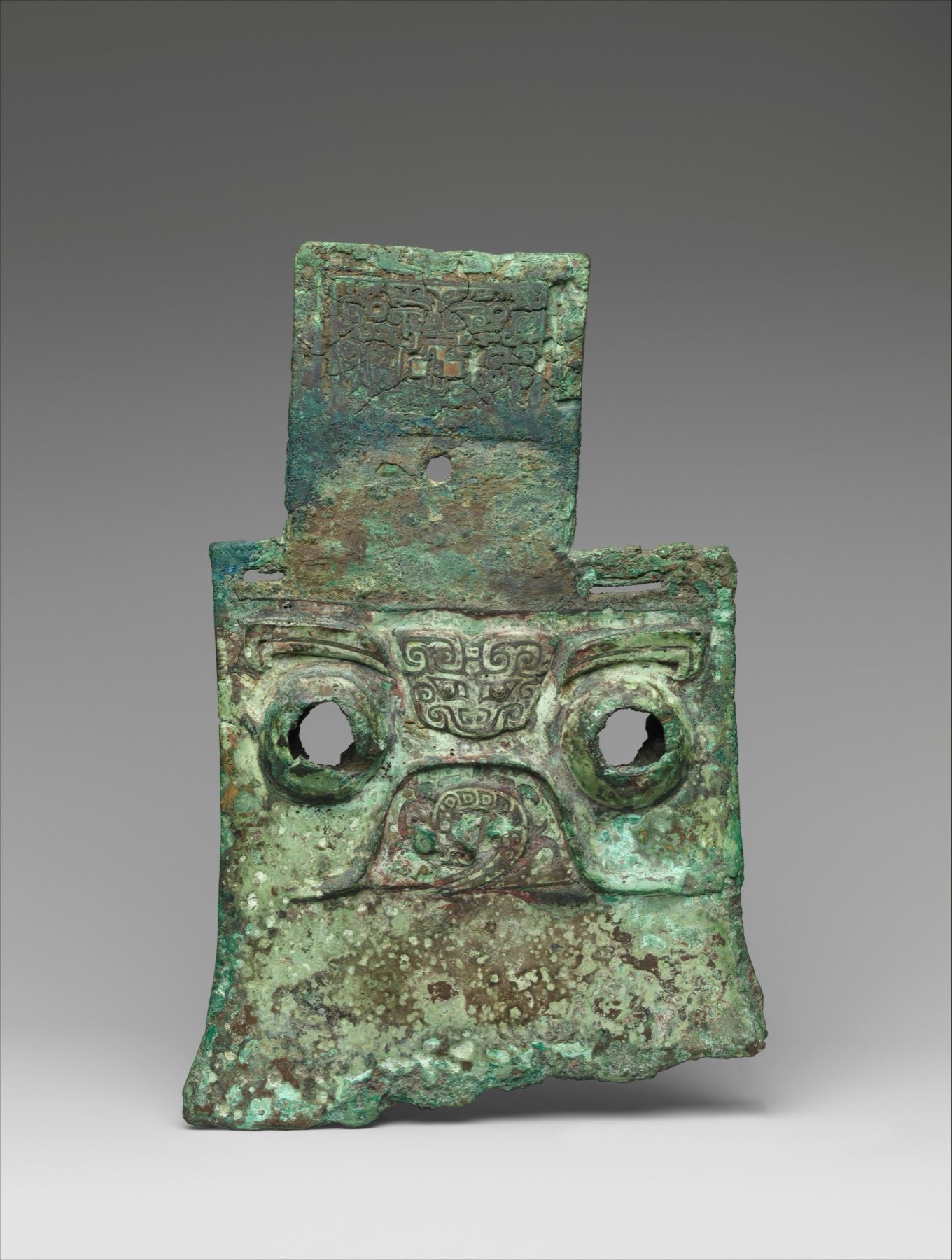
- Bronze yue (Met example)
- 29.2 cm high, Shang dynasty, 13th–11th century BCE
- Symbol of
- Royal and military authority; the right to punish
- Key texts
- Shuowen jiezi; Shiji, ch. 4; Huainanzi, “On Military Strategy”; Song History, ch. 366
- In fiction
- Li Kui's two broad axes (Water Margin); Cheng Yaojin's “three axe strokes”
- In Phantom Blade Zero
- Dread Axe (巨凶斧), Phantom Edge, from Peng Meng; Sundering Dual Axes (天煞双钺), from Heartpiercer
A Chinese battle axe is either a fu , the ordinary axe that woodcutters and soldiers carried, or a yue , the broad ceremonial axe that Bronze Age kings and generals held as the sign of their right to punish and kill. Axes are among China’s oldest weapons, and the yue is so bound up with power that the character for king, 王, began as a picture of one.
A boss list in the game’s second week put this question in front of players. PlayStation’s post of the game’s “brutal bosses” named an old comrade with a chain sickle, a ghost bride and a three-faced puppet, and between them a brute called Peng Meng, the Axemaster. Players who fought him know the axe as a club for smashing shields. In Chinese history it started as something stranger: a jade badge, a royal glyph and an executioner’s warrant.
Eight axes · 4,400 years
From jade to the Dread Axe: how an axe became a king
A jade axe nobody chopped with
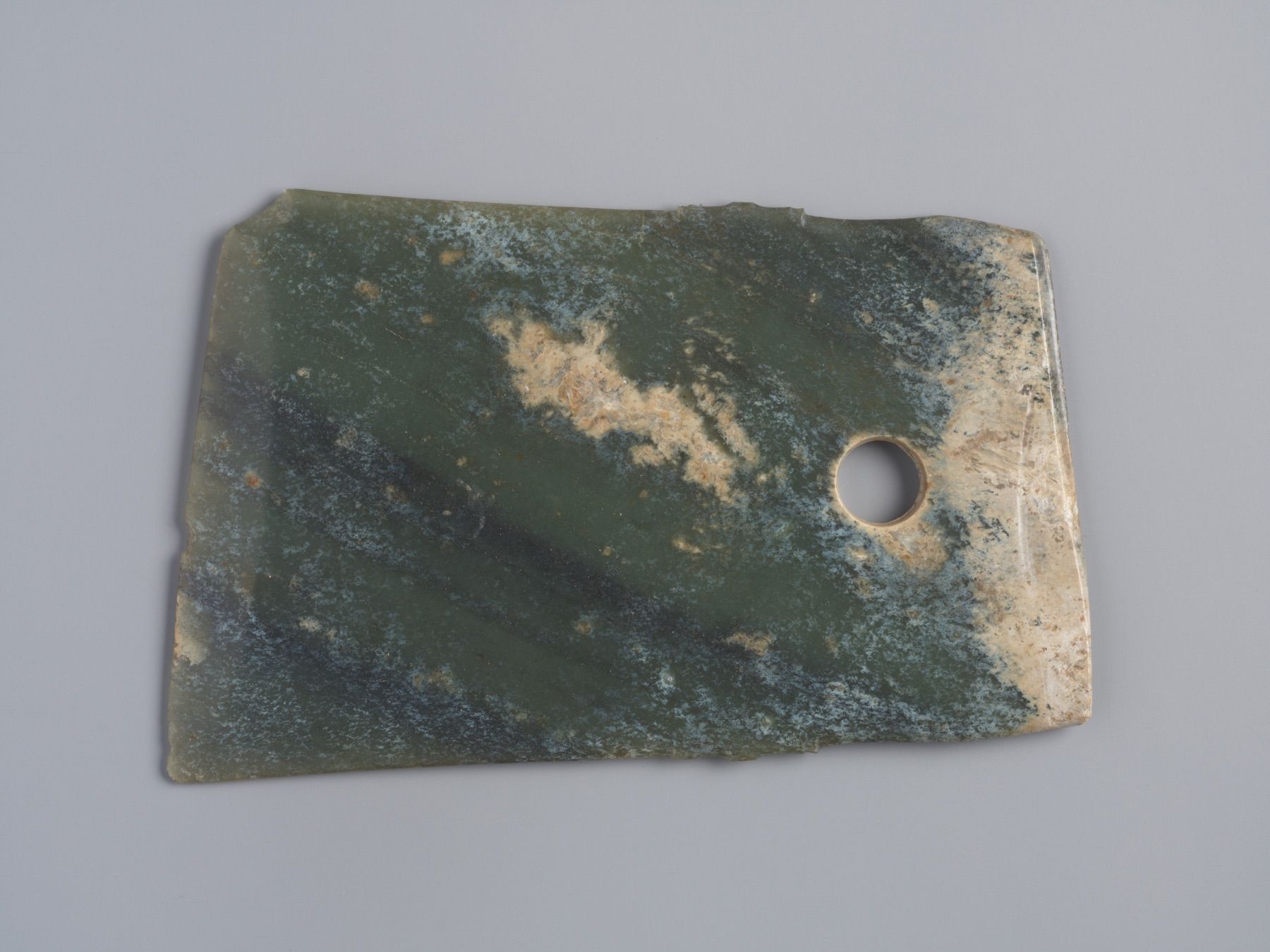
Before bronze, the finest axes were jade: ground thin, polished, drilled for a haft. This one, from the late Dawenkou–early Longshan culture, is 15.6 cm long and now in the Met. An axe that precious was a badge, not a tool.
The Met, 1991.250
The bronze yue
Shang casters made the axe broad, heavy and frightening: a blade nearly as wide as it is tall, a tang for the haft, and often a face. The Met’s example is 29.2 cm high. Fu Hao, the queen who led Shang armies, was buried with great bronze axes.
戉,斧也。Shuowen jiezi (100 CE): “The yue is an axe.”
The character for “king” is an axe
On Shang oracle bones, 王 (wáng, king) is drawn as an axe head standing blade-down. The usual reading is that the ritual axe stood for the ruler’s power, and the pictogram straightened over 3,000 years into three bars and a stroke.
王Oracle-bone form → modern form
King Wu’s yellow axe
Swearing in his army before Muye, King Wu of Zhou held a yellow axe in his left hand and a white yak-tail banner in his right. After the battle, Sima Qian writes, he cut off the dead Shang king’s head with that axe and hung it from a white banner.
以黃鉞斬紂頭,縣大白之旗。Sima Qian, Shiji, ch. 4
Handing the general the axe
In the ritual for sending out a general, the ruler held the yue by its head and gave him the handle: “From here up to Heaven, the general commands it.” Then the fu: “From here down to the abyss.” The axe was the authority to kill without asking.
從此上至天者,將軍制之。Huainanzi, “On Military Strategy”
Axes against the Iron Pagoda
At Shunchang the Song general Liu Qi sent men out with sharp axes against the Jin prince Wuzhu’s armoured guard, the Iron Pagoda. Spears knocked off their helmets; big axes, the Song History says, cut off arms and smashed heads.
大斧斷其臂,碎其首。Song History, ch. 366 (Liu Qi)
Li Kui’s two broad axes
Fiction gave the axe to its wildest man. When the outlaws raid an execution ground, the Black Whirlwind, Li Kui, leaps down from a teahouse roof stark naked with a broad axe in each hand, roaring like a thunderclap.
兩隻手握兩把板斧,大吼一聲。Water Margin, ch. 40
Peng Meng’s Dread Axe
Peng Meng, the Axemaster (斧老大), swings it in Chapter 1. Beat him and it becomes Soul’s first Phantom Edge: hold to charge up to two stages, release for a shield-breaking cleave, and it cuts the iron chains that block the road.
Retail item card (S-GAME)
Fu and yue: two words for an axe
The Han dictionary Shuowen jiezi (c. 100 CE) defines the yue in four characters: 戉,斧也, “the yue is an axe”. It then quotes the military classic Sima Fa on how three dynasties carried theirs: the Xia held a black yue, the Shang a white axe called 戚, and the Zhou “in the left hand leaned on a yellow yue, in the right held a white banner”. The yue was the axe a ruler held at the head of an army.
In practice the two words split the work. The fu was a tool and a weapon; the yue was a statement. Texts pair them as 斧钺 (fǔyuè), and the pair came to mean military command or the death penalty itself. A third word, 戚, names a smaller axe: the Han Feizi has the sage-king Shun win over the Miao with a dance “holding shield and axe” (see our article on Chinese shields).
| Name | Chinese | What it is | Who holds it |
|---|---|---|---|
| Fu | 斧 | The ordinary axe, for wood or war | Woodcutters, soldiers |
| Yue | 钺 (戉) | Broad ceremonial axe, often bronze or jade | Kings, generals, executioners |
| Qi | 戚 | A smaller axe, used in ritual dances | Dancers, guards |
| Big axe | 大斧 / 长斧 | Long-handled battle axe | Song infantry |
| Banfu | 板斧 | Short, broad axe, often paired | Li Kui in Water Margin |
| Dread Axe | 巨凶斧 | Charged crescent-bladed axe | Peng Meng, then Soul (game) |
| Sundering Dual Axes | 天煞双钺 | A pair of short yue | Heartpiercer, then Soul (game) |
Why the character for king is an axe
Long before bronze, the finest axes in China were jade. A nephrite axe in the Metropolitan Museum, from the late Dawenkou to early Longshan culture (2400–1900 BCE), is ground to a thin, polished blade and drilled with a single hole for its haft. It is only 15.6 cm long, and nobody chopped wood with it. A stone that hard and that precious, worked that carefully, was a badge of rank.
Bronze made the badge heavy. Shang casters gave the yue a blade almost as wide as it is tall, a tang for the haft, and often a face: the Met’s example is 29.2 cm high, with two round eyes cut right through the metal. Fu Hao, the Shang queen whose campaigns are recorded on oracle bones (see Wuxia heroines), was buried at Anyang with great bronze axes.
The script remembers the axe too. On Shang oracle bones, 王, “king”, is drawn as an axe head standing on its blade: a short bar on top, a stem, and a wide curved edge at the bottom. The usual reading is that the ritual axe kept near the throne stood for the ruler’s power. Over three thousand years the curve straightened into the bottom stroke of the modern character. The traditional explanation, that the three bars are Heaven, Man and Earth joined by the king, is a later folk etymology.
The axe that judged: King Wu and the general’s axe
The most famous axe in Chinese history belonged to King Wu of Zhou. Sima Qian’s Shiji describes him at dawn before the Battle of Muye (c. 1046 BCE), leaning on a yellow yue in his left hand and waving a white yak-tail banner with his right as he swore in his allies. After the victory he went to where the last Shang king, Zhou, had died:
武王自射之,三发而后下车,以轻剑击之,以黄钺斩纣头,县大白之旗。
King Wu shot three arrows into the body, got down from his chariot, struck it with a light sword, cut off Zhou’s head with the yellow axe, and hung it from the great white banner.
The yue here is not a weapon of battle; it is the instrument of a sentence. That is how the axe passed from king to general. The Huainanzi, presented to the Han emperor in 139 BCE, describes the rite for sending a general to war. In the ancestral temple the ruler took the yue by its head and handed the general its handle, then did the same with the fu:
从此上至天者,将军制之。……从此下至渊者,将军制之。
From here up to Heaven, the general commands it. … From here down to the abyss, the general commands it.
The general answered that an army cannot be run from the palace and that, holding “the majesty of drums, banners and axes”, he would ask for nothing more; then he left through a gate cut for the occasion. Holding the axe meant he could execute without asking permission. Wuxia’s sects inherit that idea whenever a token or weapon of office lets its holder pass judgement.
Axes on the battlefield: Song axemen against the Iron Pagoda
Axes did real killing too, especially against armour. The best-documented case is the defence of Shunchang (in modern Anhui) in 1140, when the Song general Liu Qi faced the Jin prince Wuzhu. The Song History’s biography of Liu Qi says that in the heat of the afternoon he sent several thousand men out of the south gate with orders not to shout, “only to go at them with sharp axes”. Wuzhu’s own guard was a body of heavily armoured men called the Iron Pagoda (铁浮图), in iron helmets hung all round with long flaps, roped together in threes:
官军以枪标去其兜牟,大斧断其臂,碎其首。
The government troops knocked off their helmets with spears, and with big axes cut off their arms and smashed their heads.
The next year at Zhegao, the same biography says, the Song commander Yang Yizhong sent ten thousand men “each holding a long axe” against the Jin flanking cavalry, and the Jin broke. The pattern is clear: spears and bows did most of the fighting, and the axe was the tool for armour that a blade would only scratch. That is exactly the job Phantom Blade Zero gives its heavy weapons.
Fiction’s axe-men: Li Kui and Cheng Yaojin
Novels and storytellers turned the axe into the weapon of the wild man. In chapter 40 of Water Margin, the outlaws of Liangshan raid the execution ground at Jiangzhou to save Song Jiang, and the first man in is the Black Whirlwind, Li Kui, who jumps from the upper floor of a teahouse at the crossroads “stark naked, a broad axe gripped in each hand, with a roar like a thunderclap out of the sky”. He cuts down the executioners and keeps chopping, “soldiers and townsfolk alike”, ignoring Chao Gai’s shouts to leave the common people alone.
Sui–Tang storytelling gave the axe a comic hero as well. Cheng Yaojin, in the popular tales a salt smuggler turned general, has three famous axe strokes and not much after them; 程咬金三板斧, “Cheng Yaojin’s three axe strokes”, is still an idiom for someone whose whole repertoire is a big opening. The axe in fiction is honest, loud and unsubtle, the opposite of the scholar’s jian.
Peng Meng and the Dread Axe in Phantom Blade Zero
Spoilers below for the tale Four Fierce Axes.
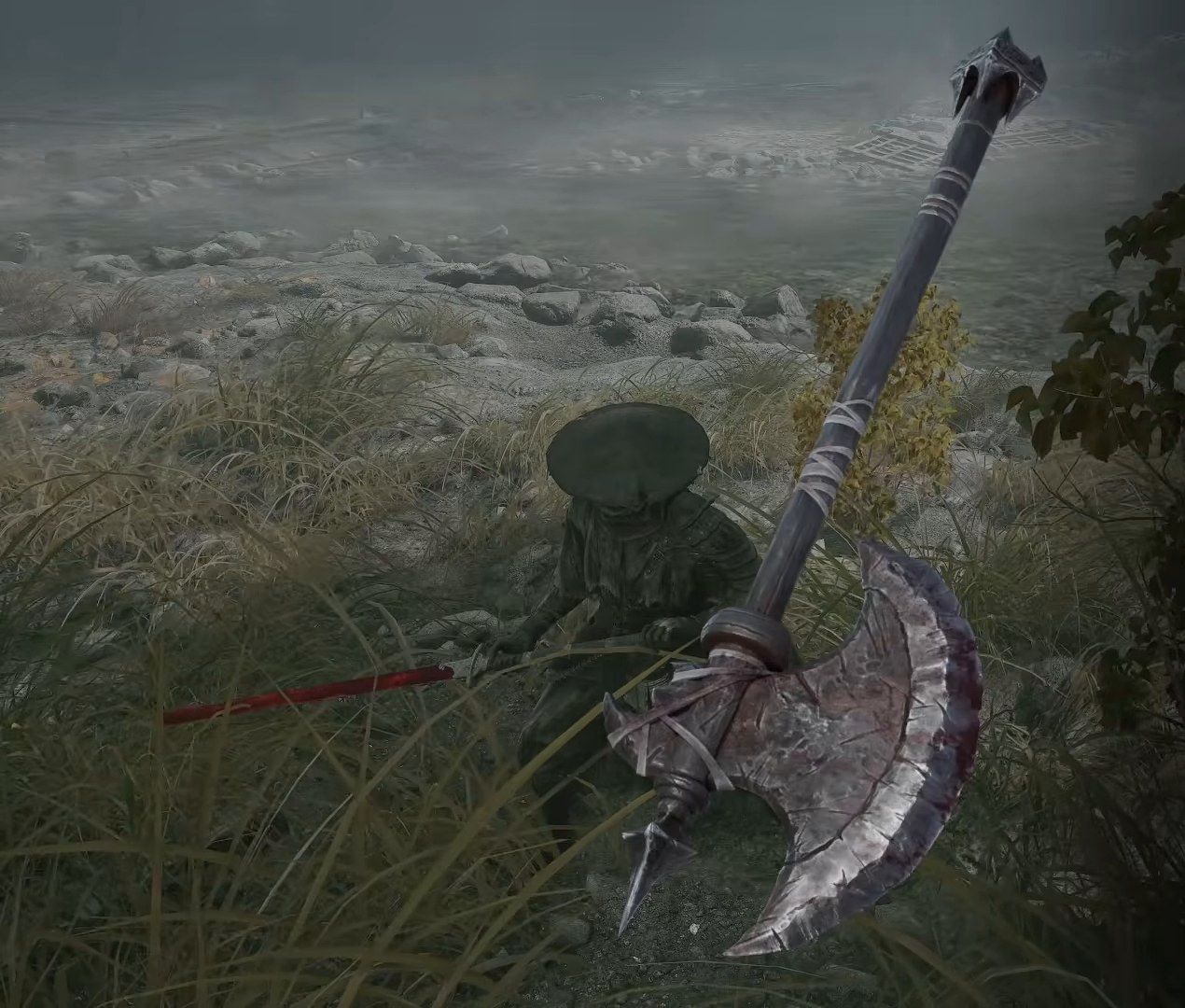
The card is short: “A thick-bladed great axe once wielded by the Axemaster, Peng Meng” (曾为斧老大彭猛所用的厚刃巨斧), and the lore line adds that it can split mountains and cleave armour in a single blow (一击可开山裂甲). His title is gang slang: 老大 is “boss” or “big brother”, so 斧老大 reads roughly “Big Boss Axe” (more in our character names guide). The axe sits in the line of Li Kui’s, not King Wu’s: a brute’s tool for smashing guards and shields, like the Song axemen at Shunchang. Its card even makes it a key for chained roads, our favourite small joke in the game’s weapon design. The Dread Axe teardown draws the game build against real axes.
Who he was. His bestiary entry says he was the eldest of the Four Axes (四凶斧), sworn brothers who once “drank deep and feasted heartily” and settled every debt “by the Wulin’s rules”, until his three brothers “were murdered through treachery”. Peng Meng underwent Transcension to avenge them; a Mandate squad subdued him “only at terrible cost” and drove thick chains through his shoulder blades to hold him behind the Outpost, which is why the fight opens with him in chains.
The case file. The eight papers of The “Four Axes” Case Files (“四凶斧”案卷) tell the rest, and finding them is the tale Four Fierce Axes (凶斧). Peng Meng drops the first, The Axemaster’s Final Request, a furious letter: “We caught him violating and killing a woman, and he twisted the truth and accused us instead!” (奸杀女子被我等撞破,更颠倒黑白,血口喷人!). The man was Sect Leader Ming of the Mandate; Gu Lingran befriended the brothers, then proposed in writing how to trap them (Gu Lingran’s Letter to Sect Leader Ming), and killed three of them. Ming’s only written word on the matter is his reply: handle it, and burn this. Hand all eight papers to the Child of Insight (八卦童子) atop the Pavilion of Knowledge in Pangzhen and he gives you what Peng Meng left there: the Blood Oath Dagger (义结金兰之歃血刀), “the dagger used by the Four Axes when they swore brotherhood in blood”. It is the Dread Axe’s Soul Tempering material, and it makes the charge 30% faster (Rapid Charge, 急速蓄力).
Fu and yue, again. The Mandate branded the brothers 四凶, the name the Zuo zhuan gives the four villains the sage-king Shun banished (the case file’s roots explain it). Our reading: the Four Axes story is the old split between the two axes. The Mandate held the yue, the right to name criminals and have them killed; Peng Meng had only the fu, the heavy tool. The dagger they swore on carries the phrase 义结金兰, sworn brotherhood, and the Four Axes codex entry gathers the whole case.
The other yue. The game has a second axe weapon, and its Chinese name uses the royal word. The Sundering Dual Axes (天煞双钺, “heaven-fiend twin yue”) are a dual-wield primary weapon dropped by Heartpiercer, Elite Shadow Warden (鬼差高手:断肠), who guards the White Serpent House on Meigu Lake. Their card opens with a fighter’s warning, “The shorter the blade, the greater the peril” (一寸短一寸险): light hits build a Baleful Aura (煞气) gauge, and once it fills, heavy combos hurl the axes, which “latch onto enemies and continuously slice them”. His bestiary entry says his whirling axes kill so painfully that they earned him his name, 断肠, “severed guts”. The teardown has the build. Every boss in order is in the boss guide, and the full arsenal in our Phantom Blade Zero weapons guide.
Four thousand years separate a jade axe nobody chopped with from a crescent axe that cuts chains, and in between the axe was a king’s glyph, a death sentence and a general’s licence to kill. Peng Meng gets only the last part of that history, the weight and the noise. The ancient yue meant something heavier, the right to decide who dies, and in his story the Mandate kept it.
Names in this article · Codex
Frequently asked
Q01What is a Chinese battle axe called?
Q02What is the difference between a fu and a yue?
Q03Is the Chinese character for king an axe?
Q04Did Chinese armies really fight with axes?
Q05Who is the axe boss in Phantom Blade Zero?
Q06Who were the Four Axes in Phantom Blade Zero?
Q07Are there dual axes in Phantom Blade Zero?
Sources & further reading
- Shuowen jiezi, ch. 12: 戉 (yue), “an axe”, with the Sima Fa on the axes of Xia, Shang and Zhou — Xu Shen, c. 100 CE (Wikisource)
- Shiji, ch. 4, Annals of Zhou: King Wu at Muye and the yellow axe — Sima Qian (Wikisource)
- Huainanzi, “On Military Strategy” (兵略訓): the general receives the axes — Liu An, 139 BCE (Wikisource)
- Song History, ch. 366: biography of Liu Qi (Shunchang, 1140; Zhegao, 1141) — Toqto'a et al., 1345 (Wikisource)
- Water Margin, ch. 40: Li Kui at the execution ground — Shi Nai'an (attrib.), 120-chapter edition (Wikisource)
- Axe, Shang dynasty, 13th–11th century BCE (1985.214.23) — The Metropolitan Museum of Art
- 王: glyph origin (pictogram of a ritual axe) — Wiktionary
- Dread Axe (Phantom Edge record, EN and zh-CN) — th.gl Phantom Blade Zero database
- Peng Meng, the Axemaster (bestiary record) — th.gl Phantom Blade Zero database
- Sundering Dual Axes (main weapon record, EN and zh-CN) — th.gl Phantom Blade Zero database
- 《影之刃零》全影之武装获取攻略:巨凶斧 — Gamersky, Oct 2026
- “Face brutal bosses in Phantom Blade Zero” — PlayStation on X, 7 Nov 2026
Cite this page
Wuxiapunk Editors. (2026, November 15). Chinese Battle Axes: The Yue, the Fu and the Axe of Kings. Wuxiapunk. https://wuxiapunk.com/weapons/chinese-axes/
“Chinese Battle Axes: The Yue, the Fu and the Axe of Kings.” Wuxiapunk, 15 Nov. 2026, https://wuxiapunk.com/weapons/chinese-axes/.
Keep reading
Phantom Blade Zero Weapons & Their Real Chinese Origins
All 25 main weapons and 24 Phantom Edges in Phantom Blade Zero, with official English and Chinese names, where each one drops, and the real Chinese weapon behind it.
Chinese Shields: Rattan Shields and the Mandarin Duck Formation
Chinese shields explained: the ancient gan, Ming rattan shields, Qi Jiguang's twelve-man Mandarin Duck Formation, and Zhuo Bi's Bastion in Phantom Blade Zero.
Wuxia Heroines: The Real Women Warriors Behind Mu Xiaokui
Were there real women warriors in ancient China? Fu Hao, the Maiden of Yue, Lady Gongsun, Nie Yinniang and Qin Liangyu, sorted into history, legend and fiction.