Codex · Weapons
Heartrend Pipa
催心琵琶cuīxīn pípa
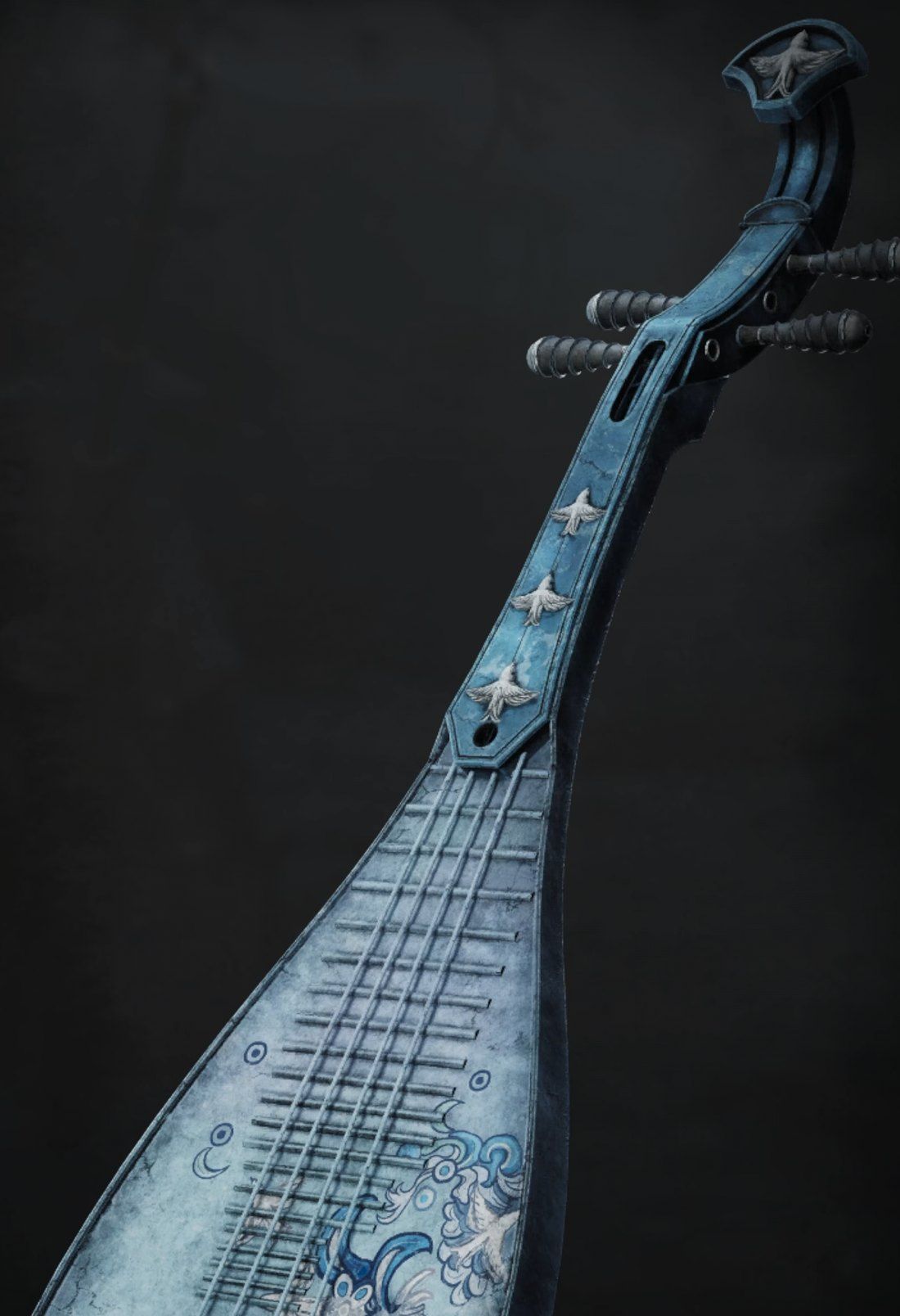
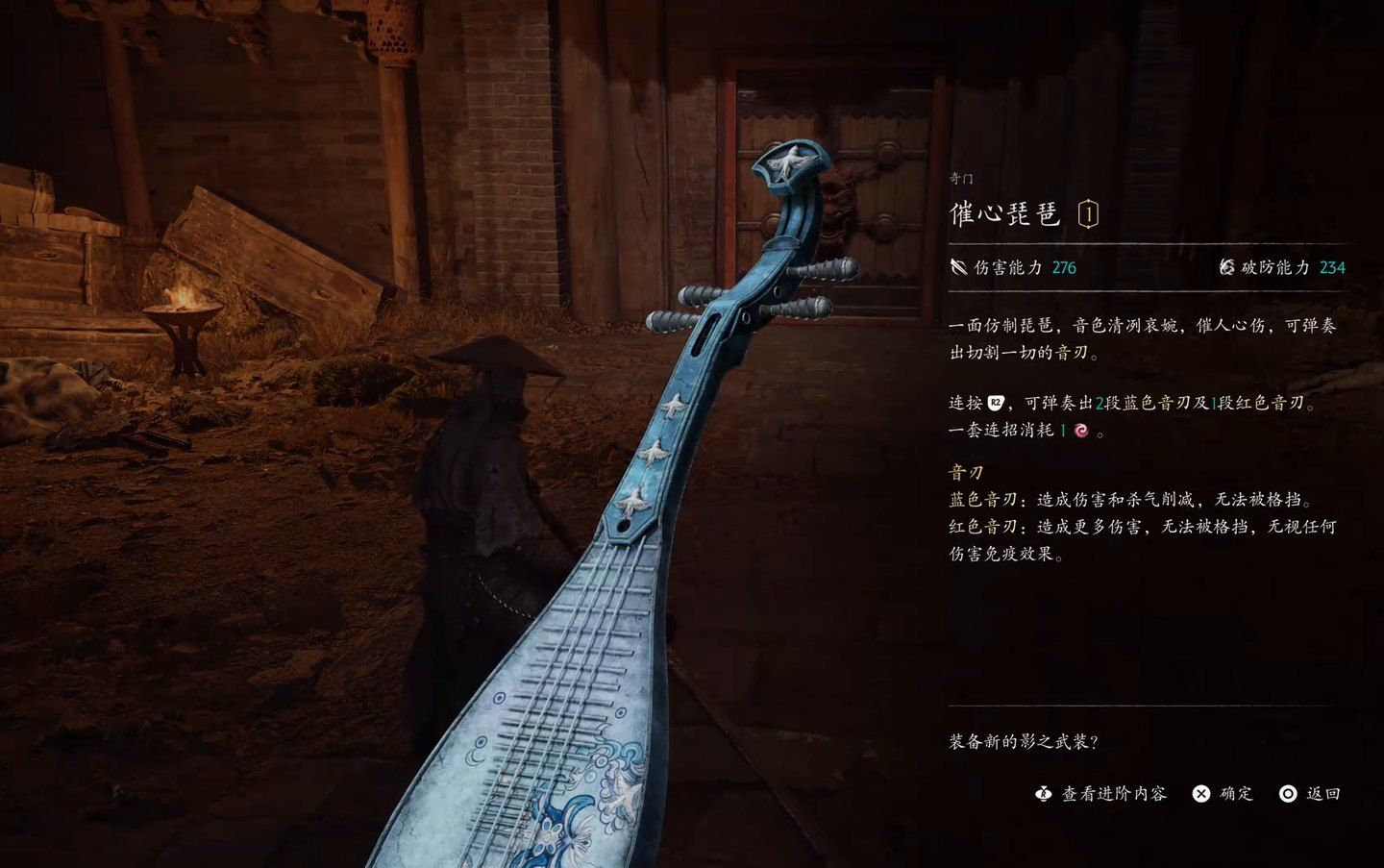
An Artifice Phantom Edge: “an exquisite pipa once wielded by Musician Puppet Yuzan” (item card), “a replica pipa with a clear, mournful tone that rends the heart” whose music releases Sonic Blades “sharp enough to cut through anything” (lore), at one Remnant Spark per full combo. The blue blades strike Sha-Chi and cannot be blocked; the red one strikes HP. It is won from Yuzan, No. 3 Musician Puppet, a puppet that looks almost like the Chord’s twin, in the Puppet Testing Grounds under the Well of the Three Puppets in the Village of Lu, once Bi Yuan and Bi Hai have fallen. Its Soul Tempering is not a material swap: find the three missing parts of the original (head, backplate and strings) and Myst rebuilds “the Chord’s reforged Illusory Pipa” (幻术琵琶), which dispels Phantom Barriers and can take control of weaker enemies. The original belonged to the Chord, Inanis’s daughter.
Game build vs the real pipa
First the Heartrend Pipa in S-GAME’s own footage, then the same weapon drawn over a 1:1 pipa: switch tabs to compare it with the real thing, and pick any part to see what changed.
Game images © S-GAME, from the official website, official footage and retail in-game screens; tap an image to see its source.
Anatomy plate
催心琵琶 Game build
琵琶 The real weapon
催心琵琶 Game build
卷首与扇形顶板 juǎn shǒu yǔ shàn xíng dǐng bǎnScroll head & cap plateChanged
Still a head bent back, but drawn out into a long swan-neck scroll, double-grooved, lashed with cord where it leaves the pegbox, that curls away from the player and ends in a fan-shaped cap plate with a concave outer edge, wider than the neck (item renders; inset). The Tang head is a short, sharp bend.
弦轴 xián zhóuTuning pegsChanged
Four pegs, two each side, as on the real pipa, but staggered along the pegbox and turned in near-black iron: a thin shank, then a swelling grip with spiral ribs and a rounded silver cap, with a pale ring where each enters the box. A framed slot opens in the pegbox face at its neck end (item renders).
琴颈 qín jǐngNeckChanged
Longer than the Tang neck and bare: no 相 frets and no strings run along it. Its flat blue face, edged with darker raised rails and split by a thin centre line, ends on the body in a pointed tongue with a small hole (item renders). As drawn in the game, nothing on the neck could be stopped with a finger.
银鹤 yín hèSilver cranesAdded
Added ornament with no counterpart on the real pipa: three small silver birds with spread wings in relief down the neck, flying toward the head (cranes, by the painting), and a larger one on the cap plate (item renders). More cranes fly in the painting on the body.
弦枕 xián zhěnString barChanged
The strings do not reach the pegbox. In the item renders they come out from under the tip of the neck tongue, on the body itself, so the string rest sits a whole neck-length below where the Tang nut was.
品 pǐnFrets on the bodyChanged
The low frets of later pipa, crowded together: about twenty pale bars, nearly as wide as the board and shortening steadily toward the tail, across the upper body under the strings (item renders). The Tang pipa had none; the modern pipa’s 品 are fewer and spaced wider.
蓝漆面板 lán qī miàn bǎnBlue lacquered soundboardChanged
A pale blue, worn lacquered face, darker blue at the edges, painted low down with a mass of cobalt wave crests with white foam, clouds and white cranes, with separate ring and crescent marks either side of the frets (item renders). The pear outline is narrower than the Tang body, widest well toward the tail (gameplay frames). The card calls it 一面仿制琵琶, “a replica pipa”.
琴背与包边 qín bèi yǔ bāo biānBowl back & edgeKept
Kept: a hollow, rounded bowl back under a flat face. In the game the back and the rim around the face are a dark blue-black (item renders; the back is seen as a dark round bowl in gameplay).
弦 xiánStringsKept
Kept: four strings, close together, running down the body from the bar (item renders). The renders crop the lower body, so where they are tied off is not seen; they fade out here.
半月 bàn yuèMoon holesDropped
Gone. No crescent sound holes show on the painted board in any item render. Shown as ghosts where the Tang pair sits.
捍拨 hàn bōPlectrum guardDropped
Not seen: no separate leather or tortoiseshell guard panel shows; the painting covers the board itself. Shown as a ghost where the Tang guard sits.
拨 bōPlectrumDropped
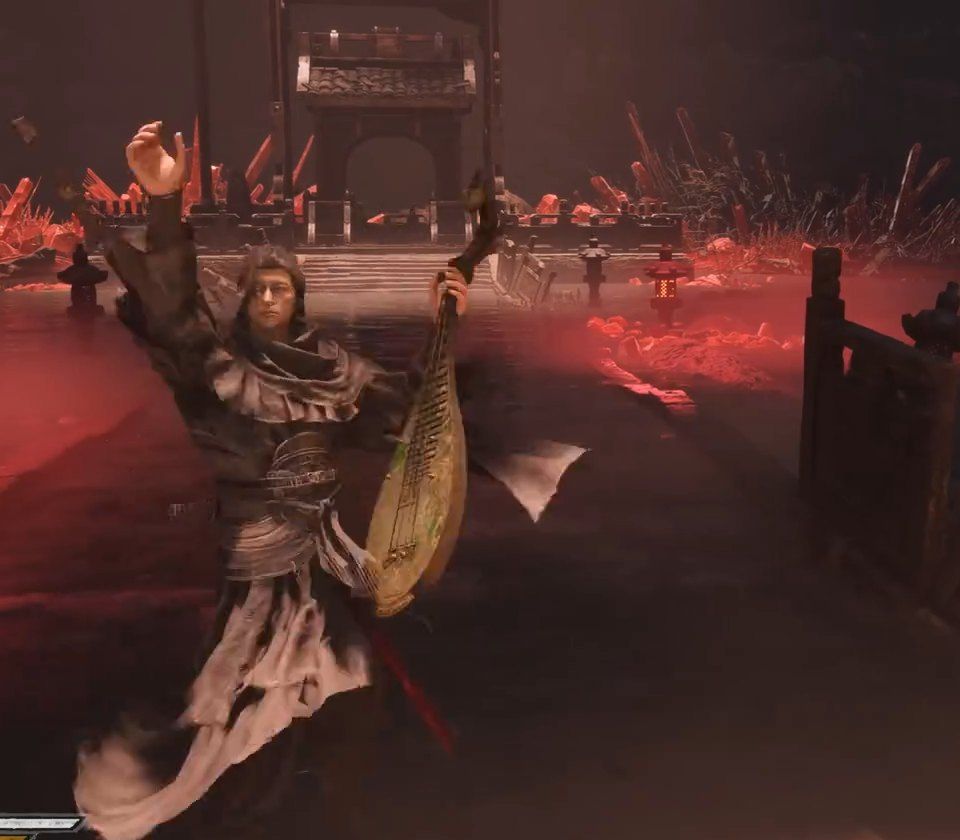
Gone. Soul plays with his bare hand and swings the instrument itself; no plectrum appears in the gameplay we checked.
The Heartrend Pipa from Phantom Blade Zero, lying face up like the Tang pipa it is compared with, at the same scale (about 110 cm head to tail: our estimate from Soul’s hand and figure; the frames allow roughly 1.0–1.35 m). Every part is tagged: kept from the real pipa, changed, or added by the game; switch on “dropped” to see what S-GAME left out. Head, neck and the top of the body are traced from the retail item cards; the body’s full outline comes from in-hand gameplay, because every item render crops the lower body.
琵琶 The real weapon
曲项 qū xiàngBent-back head
The head bends back almost at a right angle. That bend gives the “crooked-neck pipa” its name, and it shows best side-on, in the inset. The form came from West and Central Asia; Chinese sources link its arrival to Kucha (龟兹). The angle makes the strings bear down hard on the nut. On the Shōsōin pipa the head ends in a curled tip the Japanese call the “shrimp tail” (海老尾).
弦轴 xián zhóuTuning pegs
Four pegs, two on each side, push through the walls of the pegbox, and each string winds onto one. Friction alone holds them, so the player retunes by turning a peg and pressing it home. The Shōsōin’s Japanese name for them is tenju (転手, “turning hands”).
山口 shān kǒuNut
The raised ridge where the strings leave the neck for the pegbox. It sets their height above the frets and marks one end of their sounding length; the 覆手 marks the other. The Shōsōin records call this piece 乗絃 (“string rest”).
琴颈与相 qín jǐng yǔ xiàngNeck & frets
A short neck carrying the frets called 相 (xiàng). The Tang pipa had just four, tall ridges of wood: the Shōsōin instruments are all “four strings, four frets” (四弦四柱). Pressing a string just behind a fret shortens it, so four frets on four strings gave the notes of a Tang mode. The modern pipa has six 相 on the neck.
品 pǐnSoundboard frets (later)
Drawn dotted because the Tang pipa did not have them. Later centuries added low frets called 品 down the soundboard; old instruments carried four 相 and 13 to 15 品, and the modern pipa has six 相 and 18 to 30 品. Over the same centuries the instrument was turned upright and played with the fingers, with false nails, instead of a plectrum.
面板 miàn bǎnSoundboard & moon holes
A thin board glued over the hollow body: it is what vibrates and makes the sound. Tang pipa have two crescent sound holes, the 半月 (“half moons”), which survive on the Japanese gaku-biwa, a near twin of the Tang instrument. Today’s pipa soundboards are paulownia (泡桐, 桐木).
捍拨 hàn bōPlectrum guard
A panel of leather or tortoiseshell across the face where the plectrum strikes, so the hard plectrum doesn’t scar the soft soundboard. Because it sat in plain view it was painted. One Shōsōin pipa shows musicians riding an elephant, probably painted in China in the eighth century; the five-string pipa has a camel rider who is himself playing a pipa. The scene here is our own sketch of that subject.
覆手 fù shǒuString holder
A hardwood bar glued to the soundboard near the tail. The strings are tied through it, and it passes their pull into the body. Makers still use the old name, along with the variant 缚手 (“tying hand”).
弦 xiánStrings
Four strings of twisted silk, thick to thin. In Bai Juyi’s “Song of the Pipa” (琵琶行, 816) the player ends a piece by sweeping the plectrum across all four at the centre of the board: 曲终收拨当心画,四弦一声如裂帛, “four strings, one sound, like tearing silk”. Modern pipa use metal strings.
背板 bèi bǎnBowl back
The body is a bowl hollowed from hardwood with the soundboard laid over it, so from the side the pipa is a half pear (inset). Most of the Shōsōin pipa have backs of zitan (紫檀) inlaid with mother-of-pearl and tortoiseshell. Modern makers use rosewood, redwood or other hard woods.
拨 bōPlectrum
Tang players struck the strings with a large plectrum held in the whole hand. The Shōsōin also keeps plectrums of red-stained, engraved ivory (紅牙撥鏤撥). The Han dictionary Shiming explains the instrument’s very name by the stroke: 推手前曰枇,引手却曰杷, “pushing the hand forward is pi, drawing it back is pa”.
A pear-shaped lute with a short neck, four silk strings and a head bent sharply back: the “crooked-neck pipa” (曲项琵琶) that came into China along the Silk Road and became the star of Tang court music. Tang players held it across the lap and struck it with a large plectrum. The Shōsōin in Nara keeps five eighth-century pipa: four are four-string instruments of this kind, while the famous fifth, the five-string pipa, is a different, straight-necked instrument. The pipa was never a weapon. Its fighting career is literary, from the magic pipa of Investiture of the Gods to the sonic killers of wuxia. Pick a part to see what it does.
The Heartrend Pipa from Phantom Blade Zero, lying face up like the Tang pipa it is compared with, at the same scale (about 110 cm head to tail: our estimate from Soul’s hand and figure; the frames allow roughly 1.0–1.35 m). Every part is tagged: kept from the real pipa, changed, or added by the game; switch on “dropped” to see what S-GAME left out. Head, neck and the top of the body are traced from the retail item cards; the body’s full outline comes from in-hand gameplay, because every item render crops the lower body.
What the name means
| Character | Pinyin | Meaning |
|---|---|---|
| 琵 | pí | the push-out stroke of the playing hand (per the Han dictionary Shiming) |
| 琶 | pá | the pull-back stroke |
| 催心 | cuīxīn | “to wring the heart”: the Chinese card’s own words are 催人心伤, “wringing the heart with grief” |
| Heartrend | — | English name only: “heart-rending”, from the card’s “mournful tone that rends the heart” |
In Phantom Blade Zero
- Slot
- Phantom Edge · Artifice (奇门 on the Chinese card)
- Input / cost
- R2 repeatedly: two blue Sonic Blades, then one red; full combo = 1 Remnant Spark
- Blue Sonic Blade
- Damage and Sha-Chi drain; unblockable
- Red Sonic Blade
- More damage; unblockable; ignores all Damage Reduction
- Perks
- Lv 5 Evasive Pluck · Lv 10/20/30 Ringing Steel · Lv 15 Harmonic Shift · Lv 25 Formation-Breaking Song
- How to get
- Defeat Yuzan, No. 3 Musician Puppet, under the Well of the Three Puppets, Village of Lu
- Stats
- Level 1: Damage 276 · Guard Break 234; level 30: 1076 · 913
- Soul Temper
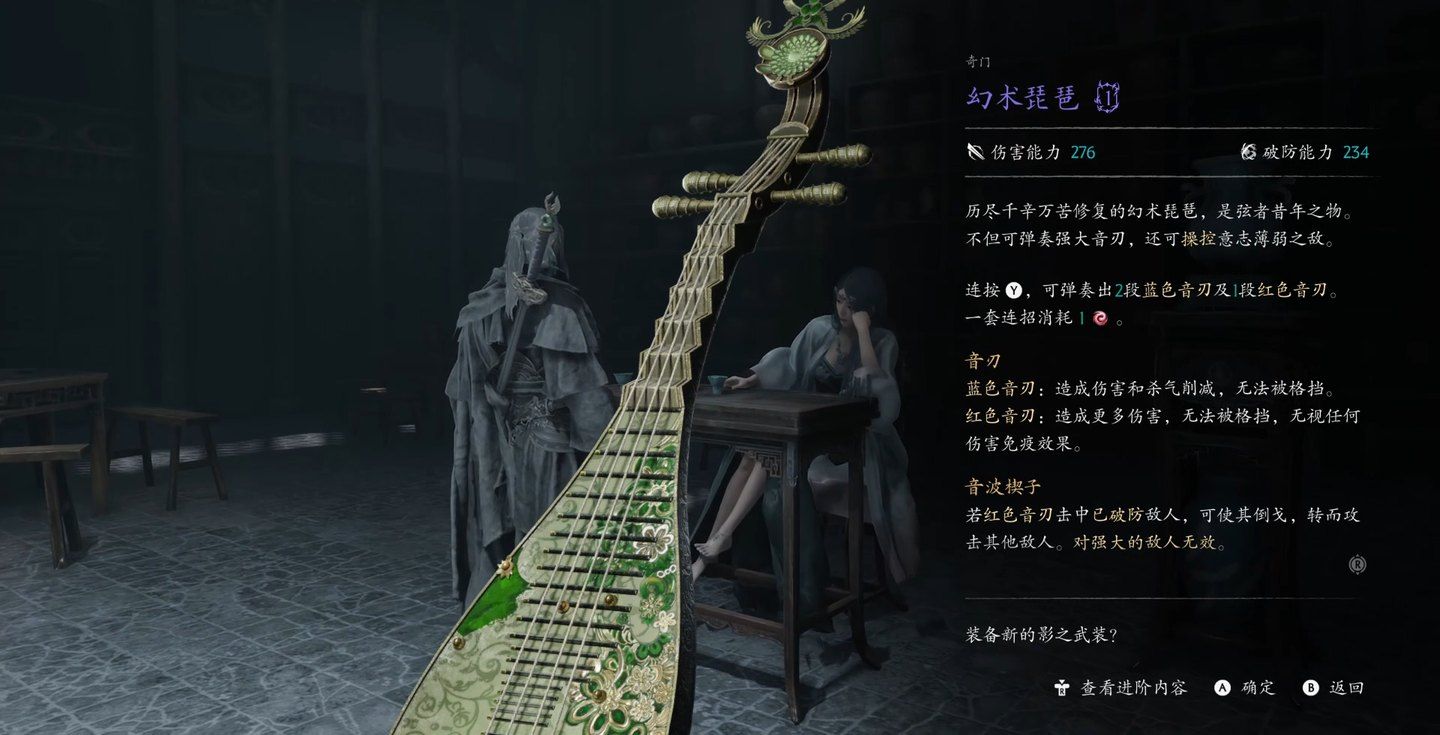
- Illusory Pipa (幻术琵琶), the Chord’s restored original: three parts, repaired by Myst; adds Sonic Mindseal and Mist Dispersion
- Chinese name
- 催心琵琶 (game data and the Chinese new-item card)
- Real counterpart
- The pipa lute (琵琶), an instrument, never a weapon
The Heartrend Pipa (催心琵琶, “the pipa that wrings the heart”) is an Artifice Phantom Edge you take from a boss in the Village of Lu. Its card first flashed past for about a second in S-GAME’s State of Play deep dive of August 2026; the retail game names it in both clients. The card calls it “An exquisite pipa once wielded by Musician Puppet Yuzan”, and the lore line reads: “A replica pipa with a clear, mournful tone that rends the heart. Its music can release Sonic Blades sharp enough to cut through anything.” The Chinese says the same: 一面仿制琵琶,音色清冽哀婉,催人心伤,可弹奏出切割一切的音刃。
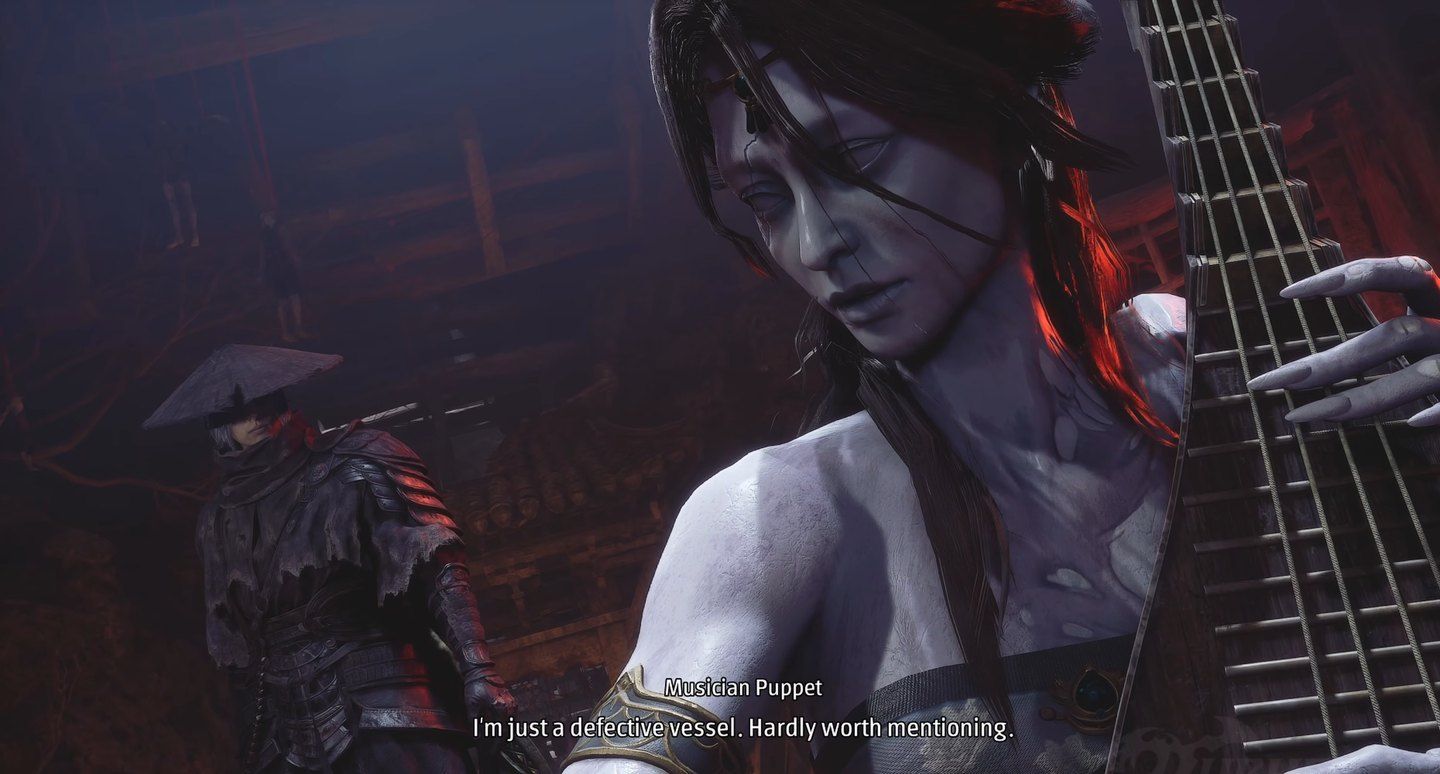
How to get it. After the fights with Bi Yuan and Bi Hai, return to the Well of the Three Puppets in the Village of Lu, drop down and defeat Yuzan, No. 3 Musician Puppet (三号·乐师偶:“玉瓒”). In the cutscene before the fight she sits with a dark wooden pipa and calls herself “just a defective vessel”. The new-Phantom-Edge card appears as soon as she falls: level 1, Damage 276, Guard Break 234.
How it works. Press R2 repeatedly for a three-stage combo: two blue Sonic Blades (音刃), then one red. A full combo costs 1 Remnant Spark (暗源). Blue blades deal damage and drain the enemy’s Sha-Chi; red blades deal more damage and ignore all Damage Reduction. Neither can be blocked, so one button both breaks a guard and finishes. In play, Soul swings the instrument like a club as often as he plucks it. Upgrades: Evasive Pluck (转轴拨弦, level 5), fire Sonic Blades straight out of a side dodge; Ringing Steel (金戈鸣, levels 10, 20 and 30), more Sha-Chi drain from blue blades and more damage from red; Harmonic Shift (移商换羽, level 15), the same out of a forward dash or a backstep; Formation-Breaking Song (破阵曲, level 25), hold L1 + R2 to sit and play on and on, pouring blue and red blades forward while Remnant Spark drains. At level 30 the untempered card reads Damage 1076, Guard Break 913.
The Chinese perk names are a small anthology of pipa writing. 转轴拨弦, “turning the pegs and plucking the strings”, is a line of Bai Juyi’s Song of the Pipa (琵琶行): “Turning the pegs, plucking the strings, two or three notes; before any tune takes shape, the feeling is already there” (轉軸撥絃三兩聲,未成曲調先有情). The same poem hears the pipa break out like cavalry: “Iron horsemen burst out, blades and spears ringing” (鐵騎突出刀槍鳴), which is exactly what 金戈鸣, “ringing steel”, makes literal. 移商换羽 shifts between the notes shang and yu of the old five-note scale, an idiom for changing key. 破阵曲 calls up a battle song, “a tune to break the enemy line”.
The Illusory Pipa. The Heartrend Pipa is a copy. The original belonged to the Chord (弦者), and its Soul Tempering is not a material but a rebuild: the restored Illusory Pipa (幻术琵琶) is, in the client’s words, “The Chord’s reforged Illusory Pipa. Grants the ability to dispel Phantom Barriers and control weaker enemies.” The Chinese card adds 历尽千辛万苦修复的幻术琵琶,是弦者昔年之物, “restored after countless hardships, it once belonged to the Chord”. It keeps the same Sonic Blades and adds Sonic Mindseal (音波楔子): a red blade that hits a Guard-Broken enemy turns it against its allies, though not powerful enemies. It also adds Mist Dispersion: playing it clears Phantom Barriers in the world, even when it is not equipped. You collect three parts: the head from the hidden boss Dusk, the Puppeteer in the Village of Lu, who appears once you have all six of Firefly’s Memory Flowers; the backplate after the Yubi fight in the Mandate Encampment; and the strings from Yan Qiansui, the Zither Maiden, who appears by the Meigu Songhouse dock once you have gathered Yan’er’s six Memory Flowers. (Gamersky’s quest guide gives the head to Bai Chilian instead; 游侠 and the English guides agree on Dusk, and her broken pipa is what starts the hunt.) Then Myst (幻鬼) repairs it at Myst’s Tavern (幻鬼酒馆) in Pangzhen. The restored pipa is a different model: green, inlaid with flowers, with stepped frets on its neck.
The instrument also runs through the rest of the game. Composer Bo Caisheng uses the pipa in the score for the menace of Ambush from Ten Sides as well as for calm. Soulframe Liang has cited the sonic attacks of the Six-Fingered Qin Demon (六指琴魔) as an example of weapons that express emotion. Whether that figure is linked to the Heartrend Pipa is not on record.
Watch it in action
 Phantom Blade Zero - Soul vs Yuzan Boss Fight
 Phantom Blade Zero - All Village of Lu Weapons & Phantom Edges Locations
 How to get Illusory Pipa FULL GUIDE Phantom Blade Zero
 Phantom Blade Zero - All Weapons & Phantom Edges Showcase [4K 60FPS]
 Enter the Wulin: Gameplay & Story Deep Dive of Phantom Blade Zero
 Phantom Blade Zero Has a Lute, a Lion’s Head and a Golden Melon. Which Ones Are Real?
 【龍音】《十面埋伏》琵琶獨奏:劉德海 LIU De-hai (Pipa Solo)
Videos belong to their channels; some footage is from the 2025 demo build and may differ from the retail game.
The real culture behind it
The pipa (琵琶) is a pear-shaped plucked lute that reached China from Central Asia. The Eastern Han dictionary Shiming says it “came from the Hu peoples and was played on horseback”, and that its name imitates the hand: 推手前曰枇,引手却曰杷, “pushing forward is pi, pulling back is pa”. By the Tang it was the star of court and banquet music: a five-stringed Tang-style pipa inlaid with mother-of-pearl survives in Japan’s Shōsōin, dedicated in 756, and a mural dancer in Dunhuang’s Mogao Cave 112 plays one behind her back (反弹琵琶).
It was never a weapon, but Chinese writers have long heard battle in it. In Bai Juyi’s “Pipa xing” (816) the climax sounds like “armoured horsemen charging out, blades and spears ringing” (铁骑突出刀枪鸣), and the solo piece Ambush from Ten Sides (十面埋伏) plays out the siege of Xiang Yu at Gaixia in 202 BCE. Fiction made the next step: in Investiture of the Gods the Heavenly King Mo Lihai plucks a four-stringed pipa “and wind and fire arrive together”. Soulframe Liang has also pointed to the sonic attacks of the Six-Fingered Qin Demon as the kind of weapon that expresses emotion. Placing the Heartrend Pipa in that line is our reading.
The game quotes Bai Juyi itself. In the Chinese client the pipa’s level-5 trait (Evasive Pluck in English) is called 转轴拨弦, from the same poem: 轉軸撥絃三兩聲,未成曲調先有情, “she turns the pegs and plucks the strings two or three times; before a tune takes shape, feeling is already there.” The level-10 trait, 金戈鸣 (Ringing Steel), “the clash of spears”, sounds like the poem’s armoured horsemen; that link is ours.
Heartrend Pipa: FAQ
Q01What is the Heartrend Pipa in Phantom Blade Zero?
Q02How do you get the Heartrend Pipa?
Q03How does the Heartrend Pipa work?
Q04How do you get the Illusory Pipa?
Q05How close is the Heartrend Pipa to a real pipa?
Q06Was the pipa ever used as a weapon?
Go deeper
- Flying Guillotine, Flying Daggers & China's Hidden WeaponsWas the flying guillotine real? The Yongzheng legend, the 1970s films, real sleeve arrows and flying knives, and how Phantom Blade Zero puts both in Soul's hands.
- Chinese Mythology & Folklore in Phantom Blade ZeroIs Phantom Blade Zero based on Chinese mythology? The real folk rites behind it: nuo masks, puppets, processions, red threads, the Lady of the Veil and the Lóng.
- What Is Wuxia? Meaning, Pronunciation & Phantom Blade ZeroWuxia (武侠, wǔxiá) means “martial chivalry”: Chinese tales of wandering sword-heroes. Its meaning, pronunciation, 2,000-year history and place in Phantom Blade Zero.
- Phantom Blade Zero Weapons & Their Real Chinese OriginsAll 25 main weapons and 24 Phantom Edges in Phantom Blade Zero, with official English and Chinese names, where each one drops, and the real Chinese weapon behind it.
In the archive
Texts and memories in the game that name this
Sources & further reading
- Phantom Blade Zero (official) — Enter the Wulin: Gameplay & Story Deep Dive (State of Play, 18 Aug 2026)
- Gamersky: Soulframe Liang on Gu Long’s influence (30 Jul 2025)
- Liu Xi, Shiming 釋名, chapter 7 “Explaining musical instruments” (Wikisource)
- Bai Juyi, “Pipa xing” 琵琶行 (816) (Wikisource)
- Investiture of the Gods 封神演義, chapter 40 (Wikisource)
- Pipa (Wikipedia)
- th.gl Phantom Blade Zero database — Phantom Edges, retail game data in English and Chinese
- 游民星空 Gamersky — 《影之刃零》全影之武装获取攻略 (24 pages, Oct 2026)
- th.gl game data — Heartrend Pipa / 催心琵琶 (EN and zh-CN record, lore, perks, Soul Tempering)
- 游民星空 — 《影之刃零》全影之武装获取攻略, p. 9 (催心琵琶) and p. 19 (幻术琵琶)
- Fallw1nd-津秋 (Bilibili) — 【影之刃零】逆天者白金全收集实况15 (31 Oct 2026; Chinese Yuzan boss bar and 催心琵琶 card, about 10:19)
- 髓熠 (Bilibili) — 影之刃零幻术琵琶任务攻略 (30 Oct 2026; 幻术琵琶 card 4:40)
- 爱玩游戏的pp (Bilibili) — 《影之刃零》全满级影之武装演示 (30 Oct 2026; level-30 催心琵琶 card and gameplay 0:00–0:20)
- HarryNinetyFour — All Village of Lu Weapons & Phantom Edges Locations (29 Oct 2026; Heartrend Pipa card 2:25)
- Ben-Gun — All Weapons & Phantom Edges Showcase (Illusory Pipa card 15:15)
- Perfect Score — How to Repair The Illusory Pipa (1 Nov 2026)
- Fextralife wiki — Illusory Pipa (fan wiki)
- ChuApp 触乐 — interview with composer Bo Caisheng (12 Dec 2025)
- Gamersky — pre-order screening Q&A with Soulframe Liang, Bo Caisheng and Michael (12 Aug 2026)
Game details come from official material and press coverage; names marked “fan reading” will be checked against the retail build. Anything labelled as our reading is interpretation, not a developer statement.