Craft dossier · Legend
Gan Jiang and Mo Ye: China's Legendary Swordsmith Couple
干将 · 莫邪Gān Jiāng · Mò Yé
Who were Gan Jiang and Mo Ye? The smith couple behind China's famous paired swords, how the legend changed from Zhuangzi to Lu Xun, and Phantom Blade Zero's Forge.
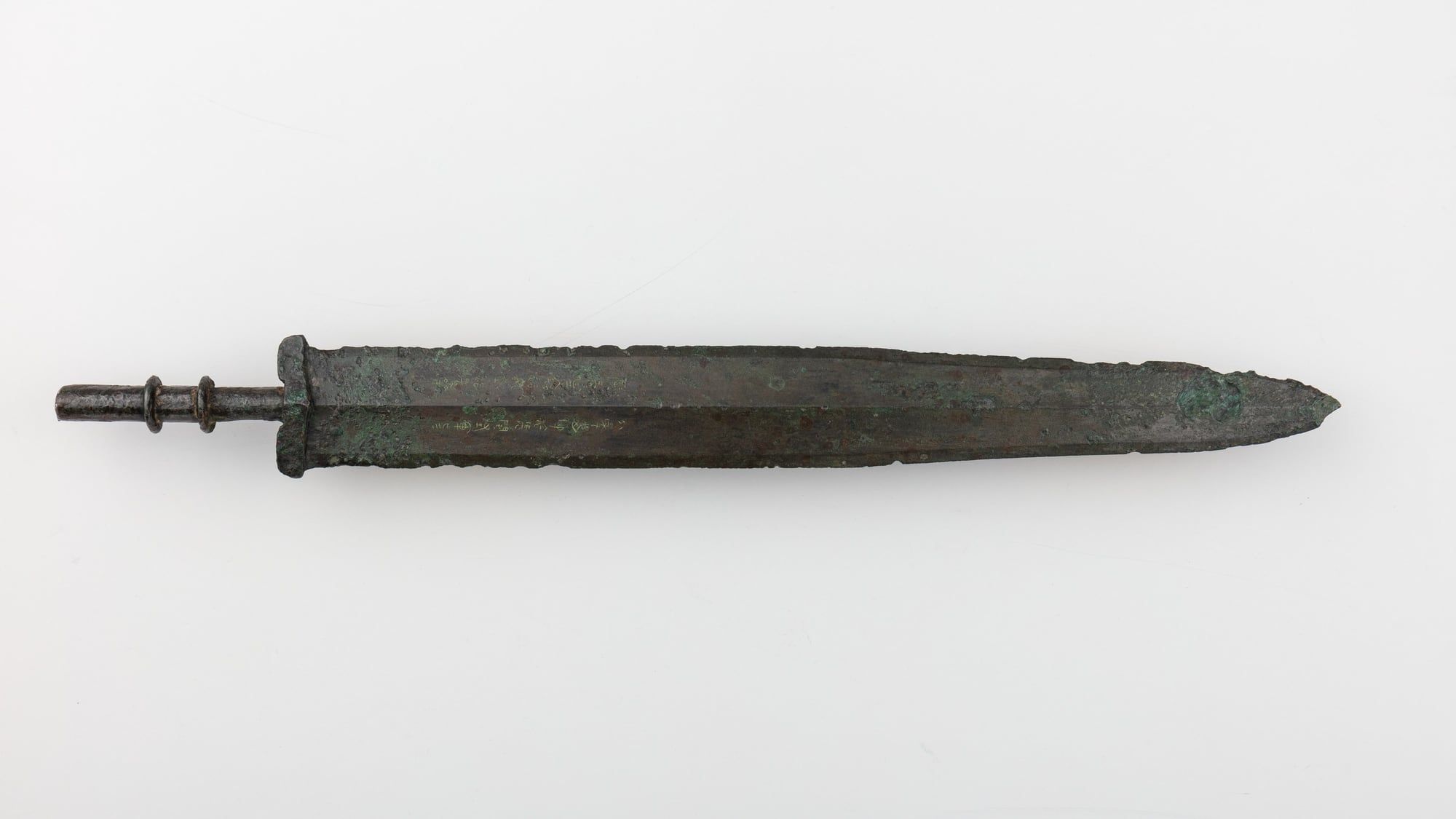
Key facts
- Gan Jiang and Mo Ye (干将, 莫邪) are a legendary husband-and-wife pair of swordsmiths from the state of Wu whose names became the names of China's most famous pair of swords.
- The names came first: Zhuangzi (4th c. BCE) uses Moye as a byword for a perfect blade, and Xunzi (3rd c. BCE) lists Ganjiang and Moye among King Helü of Wu's swords.
- The Wu Yue Chunqiu (1st c. CE) adds the couple: the iron would not melt until Mo Ye cut off her hair and nails and threw them into the furnace. In that text she does not leap in herself.
- The swords were a pair: the yang sword Ganjiang bore a tortoise-shell pattern, the yin sword Moye a flowing grain, and Gan Jiang hid the yang blade from the king.
- Gan Bao's In Search of the Supernatural (4th c. CE) turns it into a revenge story with a boiled head and a Tomb of the Three Kings, which Lu Xun retold in 1927 as “Forging the Swords”.
- Chinese
- 干将 (Gān Jiāng) · 莫邪 / 莫耶 / 镆铘 (Mò Yé)
- What they are
- A legendary smith couple and the paired swords named after them
- Patron
- King Helü of Wu (r. 514–496 BCE); the King of Chu in later versions
- The swords
- Yang (male) Ganjiang, tortoise-shell pattern; yin (female) Moye, flowing grain
- Earliest mention
- Zhuangzi, “The Great and Venerable Teacher” (4th c. BCE)
- Key texts
- Wu Yue Chunqiu (1st c. CE); In Search of the Supernatural (4th c. CE); Lu Xun, “Forging the Swords” (1927)
- Place names
- Mount Mogan (莫干山), Zhejiang, named after the pair by Ming times
Gan Jiang and Mo Ye are China’s legendary swordsmith couple: a smith of the state of Wu and his wife, who forged a pair of swords for King Helü and gave the blades their own names. Their story is two thousand years old, and it keeps changing. The furnace that will not melt, the woman who feeds it part of herself, the hidden male sword and the son who avenges his father were added one telling at a time.
Phantom Blade Zero puts a woman at its anvil too. The first artisan Soul meets, at the Outpost in Weeping Creek Valley, is the smith Forge, 炼邪 in Chinese, who looks him over and finds him “not much to look at”. China’s most famous smith legend also turns on a woman at the furnace. Gan Jiang worked as one of a couple, and the metal only flowed because of his wife.
- KING
- Helü of Wu
- TIME AT THE FORGE
- 3 months
- INTO THE FURNACE
- Mo Ye’s hair and nail clippings
One legend, five versions
Zhuangzi
No couple and no story yet. Moye is simply the byword for a perfect blade: metal that leaps up in the crucible shouting “I must become a Moye!” is, says the great smith, ill-omened metal.
今大冶铸金,金踊跃曰:“我且必为镆铘!”大冶必以为不祥之金。
Xunzi
Ganjiang and Moye are now named swords of King Helü of Wu (r. 514–496 BCE), listed among the fine blades of antiquity. Xunzi’s point: even they cut nothing without the whetstone.
阖闾之干将、莫邪、钜阙、辟闾,此皆古之良剑也;然而不加砥厉则不能利。
Wu Yue Chunqiu
Now they are people: Gan Jiang of Wu and his wife Mo Ye. The iron will not melt. Gan Jiang recalls that his own master and his master’s wife once climbed into the furnace; Mo Ye throws in her hair and nail clippings instead, 300 boys and girls work the bellows, and the metal flows. He hides the yang sword and presents the yin.
于是干将妻乃断发剪爪,投于炉中……遂以成剑,阳曰干将,阴曰莫耶,阳作龟文,阴作漫理。
In Search of the Supernatural
The forge moves to Chu, the deadline becomes three years and the king kills the smith. Their son Chi, the boy with “a foot between his brows”, gives his head and the hidden male sword to a stranger, who boils it before the king and beheads him into the cauldron. Three heads, one tomb.
客以剑拟王,王头随堕汤中;客亦自拟己头,头复堕汤中。三首俱烂,不可识别。
Lu Xun, “Forging the Swords”
China’s great modern writer retells the revenge as a dark, deadpan fable: the iron was born to the queen, the son is sixteen-year-old Mei Jian Chi, and the stranger, a man in black, sings in the cauldron.
“这是雄剑。你收着。明天,我只将这雌剑献给大王去。”
Names before people
The two names began as names of swords. In the Zhuangzi, written in the 4th century BCE, a sage compares a man who demands to be reborn human to molten metal that jumps in the crucible and shouts that it must become a Moye:
今大冶铸金,金踊跃曰:“我且必为镆铘!”大冶必以为不祥之金。
Suppose a master smith is casting metal, and the metal leaps up and says, “I must be made into a Moye!” The smith would surely think it ill-omened metal.
A generation or two later Xunzi lists “Helü’s Ganjiang, Moye, Juque and Pilü” as the fine swords of antiquity. Xunzi only wanted a metaphor for education: even those blades will not cut without the whetstone. At this stage nobody has a wife, a furnace or a grudge. What existed was the fame of the southern states of Wu and Yue for swords. That fame was real. Bronze blades like the Sword of Goujian still look sharp after 2,500 years in the ground.
The furnace that would not melt
The couple first appear in full in the Wu Yue Chunqiu, the “Spring and Autumn Annals of Wu and Yue”, compiled by Zhao Ye in the 1st century CE. Gan Jiang is a man of Wu who trained under the same master as Ou Yezi, the smith of the Longquan legend. King Helü has him forge two swords. Gan Jiang gathers “the iron essence of five mountains and the golden flower of the six directions” and waits for the right signs from heaven and earth, yet for three months the metal will not flow.
Mo Ye asks what is missing. Gan Jiang remembers that when the same thing happened to his teacher, “husband and wife both entered the furnace, and then the work was done.” Mo Ye answers that if the master could melt his own body to finish a sword, her part is easy:
于是干将妻乃断发剪爪,投于炉中,使童女童男三百人鼓橐装炭,金铁乃濡。遂以成剑,阳曰干将,阴曰莫耶,阳作龟文,阴作漫理。
So Gan Jiang’s wife cut off her hair and pared her nails and threw them into the furnace. Three hundred boys and girls worked the bellows and fed the charcoal, and the metal melted. The swords were finished: the yang one called Ganjiang, the yin one called Moye. The yang bore a tortoise-shell pattern, the yin a flowing grain.
Hair and nails stand in for the body; she gives a part of herself, not her life. The famous image of Mo Ye leaping into the furnace is not in this text, and not in Gan Bao’s either. It belongs to later retellings, which merged her with the teacher’s wife who really does go into the fire.
The ending is quieter than you might expect. Gan Jiang hides the yang sword and presents only the yin. Helü treasures it. When an envoy from Lu draws it and finds a nick in the edge “the size of a millet grain”, he declines it as an omen that Wu will rise and then fall. Read the tortoise-shell and flowing patterns as storytelling, not metallurgy. Patterned blades did exist, but the text is pairing yang with yin and hard plates with water, not describing a forge.
Three years, one king and a boiled head
Three centuries later Gan Bao’s In Search of the Supernatural (Soushen ji) tells a darker story, and almost every detail changes.
| Wu Yue Chunqiu (1st c. CE) | Soushen ji (4th c. CE) | |
|---|---|---|
| State | Wu | Chu |
| Patron | King Helü | “The King of Chu” |
| Time at the forge | Three months and still no sword | Three years, and the king is furious |
| The furnace | Will not melt until Mo Ye’s hair and nails go in | No crisis, no sacrifice |
| The swords | Yang and yin, patterned | Male and female (雌雄) |
| Hidden blade | Gan Jiang hides the yang sword | The male sword is hidden behind a pine on a stone |
| Gan Jiang’s fate | Survives | Executed by the king |
| Ending | An envoy refuses the nicked sword | The son’s revenge and the Tomb of the Three Kings |
In Gan Bao’s version the smith knows the king will kill him for the late delivery, so he takes only the female sword to court and leaves his pregnant wife a riddle: “Go out the door, look at the southern mountain, a pine grows on a stone, the sword is at its back.” Their son Chi grows up, works out that the “pine on a stone” is a pillar of the house standing on its stone base, and digs out the male sword.
The king dreams of a boy whose brows are a foot apart and puts a bounty on his head. A stranger meets the weeping boy on a mountain road and offers to take revenge for him, if he hands over his head and sword. Chi cuts off his own head and holds it out in both hands with the sword, and his body stays standing until the stranger promises to keep his word. At court the stranger has the head boiled for three days; it will not soften, and it leaps out of the cauldron glaring. When the king leans over to look, the stranger strikes his head into the pot, then cuts off his own. The three heads boil together until no one can tell them apart. They were buried in one grave, the Tomb of the Three Kings.
The stranger is one of the great nameless avengers of Chinese literature, a cousin of the assassins whom Sima Qian had already made famous: he kills for someone else’s wrong and keeps nothing for himself.
From legend to Lu Xun
Lu Xun, the founder of modern Chinese fiction, finished his retelling on 3 April 1927. He first published it as “Mei Jian Chi” (眉间尺, “a foot between the brows”, the boy’s nickname), renamed it “Forging the Swords” (铸剑) in 1932 and collected it in Old Tales Retold (1936). His version is grim and darkly funny. The iron was born to the queen after she embraced an iron pillar. The son is a sixteen-year-old who cannot even decide whether to drown a rat. The stranger is a man in black who calls himself Yan Zhi Ao Zhe and sings strange songs from inside a golden cauldron. Gan Jiang’s last words to his wife follow Gan Bao closely: “This is the male sword. Keep it. Tomorrow I will present only the female sword to the king.”
The pair also went into the landscape. Mount Mogan (莫干山) in Zhejiang takes its name from them: a Ming-dynasty gazetteer records a sword-forging pool on the mountain and says that the King of Wu forged swords there, “hence the name, from Moye and Ganjiang.” Today it is a resort area with a Sword Pool, a Whetstone Rock and a Sword-Testing Stone for tourists.
Twin swords in games
Paired “married” swords still carry the names. Fate/stay night gives its Archer twin blades called Kanshō and Bakuya, the Japanese readings of 干将 and 莫耶. Honor of Kings has a playable hero named after the couple. Wo Long: Fallen Dynasty includes them among its legendary weapons. The pattern is always the same: two blades, male and female, made to be used together.
Two thousand years of retellings never settled the details: Wu or Chu, three months or three years, hair or a whole body. They all agree on one thing, that a great sword costs its maker something. That is why Gan Jiang and Mo Ye still turn up wherever someone hands a hero a blade.
Forge and Soul Tempering in Phantom Blade Zero
Phantom Blade Zero comes at the legend from the smithy. Its smith is Forge, 炼邪 (Liànxié, literally “refining the uncanny”) in the Chinese client, whom Shacknews’ review calls “a sturdy and blunt goddess of the anvil”. She introduces herself at the Outpost, the Mandate’s waystation in Weeping Creek Valley: “The name’s Forge. I serve under Lady Inanis as an artisan.” She is the eldest, by her own count, of three triplet sisters in Lady Inanis’s service. Meeting her unlocks weapon upgrades, which Soul then buys at any Bell with Remnant Dust, class metals and solvent. She also made two of his blades from the material of his own red sword, Sanguine: the two-handed Sanguine Reach and Sanguine Twin (黑伤双刃), “a pair of short-handled twin blades” whose “attacks fall like rain”.
The deeper work belongs to her sister Myst (幻鬼), who keeps the Order’s secret tavern in Pangzhen. Forge says Myst “uses Phantom Arts from the Discordance to draw out a weapon’s true power”. That is Soul Tempering (铸魂): once a weapon reaches its level cap, one unique material and 5,000 Remnant Dust transform it. Sanguine Twin becomes Shadowless Edge, and the material it takes, the Chaos Twin Daggers (混沌双铁), carries the story closest to this legend. Its item text describes a pair of daggers “identical in design”, forged in the Bastion of Mó and then parted. One drifted for years through the Discordance. The other went abroad and was reforged in a cruel owner’s hands until it no longer looked like itself. “Yet now that the twin blades are reunited, their resonance remains unbroken.”
Chinese sword lore has believed this for a long time: the two halves of a pair find each other. The Book of Jin (648) gives it its classic form. When the minister Zhang Hua received one of two swords dug up at Fengcheng, he wrote to the finder, Lei Huan: “I have studied the pattern on the blade: it is Ganjiang. Why has Moye not come too? Still, divine things born of heaven must come together in the end” (詳觀劍文,乃干將也,莫邪何復不至?雖然,天生神物,終當合耳). Years later both swords were gone, and a diver at the Yanping ford saw two dragons, each several zhang long, coiled on the riverbed.
S-GAME has not linked Forge, her twin blades or their tempering material to Gan Jiang and Mo Ye, and no game text we have read names the couple. The echo is our reading, and so is the one in her name: 炼邪 ends on the same 邪 as 莫邪. For what real Chinese smiths did at the anvil, see hundred-refined steel and the jian; the two swords Lei Huan dug up at Fengcheng were inscribed Longquan and Tai’a, and Longquan swords traces the first of those names.
Names in this article · Codex
Frequently asked
Q01Who were Gan Jiang and Mo Ye?
Q02Did Mo Ye throw herself into the furnace?
Q03Were the Ganjiang and Moye swords real?
Q04What is the Tomb of the Three Kings?
Q05Who is Forge (炼邪) in Phantom Blade Zero, and is she based on Mo Ye?
Q06What is Soul Tempering, and who does it?
Sources & further reading
- Wu Yue Chunqiu, “Inner Chronicle of Helü” — Zhao Ye, 1st century CE (Wikisource)
- In Search of the Supernatural (Soushen ji), juan 11 — Gan Bao, 4th century CE (Wikisource)
- Zhuangzi, “The Great and Venerable Teacher” — Wikisource
- Xunzi, “Human Nature Is Bad” — Xun Kuang, 3rd century BCE (Wikisource)
- Forging the Swords (鑄劍), in Old Tales Retold — Lu Xun, 1927 (Wikisource)
- Mount Mogan (莫干山) — Wikipedia (Chinese), citing the Jiajing-era Zhejiang gazetteer
- Book of Jin, juan 36: biography of Zhang Hua (the Longquan and Tai'a swords) — Fang Xuanling et al., 648 (Wikisource)
- Phantom Blade Zero review — Shacknews
- Forge and Myst: character pages quoting the launch game's dialogue — Kungfupunk (also /characters/myst), read 3 Nov 2026
- Sanguine Twin and Chaos Twin Daggers: game data records, EN and zh-CN — th.gl (item record /db/inventory/item_tu_15002)
- Upgrades Guide — Fextralife Phantom Blade Zero wiki
Cite this page
Wuxiapunk Editors. (2026, November 15). Gan Jiang and Mo Ye: China's Legendary Swordsmith Couple. Wuxiapunk. https://wuxiapunk.com/craft/gan-jiang-mo-ye/
“Gan Jiang and Mo Ye: China's Legendary Swordsmith Couple.” Wuxiapunk, 15 Nov. 2026, https://wuxiapunk.com/craft/gan-jiang-mo-ye/.
Keep reading
Hundred-Refined Steel: How Chinese Smiths Folded Steel
Chinese sword forging explained: cast iron, puddled steel, hundred-refined folding, co-fusion steel and composite blades, with original texts, dates and layer maths.
How Longquan Swords Are Forged: 2,600 Years of Craft
How Longquan swords are forged in Zhejiang: the Ou Yezi legend, the 2006 national heritage listing, each forging step with Chinese terms, and how to spot décor blades.
Jian: The Chinese Straight Sword, Explained
What a jian is, how China's double-edged sword went from bronze to steel, why it is the gentleman of weapons, and which jian Soul wins in Phantom Blade Zero.