Craft dossier · The smithy
Chinese Blacksmiths: The Real Trade Behind Phantom Blade Zero's Forge
铁匠tiějiàng
What did Chinese blacksmiths do? Song Yingxing's 1637 forge, the 30% iron loss, mud welding, Ming hereditary smiths, the Great Bell legend and PBZ's smith Forge.
Key facts
- A Chinese blacksmith (铁匠, tiějiàng) hammered hot iron into tools and weapons on an iron anvil, with a fire blown by box bellows; the classic description is Song Yingxing's Tiangong Kaiwu (1637).
- Song says fresh iron loses three parts in ten to scale under the hammer, scrap iron only one in ten, and that a smith's fire burned about 70% coal and 30% charcoal.
- Ming smiths forge-welded with yellow mud smeared on the joint and quenched hot iron in clear water to make 健钢, “strengthened steel”.
- Under the Ming, craftsmen were registered in hereditary artisan households (匠户) that owed labour to the state: resident artisans worked ten days a month.
- Phantom Blade Zero's smith is Forge (炼邪, Liànxié), eldest of Inanis's triplet artisans, who keeps her smithy at the Outpost in Weeping Creek Valley, upgrades Soul's weapons and made the Sanguine Twin and Sanguine Reach from the Sanguine's material.
- Chinese
- 铁匠 · tiějiàng (Song Yingxing also writes 锻工, “forging worker”)
- Key text
- Tiangong Kaiwu, “Hammering and forging” (锤锻), Song Yingxing, 1637
- Tools
- Anvil 砧, hammer 锤, tongs 钳, box bellows 风箱
- Fuel
- About 7 parts coal to 3 parts charcoal
- Forging loss
- 30% for fresh iron, 10% for recycled iron
- Legal status (Ming)
- Hereditary artisan households, resident or rotating
- In the game
- Forge (炼邪), smith of the Order; her sisters Myst (幻鬼, Soul Tempering) and Jewel (珍妖, jeweller)
A Chinese blacksmith heated iron in a fire blown by hand bellows and hammered it on an iron anvil into tools, weapons and fittings. The fullest picture of the trade comes from Song Yingxing’s Tiangong Kaiwu (天工开物, 1637), written in the last years of the Ming dynasty, which gives the smith’s fuel, his losses, his welding flux and his quench in a few hundred precise characters.
Phantom Blade Zero’s smith, Forge, is one of the first allies Soul meets on the road: a woman at an anvil in the Mandate’s Outpost in Weeping Creek Valley, who looks him over and is not impressed. The real smithy behind her is worth a visit. Try it first: pump the bellows, watch the colour of the bar, and do the three jobs Song describes.
Tiangong Kaiwu · at the anvil
凡治铁成器,取已炒熟铁为之。先铸铁成砧,以为受锤之地。谚云:“万器以钳为祖。”
“To make anything of iron, take iron that has already been puddled. First cast an anvil, the ground that takes the hammer. As the proverb says: ‘Of all tools, the tongs are the ancestor.’”
Song Yingxing, Tiangong Kaiwu, “Working iron” (1637)
- Heat
- —
- Colour
- —
- Iron left
- 100%
Strike Orange to yellow · about 980–1,260 °C
凡出炉熟铁,名曰毛铁。受锻之时,十耗其三为铁华、铁落。
Under the hammer, fresh “raw iron” loses three parts in ten as scale: “iron flowers” and “iron flakes”.
Weld with mud Yellow-white · about 1,260 °C and up
涂上黄泥于接口之上,入火挥槌,泥滓成枵而去……胶结之后,非灼红斧斩,永不可断也。
Smear yellow mud on the joint, heat and hammer, and the slag burns off; once joined, it never parts unless cut red-hot.
Quench From cherry red · about 815 °C and up
乘其出火之时,入清水淬之,名曰健钢、健铁。
Plunge it into clear water the moment it leaves the fire: this is called “strengthened” steel or iron.
Song Yingxing gives no temperatures. Colour bands follow Chapman’s steel heat-colour table (Workshop Technology); the heat for each job is modern smithing practice and approximate.
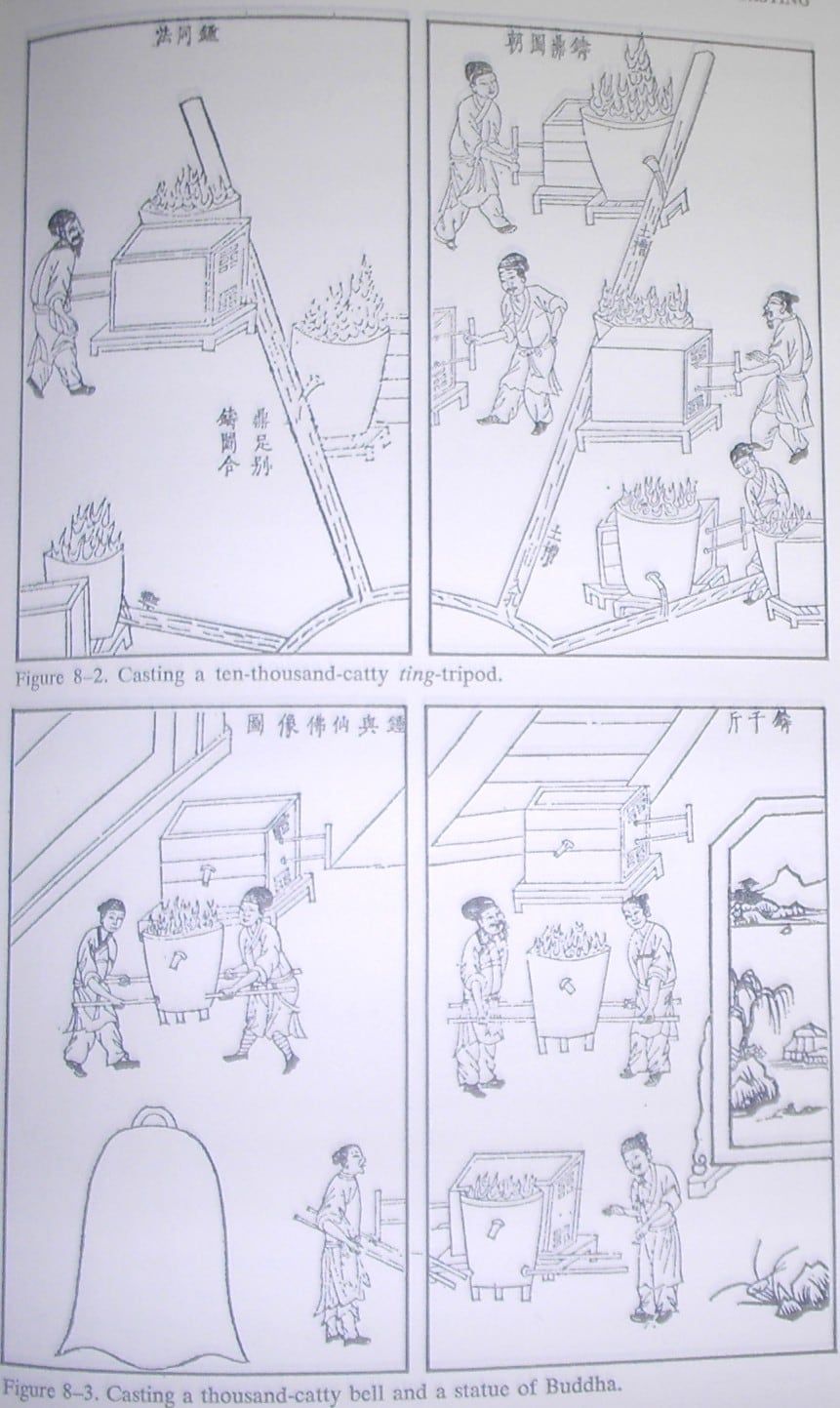
What a Ming smithy looked like
Song opens his chapter on hammering and forging (chuiduan ) with the anvil. Everything else follows from it.
凡治铁成器,取已炒熟铁为之。先铸铁成砧,以为受锤之地。谚云:“万器以钳为祖。”非无稽之说也。
To make anything of iron, take iron that has already been puddled. First cast an anvil, the ground that takes the hammer. The proverb says, “Of all tools, the tongs are the ancestor.” It is not idle talk.
The anvil (zhen ) was itself cast iron. The raw material was wrought iron already “fried” out of cast iron, the puddling process explained in hundred-refined steel. The fire ran on about seven parts coal to three parts charcoal. Where there was no coal, Song says, smiths charred hard branches into a fuel he calls 火墨, “fire ink”, which burned hotter than coal.
The blast came from bellows. Song’s illustrations show box bellows (风箱) worked by a handle, and the idea of driving them with water is far older: the Book of the Later Han credits Du Shi, governor of Nanyang from 31 CE, with water-powered bellows for casting farm tools.
造作水排,铸为农器,用力少,见功多,百姓便之。
He built water-driven bellows and cast farm tools with them: less effort, more done, and the people found it convenient.
Three parts in ten: what the hammer takes
Song is unusually exact about waste. Iron fresh from the furnace, which he calls “raw iron” (maotie ), loses three parts in ten under the hammer, flying off as “iron flowers” and falling as “iron flakes”. Iron from broken tools, “worked iron” (劳铁), loses only one part in ten when it is reforged. Every bar that reached the smith was paying for its shape in weight.
Joining two pieces was the hard part. Song’s flux is mud:
凡铁性逐节粘合,涂上黄泥于接口之上,入火挥槌,泥滓成枵而去,取其神气为媒合。胶结之后,非灼红斧斩,永不可断也。
Iron joins piece by piece. Smear yellow mud on the joint, put it in the fire and swing the hammer: the mud and slag burn hollow and fall away, and only their essence remains to bind it. Once joined, it never parts unless cut with an axe while red-hot.
For the biggest work, ship anchors weighing about a thousand jin, he describes men standing on a timber scaffold, swinging the anchor’s parts on iron chains to hammer them together, with old wall earth sifted fine as the flux. He is also frank about limits: foreign countries, he writes, have special welding compounds, while Chinese smiths join large pieces by brute hammering that never holds for long, which is why China casts its cannon instead of forging them. The last step is the quench: plunged into clear water straight from the fire, the metal becomes 健钢, “strengthened steel”.
| Forging (锤锻) | Casting (冶铸) | |
|---|---|---|
| Metal | Wrought iron and steel, worked solid | Bronze or cast iron, poured molten |
| Core tools | Anvil, hammer, tongs, bellows | Clay and wax moulds, many furnaces, clay channels |
| Typical products | Blades, axes, needles, anchors | Bells, cauldrons, statues, cannon |
| What goes wrong | Joints that will not weld; 30% lost to scale | Later pours that do not fuse with metal already cooling |
| In the game | Forge raises a weapon’s level with class metals and solvent | Soul Tempering, 铸魂, “casting the soul”, is Myst’s art |
Born into the trade: Ming artisan households
A Ming blacksmith was often a smith by law as well as by skill. The dynasty registered families by occupation, and craftsmen belonged to artisan households that owed work to the state for good.
凡军、匠、灶户,役皆永充……匠户二等:曰住坐,曰轮班。住坐之匠,月上工十日。不赴班者,输罚班银月六钱。
Military, artisan and salt households all serve in perpetuity. Artisan households are of two kinds, resident and rotating. Resident artisans work ten days a month; those who fail to report pay a fine of six qian of silver a month.
The same passage complains that the eunuchs who ran the palace workshops seized artisans, even boys, by the thousand, and that a craftsman who died or fled was replaced from his family “as with soldiers”. Song Yingxing’s smith, hammering at his own anvil, sits inside this system: a skilled man whose labour the state could call in.
Women at the furnace: Mo Ye and the Great Bell
Chinese legend keeps putting a woman into the fire. The oldest is Mo Ye, the swordsmith’s wife who cast her hair and nail clippings into a furnace that would not melt. A later story belongs to the bell founders of Beijing. In the version Lafcadio Hearn published in 1887, the Yongle emperor orders a bell to be heard for a hundred li. The official in charge, Kouan-Yu, fails twice because “the gold had scorned alliance with the brass, the silver would not mingle with the molten iron”. His daughter Ko-Ngai learns that the metals will only blend if a maiden is melted with them, and on the day of the third casting she leaps in. Her servant is left holding one embroidered shoe. Ever since, Hearn writes, the bell’s long sigh ends in a whisper of “hiai”, and Beijing mothers tell their children it is Ko-Ngai calling for her shoe (鞋, xié).
Song Yingxing explains both the mixed metals and the failures without anyone in the crucible. His recipe for the court bell of his own day calls for 47,000 jin of copper, 4,000 jin of tin, 50 liang of gold and 120 liang of silver: the gold and silver of the legend really were in the alloy. Bells under a thousand jin were poured from a row of small furnaces, one straight after another, and timing was everything:
甲炉既倾,乙炉疾继之,丙炉又疾继之,其中自然粘合。若相承迂缓,则先入之质欲冻,后者不粘。
When the first furnace has poured, the second follows at once, then the third, and the metal fuses by itself. If they follow too slowly, the metal already in begins to freeze and the next pour will not bond.
Laojun’s furnace: the forge in Chinese myth
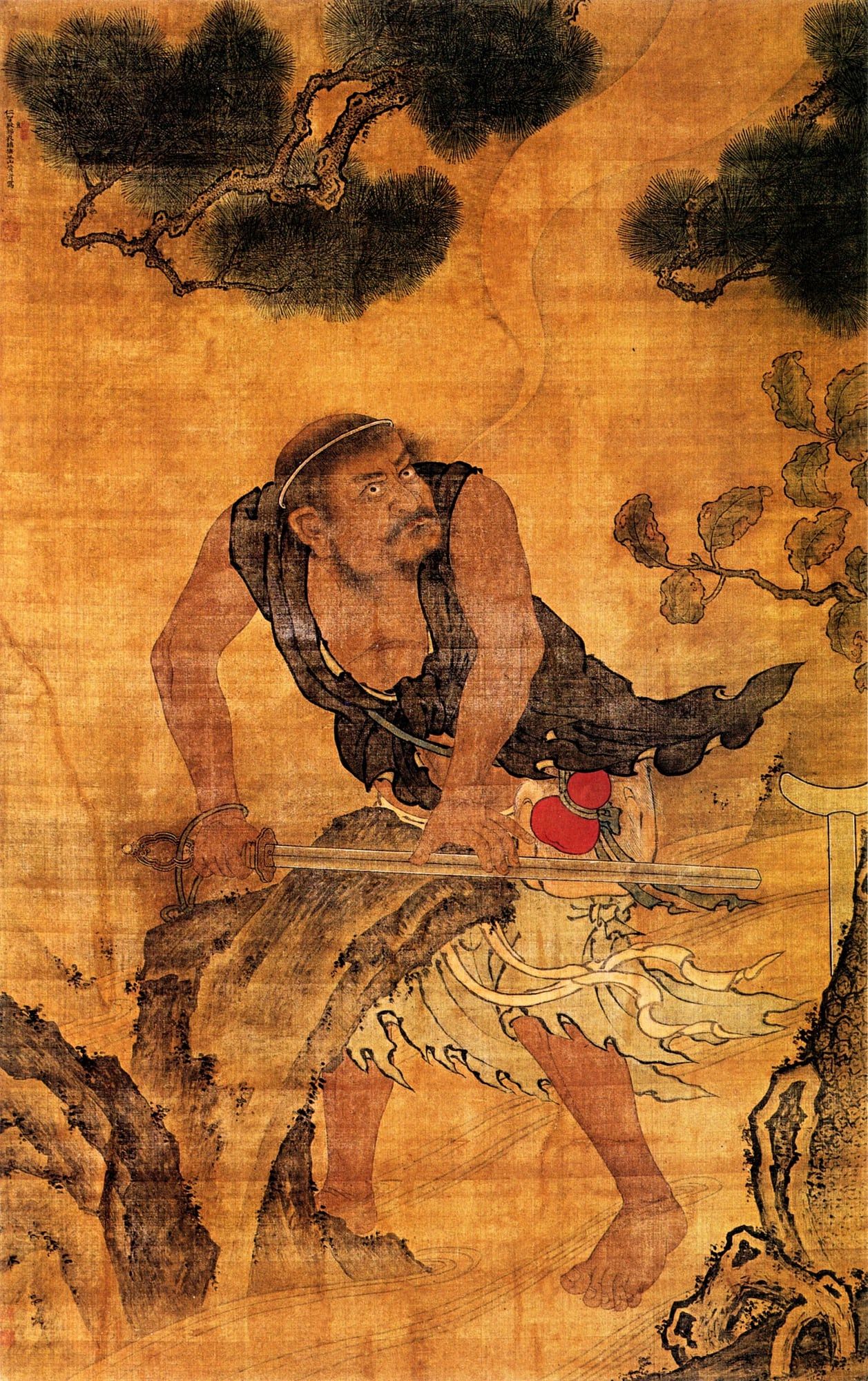
The most famous furnace in Chinese fiction is not a smith’s but an alchemist’s. In chapter 7 of Journey to the West, Laozi as the god Taishang Laojun has Sun Wukong pushed into his Eight Trigrams Furnace (八卦炉) and orders his attendants to fan the fire and “forge and refine” him, in the smith’s own word, 锻炼. The Monkey King crouches under the trigram 巽, xun, which stands for wind, because “where there is wind there is no fire”. The smoke reddens his eyes into the famous “fiery eyes and golden pupils” (火眼金睛). After forty-nine days the lid is lifted, and he kicks the furnace over.
The joke works because every reader knew what fire and wind do to metal. Wind is what a smith pumps into his hearth; here it is what keeps the monkey from melting.
Forge and her sisters in Phantom Blade Zero
The game’s smith introduces herself in one line: “The name’s Forge. I serve under Lady Inanis as an artisan” (我名唤炼邪,乃是冥使虚空麾下工匠). Her Chinese name, 炼邪 (Liànxié), was only a fan reading before launch; the Chinese client settles it. Forge keeps her smithy at the Outpost in Weeping Creek Valley, one of the few posts the Mandate still holds, and the game’s own reader Outposts, Rare Places of Rest explains why that matters: the Mandate built such stations across the Wulin when the Maskwalker uprising began, and most have since rotted. The word is the old one: a 驿站 was an imperial relay station where couriers ate, slept and changed horses.
She is the eldest of three triplet artisans who serve Inanis, by her own count: “I’m Forge, the eldest. I devote myself to smithing. Our youngest sister, Jewel, is a master jeweler.” The Chinese says 专习锻冶之术, a phrase that covers both of Song Yingxing’s chapters at once, 锻 for the hammer and 冶 for the smelting furnace. Jewel objects that Forge was only born a moment before her. The middle sister, Myst, keeps the Order’s secret tavern in Pangzhen. The three names pair a craft with something uncanny: 炼 “smelt” with 邪 “evil”, 幻 “illusion” with 鬼 “ghost”, 珍 “treasure” with 妖 “demon”. That reading is ours.
Her work is the plainest smithing in the game, and it reads like Song’s. Upgrades unlock once you meet her and then run from the menu at any Bell, paid in Remnant Dust, a universal Solvent and a metal for each weapon class: Forged Metal for one-handed weapons, Twinned Metal for paired blades, Broadplate Metal for two-handers, each in three grades. The item text of the second grade could stand in the Tiangong Kaiwu:
于铸造金属之上,打磨千次百次,直至表面泛起淡淡光泽。抛光并非为了美观,而是为了去除杂质,令所铸刀剑更加锋利坚实。
The forged metal is ground and polished hundreds, even thousands of times, until a faint sheen appears on its surface. Polishing is not merely for appearance, but to remove impurities and make the forged blade sharper and stronger.
Note the one word that differs. The English says “forged”; the Chinese name of the metal, 铸造金属, uses 铸, “to cast”, the other half of Song’s book. She also made two of Soul’s blades. The Sanguine Twin is “a pair of short-handled twin blades crafted by Forge from the same material as Sanguine”, and the Sanguine Reach “a two-handed long blade crafted by Forge from the same materials”; the Chinese cards say 仿制, a copy made after a model, which is what a smith with a master’s blade on her bench would do. Sanguine itself is the original. Shacknews’ review called her “a sturdy and blunt goddess of the anvil”, which fits the woman who tells a former Shadow Edict he is not much to look at.
The furnace legends come back through her sister. Myst’s Soul Tempering (铸魂, “casting the soul”) draws the memories lingering in an object into a weapon that has reached its level cap; without it, she says, a weapon has form but no spirit. Each material carries its owner’s story in its item text. The Embroidered Shoes that temper the Scarlet Wraithblade were the last piece of a dowry that Grief-Stricken Jin saved for his younger sister before he became a Maskwalker. The Bronze Essence that tempers the Tianxuan Bronze Sword is dug from the furnace of a ruined smithy on Pangzhen Backstreet in the tale The Sword and the Way, and its text is a blacksmith’s story: Wulin men seized his son and daughter and forced him to forge “something that could replace a heart”; a Daoist brought the children back, and the smith fled that night after throwing every half-finished piece into the fire. A smith forced to make what his masters demand is the Ming artisan household again, and a soul needed before a weapon comes alive is Mo Ye’s hair in the furnace. Both readings are ours. The full list of weapons and tempering materials is in Phantom Blade Zero’s weapons.
The real trade was heat, weight and timing: a bar that loses three parts in ten, a joint sealed with yellow mud, a pour that has to follow the last before it freezes. Forge’s anvil keeps that trade; the game hands the legends, the soul in the metal and the girl in the fire, to her sister.
Names in this article · Codex
Frequently asked
Q01What did blacksmiths do in ancient China?
Q02What is the Chinese word for blacksmith?
Q03How much iron did Chinese smiths lose when forging?
Q04Who is Forge in Phantom Blade Zero?
Q05Where do you upgrade weapons in Phantom Blade Zero?
Q06What is the difference between Forge and Myst?
Q07What is the legend of the girl and the Great Bell?
Sources & further reading
- Tiangong Kaiwu, “Working iron” (治铁, Chuiduan chapter) — Song Yingxing, 1637 (Wikisource)
- Tiangong Kaiwu, “Bells” (钟, Yezhu chapter) — Song Yingxing, 1637 (Wikisource)
- History of Ming, juan 78: Treatise on Food and Money 2 — Zhang Tingyu et al., 1739 (Wikisource)
- Book of the Later Han, juan 31: biography of Du Shi — Fan Ye, 5th century (Wikisource)
- Journey to the West, chapter 7 — Wu Cheng'en (attrib.), 1592 (Wikisource)
- Some Chinese Ghosts: “The Soul of the Great Bell” — Lafcadio Hearn, 1887 (Project Gutenberg)
- Forge: who she is, her lines and the weapons she made (EN and ZH game text) — Kungfupunk, read against the launch build
- Sanguine Twin and Sanguine Reach (weapon records, EN and zh-CN game text) — th.gl, retail game data
- Polished Forged Metal (item record, EN and zh-CN) — th.gl, retail game data
- Bronze Essence and Embroidered Shoes (Soul Tempering materials) — th.gl, retail game data
- Forge and the Upgrades Guide — Fextralife Phantom Blade Zero wiki
- Phantom Blade Zero review — Shacknews
Cite this page
Wuxiapunk Editors. (2026, November 15). Chinese Blacksmiths: The Real Trade Behind Phantom Blade Zero's Forge. Wuxiapunk. https://wuxiapunk.com/craft/chinese-blacksmiths/
“Chinese Blacksmiths: The Real Trade Behind Phantom Blade Zero's Forge.” Wuxiapunk, 15 Nov. 2026, https://wuxiapunk.com/craft/chinese-blacksmiths/.
Keep reading
Hundred-Refined Steel: How Chinese Smiths Folded Steel
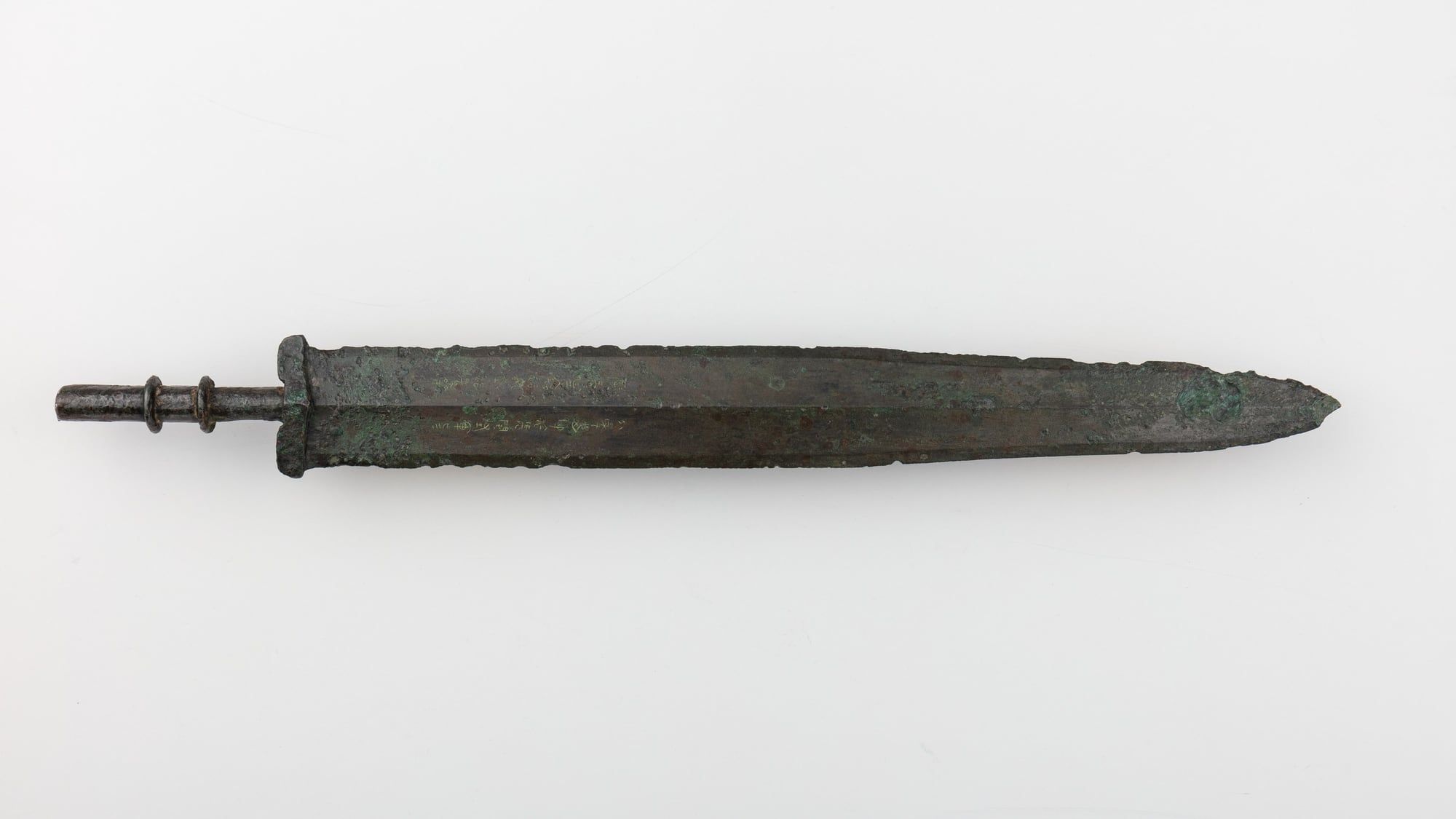
Chinese sword forging explained: cast iron, puddled steel, hundred-refined folding, co-fusion steel and composite blades, with original texts, dates and layer maths.
Gan Jiang and Mo Ye: China's Legendary Swordsmith Couple
Who were Gan Jiang and Mo Ye? The smith couple behind China's famous paired swords, how the legend changed from Zhuangzi to Lu Xun, and Phantom Blade Zero's Forge.
How Longquan Swords Are Forged: 2,600 Years of Craft
How Longquan swords are forged in Zhejiang: the Ou Yezi legend, the 2006 national heritage listing, each forging step with Chinese terms, and how to spot décor blades.