History dossier · Martial arts
Drunken Sword and Drunken Boxing: The Real Kung Fu of the Stagger
醉剑 · 醉拳zuìjiàn · zuìquán
Is drunken sword real? The kung fu behind Phantom Blade Zero's Sword Fanatic: Wu Song's fake drunk in Water Margin, Tang wine and swords, and Drunken Master.
Key facts
- Drunken boxing (醉拳, zuìquán) is a family of Chinese martial arts that imitate a drunk's stagger; drunken sword (醉剑, zuìjiàn) is the same idea performed with an ordinary jian.
- The trick is to look drunk without being drunk. Chinese coaches sum it up as 形醉意不醉: the body is drunk, the intent is not.
- The classic model is Wu Song in Water Margin, chapter 29. On the way to fight Jiang Menshen he has drunk five or seven parts in ten but plays it as ten, then wins with a feint and a double kick.
- Drunken styles have no single founder. Shaolin lineages credit drunken monks, Daoist ones the Eight Immortals, and Jackie Chan's Drunken Master (1978) made the Eight Immortals version famous worldwide.
- In Phantom Blade Zero the style belongs to Hua Qianxiao, the Sword Fanatic (剑痴:花千笑), a former Daoist sect leader who drinks on the bridge to Pangzhen; he drops The Fanatic's Broken Blade (痴者残剑), whose Drink move turns Soul's attacks into flying swords.
- Chinese
- 醉剑 (zuìjiàn), drunken sword · 醉拳 (zuìquán), drunken boxing
- What it is
- A group of loosely related styles that imitate a drunk's movements, not one lineage
- Weapon
- An ordinary jian; the drunken part is the footwork and timing
- Core idea
- 形醉意不醉: the body looks drunk, the intent stays sober
- Classic literary model
- Wu Song, Water Margin ch. 29, “Wu Song beats Jiang Menshen while drunk”
- Famous on screen
- Come Drink with Me (1966); Drunken Master (1978)
- In the game
- Hua Qianxiao, the Sword Fanatic (Crimson Forest); The Fanatic's Broken Blade, Soul Tempered into The Fanatic's Drunken Sword
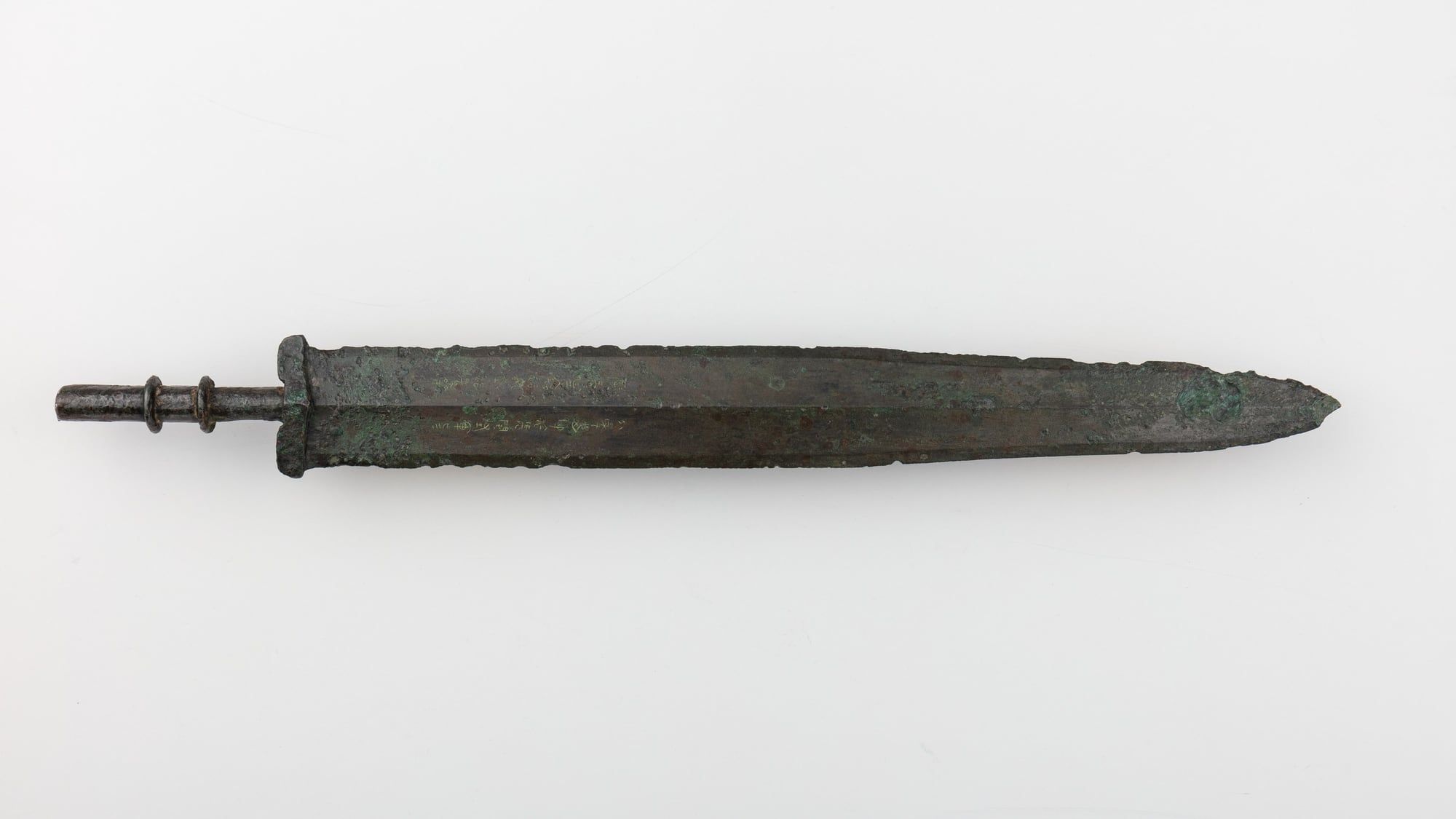
Drunken sword is a real Chinese sword routine that imitates a drunk’s stagger. It belongs to drunken boxing , a loose family of kung fu styles built on one trick: the body lurches as if drunk while the mind stays sober and picks its moment. The sword is an ordinary jian 剑 jiànThe straight, double-edged Chinese sword — “gentleman of the hundred weapons”.; what is drunk is the footwork.
Phantom Blade Zero puts the style on a bridge. Early in the Crimson Forest a swordsman in blue blocks the road to Pangzhen, tipping his head back to drink and pouring the wine straight over his mask: Hua Qianxiao, the Sword Fanatic. Players reach for Jackie Chan when they meet him, and they are right that the style is real. Its best teacher, though, is older than any film: a fourteenth-century novel whose hero is only half as drunk as he looks.
- LOOKS DRUNK
- 10/10
- ACTUALLY
- 5–7/10
- IN PHANTOM BLADE ZERO
- Not a state: the trick itself
Four ways to be drunk
It starts sober
China’s great poet of wine says he loved swordsmanship from the age of fifteen. Drunken style starts the same way: in most kung fu systems the drunken forms are an advanced layer on top of ordinary stances and steps, not where training begins.
十五好剑术,遍干诸侯;三十成文章,历抵卿相。
Three cups loosen the hand
Du Fu’s “Eight Immortals of the Wine Cup” gives the calligrapher Zhang Xu three cups before his brush runs wild. The Tang treated a little wine as something that freed the hand, not something that lost it. In Phantom Blade Zero a swig refills Sha-Chi and makes Soul tipsy, and his attacks start leaving the hand as flying swords.
张旭三杯草圣传,脱帽露顶王公前,挥毫落纸如云烟。
Ten parts wine, ten parts skill
Wu Song’s boast in Water Margin: one part wine gives one part skill, five parts five, and with ten parts “I don’t know where the strength comes from”. Phantom Blade Zero’s director says the same of the Drunken Sword: the drunker Soul gets, the stronger he becomes.
带一分酒,便有一分本事;五分酒,五分本事。我若吃了十分酒,这气力不知从何而来。
Look ten, be five
The real secret is in the same chapter. On the road to Jiang Menshen, Wu Song carries “five or seven parts” of wine but plays it as ten, lurching forward and back, east and west. Then he feints with a fist, turns and lands his signature double kick. That gap between how drunk you look and how drunk you are is what every drunken style trains.
虽然带着五七分酒,却装做十分醉的,前颠后偃,东倒西歪。
What drunken sword actually is
Drunken boxing is not one martial art with a founder and a family tree. It is a group of loosely related styles, and in most systems it is an advanced layer, a drunken form or two inside a broader school, rather than where a student starts. Shaolin lineages have drunken forms with bare hands and weapons; the drunken staff is the commonest, but drunken sword is practised too.
What the styles share is a body language. Steps cross and stagger, the trunk sways and tips past its balance point, the fighter sinks, rolls and springs up, and the weapon hides behind the body until it doesn’t. Chinese coaches sum it up in four characters, “the form is drunk, the intent is not” . The stagger is bait: it makes the opponent misread distance and timing.
The routine survives in modern competition. In 2018 a Shanghai athlete won the men’s drunken sword event at China’s national traditional wushu championship with this:
 Men's Drunken Sword 男子醉剑 第1名 上海 彭傲枫 8.96分
Wu Song: the drunk who was only half drunk
The model every Chinese reader knows is Wu Song (武松), the tiger-killer of Water Margin (水浒传), the 14th-century novel attributed to Shi Nai’an. Drink follows him through the book. In chapter 23 a tavern flag warns 三碗不过冈, “three bowls and you won’t cross the ridge”. Wu Song drinks fifteen by the novel’s count (popular retellings round it up to eighteen), walks up Jingyang Ridge anyway and kills a tiger with his fists.
Chapter 29, “Wu Song beats Jiang Menshen while drunk” (武松醉打蒋门神), is the drunken-boxing chapter. Wu Song insists on three bowls at every tavern on the road, a rule he calls 无三不过望, and when his friend worries he will be too drunk to fight, he boasts:
带一分酒,便有一分本事;五分酒,五分本事。我若吃了十分酒,这气力不知从何而来。
With one part wine I have one part skill; with five parts, five parts. Drink ten parts, and I don’t know where the strength comes from.
Then the novel quietly undercuts the boast. Approaching the enemy’s tavern, Wu Song “carries five or seven parts of wine, but plays it as ten, lurching forward and back, east and west” (虽然带着五七分酒,却装做十分醉的,前颠后偃,东倒西歪). Close in, he feints with a fist, turns, and lands a left kick and a right kick, a combination the narrator names “Jade Ring Step, Mandarin Duck Kick” and calls “the real skill of his life”.
Water Margin never uses the word 醉拳, but the scene contains the whole art: a fighter who looks ten parts drunk, is five to seven, and wins with a feint. It is why Wu Song is so often cited as drunken boxing’s first written appearance.
Tang wine, swords and the wild brush
The pairing of wine and the blade is older still. Du Fu’s “Eight Immortals of the Wine Cup” (饮中八仙歌) is a roll call of famous Tang drinkers. Li Bai “writes a hundred poems on one measure of wine” and calls himself “an immortal of the wine”; the calligrapher Zhang Xu needs “three cups” before he becomes the sage of cursive script, “bareheaded before princes, his brush on paper like clouds and smoke”. Li Bai himself wrote that he “loved swordsmanship at fifteen” (十五好剑术).
Du Fu draws the line from sword to brush directly. In the preface to a poem of 767 CE, he recalls that Zhang Xu often watched Lady Gongsun (公孙大娘) perform her famous sword dance and that “from then on his cursive made great progress”. Scholars still argue over exactly what props the 剑器 dance used, but the idea that a drunk-loose hand and a sword-sharp eye can be the same thing is pure Tang.
| Wu Song (Water Margin) | Drunken sword (wushu) | The Fanatic’s Broken Blade (Phantom Blade Zero) | |
|---|---|---|---|
| Really drunk? | Five to seven parts in ten | No: imitation | Soul drinks: Sober, Tipsy, Drunk |
| What the stagger hides | A feint, then a double kick | Balance, timing, the blade | Auto-dodges while Drunk; strikes from range |
| Power from wine? | So he boasts | No | Yes: Drink restores Sha-Chi; flying-sword damage rises sharply when Drunk |
| Defence | Footwork | Sway, twist and evade | Drunk Soul cannot block but dodges by himself |
| Weapon | Fists and feet | An ordinary jian | Half a sword that flies from the hand |
Eight Immortals, Shaolin monks and Drunken Master
Because the styles are scattered, so are their origin stories. Shaolin versions are told around drunken monks and the drunken luohan, the arhat who sways with disorderly steps. Daoist versions borrow the Eight Immortals (八仙), the most famous drinking party in Chinese myth, and give each immortal a drunken technique of their own. An 18th-century boxing manual already describes Shaolin monks practising “eight drunken immortals” boxing. None of these lineages can be traced reliably back very far.
Cinema made the style global. King Hu’s Come Drink with Me (1966), whose Chinese title 大醉侠 means “the great drunken hero”, hides a kung fu master inside a singing, drunken beggar. Yuen Woo-ping’s Drunken Master (1978) made Jackie Chan a star as a young Wong Fei-hung learning the Eight Drunken Immortals from the wine-soaked Beggar So. Wong refuses to learn one form, the immortal He Xiangu’s, and has to improvise it in the final fight. Anime fans know a cousin of the joke from Rock Lee’s accidental drunken fist in Naruto. For more of the films behind the game, see kung fu films and Phantom Blade Zero.
The Sword Fanatic in Phantom Blade Zero
The style belongs to Hua Qianxiao, the Sword Fanatic (剑痴:花千笑), the first boss of the Crimson Forest, met on the bridge by the Pangzhen Bridge Overlook bell. His codex entry tells the story the fight leaves out. He had spent his life on the sword and long stood at its summit; then men he had barely beaten began falling easily to Maskwalkers, and he saw that without Transcension, the surgery that implants a Sha-Chi device in the body, the age would leave him behind. So he let the cup decide:
他以杯中之酒来做决定,一杯是改,再一杯是不改,饮到不能再饮,他却忘记自己念到了何处。
He left the choice to his wine. One cup meant yes, the next no. By the time he could drink no more, he had forgotten which answer came last.
He is one of the four great Maskwalkers whom the Order and the Pillars of Kunlun fought a year before the story, and that battle broke his prized five-foot blade. Now, the codex says, he waits on the bridge for the man who broke it. The bounty notice Wanted: Four Maskwalker Leaders, found in the Village of Lu, profiles him in a tactician’s dry voice: “formerly the leader of a Daoist sect, he drinks heavily and wields a five-foot-long sword, specializing in Drunken Sword techniques. The more intoxicated he becomes, the fiercer his swordplay grows.” A Daoist master undone by drink sits neatly beside the Daoist Eight Immortals of the drunken boxing schools; that link is our reading, not the game’s.
His name carries a joke the codex makes explicit. 千笑 means “a thousand laughs”, and the entry ends with the broken sword making him “laugh louder and fight fiercer. Yet no amount of laughter could ease a drunken swordsman’s obsession” (奈何千般笑罢,难解醉客痴心). The 痴 of his title, “fanatic”, is that obsession. Even the wine on the mask has a story: Soulframe Liang has joked that so many villains wear masks partly to save on facial capture, which is how the Sword Fanatic came to strike a dashing pose, throw back his head to drink and pour the wine straight onto his mask.
Beat him and he drops The Fanatic’s Broken Blade (痴者残剑), “a broken sword. Drinking awakens its power, allowing it to fly through the air and strike distant enemies.” The pre-launch name “Drunken Sword” is not an item in the retail game. The moveset reads like a drunken-boxing manual turned into rules:
- Drink (Block + Heavy Attack) restores Sha-Chi and puts Soul in the Tipsy state for 15 seconds; his attacks become Flying Swords whose damage falls off with distance.
- The Power Surge Drink Until Dawn (一醉方休), used while Tipsy, makes him Drunk for 20 seconds: he can barely move and cannot block, but he dodges incoming attacks by himself, and the Flying Swords hit much harder.
- Soul Tempering with Fanatic’s Obsession (痴者执念), which Fextralife reports is completed from fragments left by Gu Wanyue and Yan Qiansui, reforges it into The Fanatic’s Drunken Sword (痴者醉剑), whose damage no longer falls off over distance. The Obsession’s item text keeps the character to the end: he would never trade his blade for another, because “if he let it go and took up another just to hide it, then the blade would not be the only thing broken.”
The Drunk state is the most faithful line in the kit. The drunken forms answer force by swaying and twisting out of its way; in the Eight Immortals set, He Xiangu’s form evades attacks with a twisting body. Liang explained the design problem in a December 2025 interview: a drunken sword’s paths are so erratic that asking players to catch its parry timing by hand would feel terrible, so the hit zone is kept to a plain arc in front of the blade and the wildest moves are saved for execution animations and post-counter cut-ins, where the “醉意”, the look of drink, can be as wild as it likes. The music follows the same brief. Liang asked composer Caisheng Bo for “醉意朦胧、带点迷幻感的氛围”, a hazy, drunken, slightly psychedelic mood; the album track is The Drunken Sword, and our Chinese instruments page covers the rest of the score. The trophy for beating him is A Thousand Cups Drained (千杯散尽). How the studio captured fights like this on wires is in fight choreography; the full stats are on the Fanatic’s Broken Blade codex page.
That puts the game closer to Wu Song’s boast than to the real routine. A wushu athlete is never drunk; Soul really drinks, and the wine is his fuel. The flying blades come from somewhere else again: the sword-immortal fiction in which swords leave the hand and cross the sky, which we untangle in wuxia vs xianxia.
Look at Hua Qianxiao’s fight with Wu Song in mind, though, and it is the same lesson. The sway invites you in, the stumble covers the step, and the blow comes from the angle you had stopped watching. Ten parts drunk on the outside, sober where it counts: the oldest trick in the jianghu. Hua Qianxiao is the warning on the other side of it, a master who let the drink do his thinking for him and woke up with a broken sword.
Names in this article · Codex
Frequently asked
Q01Is drunken sword a real martial art?
Q02Do drunken boxers actually drink?
Q03What is the difference between drunken boxing and drunken sword?
Q04Who was the original drunken master?
Q05How do you get the drunken sword in Phantom Blade Zero?
Q06How do you get The Fanatic's Drunken Sword?
Q07Who is Hua Qianxiao in Phantom Blade Zero?
Sources & further reading
- Water Margin, ch. 29: Wu Song beats Jiang Menshen while drunk (武松醉打蒋门神) — 120-chapter edition (Wikisource)
- Water Margin, ch. 23: Wu Song kills the tiger on Jingyang Ridge — 120-chapter edition (Wikisource)
- Eight Immortals of the Wine Cup (饮中八仙歌) — Du Fu, 8th century (Wikisource)
- Watching a Pupil of Lady Gongsun Dance the Sword, with preface (观公孙大娘弟子舞剑器行并序) — Du Fu, 767 CE (Wikisource)
- Drunken boxing — Wikipedia
- Hua Qianxiao, the Sword Fanatic (bestiary entry, EN and zh-CN game text) — th.gl, retail game data
- The Fanatic's Broken Blade (weapon record: card, Combat Arts, perks) — th.gl, retail game data
- The Fanatic's Drunken Sword — Fextralife Phantom Blade Zero wiki
- 《影之刃零》全BOSS打法指南 — Gamersky (游民星空), Oct 2026
- 在上海动捕棚里… (Soulframe Liang on the drunken sword's hitboxes) — Tencent News (腾讯新闻), 26 Dec 2025
- 《影之刃零》六小时试玩 (the Hua Qianxiao fight and its music) — Gcores (机核), reposted from Zhihu, 12 Oct 2026
- Phantom Blade Zero: “Playtime Is Around 30 Hours” (Soulframe Liang interview) — Inven Global, 9 Oct 2026
Cite this page
Wuxiapunk Editors. (2026, November 15). Drunken Sword and Drunken Boxing: The Real Kung Fu of the Stagger. Wuxiapunk. https://wuxiapunk.com/history/drunken-boxing/
“Drunken Sword and Drunken Boxing: The Real Kung Fu of the Stagger.” Wuxiapunk, 15 Nov. 2026, https://wuxiapunk.com/history/drunken-boxing/.
Keep reading
Jian: The Chinese Straight Sword, Explained
What a jian is, how China's double-edged sword went from bronze to steel, why it is the gentleman of weapons, and which jian Soul wins in Phantom Blade Zero.
The Kung Fu Films That Inspired Phantom Blade Zero
The kung fu and wuxia films Phantom Blade Zero's makers name, from Once Upon a Time in China III to The Blade, and the bosses and fights where each shows up in the game.
How Phantom Blade Zero's Fights Were Made: Motion Capture, Wirework and Hong Kong Action
Who choreographed Phantom Blade Zero, how its wire-rig motion capture worked, and the Hong Kong stunt lineage from Peking opera to Donnie Yen's team.