Visuals · Steam and iron
Sha-Chi Towers, Engine Boats and Iron Pagodas: The Machinery and Architecture of Phantom Blade Zero
杀气塔shāqì tǎ
What Phantom Blade Zero's Sha-Chi Towers and Engine Boats do, and the real Chinese pagodas, furnaces, paddle-wheel ships and halls they are built on.
Key facts
- In the fiction, Phantom Blade Zero's machines do two jobs: the Sha-Chi Towers made Maskwalkers, and the Engine Boats move the Order across the water.
- The game draws a hard line: Engine Art runs on fuel, while Transcension and the Engine Boats run on Sha-Chi.
- A Sha-Chi Tower is a furnace dressed in the flying eaves of a Chinese tower; a notice inside orders furnace workers to wear an iron mask over the mouth and face.
- S-GAME scouted ancestral halls in Fujian, ancient towns in Zhejiang and old steel factories in Beijing; it has not named the real site behind any single building.
- The real history is older than the punk: China cast iron pagodas in the Song dynasty, ran Ming furnaces that were tapped six times between dawn and dusk, and fought on lakes with paddle-wheel warships in 1135.
- Sha-Chi Towers
- 3: Weeping Creek Valley, Pangzhen (standing in Meigu Lake), Crimson Forest
- Built by
- The Eleven (十一人阁), to make Maskwalkers
- Power
- Sha-Chi for towers and boats; fuel for Engine Art
- Real models named by S-GAME
- Fujian ancestral halls, Zhejiang old towns, Beijing steel works (no single site)
- Real Crimson Manor
- Puyuan, Zhejiang, 2–8 Nov 2026
The machines of Phantom Blade Zero do two jobs in the fiction: they make killers, and they move the Order. The Sha-Chi Tower 杀气塔 shāqì tǎSteel towers with furnaces where the Eleven turned people into Maskwalkers. Three stand in the game: in Weeping Creek Valley (the Steel Tower of the quest Steel and Steam), in the lake off Pangzhen and in the Crimson Forest. The towers were destroyed, but their furnaces still burn.Glossary → is a furnace that turned martial artists into Maskwalkers, dressed in the carved beams and flying eaves of a Chinese tower. The Engine Boat is a fast lake boat that burns the same Sha-Chi. Around them stand real Chinese building types, scanned and recombined: relay stations, covered bridges, ancestral halls, memorial arches, merchants’ guild halls with opera stages.
Below, the machines taken apart from the game’s own texts, each region’s buildings matched to their real type, and the history underneath. Spoilers: places and quests from the whole game, including the Crimson Manor; not the endings, which are here.
The short answer: what the machines are for
Every machine in the game runs on one of two powers, and the game’s texts draw the line plainly. Engine Art “is the practice of using combustible fuel in place of Sha-Chi to power mechanisms, gears, and other mechanical constructs” (Mystery of Transcension). Sha-Chi (杀气, shāqì), which the same book calls “the foundation of all martial arts”, drives the rest. So the machines fall into three families:
- Machines that turn people into weapons. The three Sha-Chi Towers, built by the Eleven (十一人阁, Shíyī Rén Gé) to produce Maskwalkers (怪面, guàimiàn) by Transcension.
- Machines that move and feed the Order. The Engine Boat of the Servant’s workshop, with the docks and boatmasters that keep it running.
- Machines fitted to one fighter. Lei Dang’s Tiger Cannon arm, the steel lion heads of the Flaming Mane, Old Man Gen’s carriage turned War Wagon. The Village of Lu also keeps the wreck of one giant construct, which its bell list calls the Engine Giant Remains (机关巨怪残骸).
The buildings come from real places, though S-GAME has never said which building copies which site. In April 2026 the studio wrote that the team visited “many stunning locations across China, from ancestral halls in Fujian to ancient towns in Zhejiang, and even old steel factories in Beijing.” Its art director, Michael Chang, gave the rule at the August 2026 pre-order screening: 考据为基、创新为魂, “research as the foundation, invention as the soul”. Every character, weapon, scene and machine, he said, starts from the real structure of classical texts, traditional buildings and old weapons, and only then receives its “mechanical alienation” (机械异化; our translation). The towers are where that rule is easiest to see.
The Sha-Chi Tower taken apart
A Sha-Chi Tower is a wrecked factory for Maskwalkers whose furnace nobody can switch off. There are three. The Valley Sha-Chi Tower in Weeping Creek Valley is the first one you climb, in the chapter the English client calls Steel and Steam; the Pangzhen Sha-Chi Tower stands in Meigu Lake with its own dock; the Crimson Forest Sha-Chi Tower opens late in the game. The Reflections page on the ruins says why their smoke never stops:
“唯余塔内熔炉,因无人知晓关闭之法,只得任其日夜空转,黑烟蔽日。”
“Only the furnaces within remained. With no one knowing how to shut them down, they were left to run idly day and night, their black smoke blotting out the sky.”
— Reflections, Sha-Chi Tower Ruins (Library)
The best description of the look comes from a hands-on report by the writer 火狼 (Huǒláng), who played six hours of the game at a closed press session in Beijing in early September 2026; it ran on Zhihu Games and was reposted on gcores (机核) on 12 October. At the foot of the “cloud-piercing” tower the writer saw a Chinese pavilion’s “carved beams and painted rafters, flying eaves and upturned corners” fused “almost violently” with “grim steel frames, snarling chimneys, knotted pipes and blazing boilers” (our translation). Clearing the valley earns the achievement 黑塔蔽天光, “the black tower blots out the sky’s light”, as Chinese guides record it.
| Part | What the game shows or says | The real thing under it |
|---|---|---|
| Shell | A “cloud-piercing” tower: carved beams and flying eaves fused with steel frames, chimneys and boilers (火狼’s report) | The pavilion-style pagoda (楼阁式塔); our reading |
| Furnace | Runs “day and night”; holds Primal Stone; a fire-inspection hatch (探火孔) you open with a story item | The Ming iron furnace of Tiangong Kaiwu, tapped six times a day (see below) |
| Workers’ rules | Cut away burned flesh; iron mask over mouth and face; the wounded keep away | Song Yingxing’s rules for arsenic kilns: stand upwind, change trade after two years |
| Monks | Kuye Temple monks whose bodies harden like metal: the Gold, Bronze and Iron Men | 金身, the “golden body” of a gilded temple statue; our reading |
| Output | Once Maskwalkers; now metal monks, Primal Stone, and a lift down to the Crimson Manor | — |
The furnace. The Mystery of Transcension books lie around the Valley tower like an operating log. A torn page, Primal Stone Records: Perfect Transcension, reports that ground Primal Stone , eaten, calmed the “Sha-Chi fluctuations” of half the subjects (entry). Another, the Sha-Chi Tower Investigation Report, finds a furnace that “has gone cold” with “no trace of Primal Stone remaining” (entry). The side quest A Severed Mindseal (隔绝楔子) turns those pages into play: a Shadow Warden at the top of the Valley tower sends Soul to the furnaces of all three towers for Primal Stone.
The mask rule. A notice board in the furnace room carries three rules for the people who fed the fire (entry):
“杀气蚀肺,久吸必殆。操作时须覆铁面掩口。”
“Sha-Chi corrodes the lungs. Prolonged exposure is fatal. When operating the furnace, wear an iron mask over the mouth and face.”
— Instructions for the Sha-Chi Furnace
Our reading: the iron mask begins in this tower as a respirator, and 怪面, “strange faces”, is where that story ends. The game never draws the line itself; the masks get their own page in masks, red threads and costume.
The monks. The Reflections page says the furnace cores have begun to change: anyone who goes deep is “easily corrupted”, the body “gradually hardening like metal”. Certain monks resist and turn it to use: “Their wounds do not bleed, poison and flame cannot harm them, and only lightning can bring them down.” The bestiary names them the Gold Man, Bronze Man and Iron Man (活金人, 活铜人, 活铁人), “Kuye Temple monks subjected to Transcension”, filed with the Maskwalkers. Its entries tell what happened: the monks left Kuye Temple to look for their master and to find the source of strange noises reported from the tower, were ambushed inside, and were caught when the Sha-Chi Furnace burst; “molten copper infused with Sha-Chi forged their bodies as hard as copper and iron, but burned away their reason.” Guides tell you to break their golden bodies with an axe. Who lured the monks into the ruins is the question the Reflections page ends on.
What it makes. In the Eleven’s day, Maskwalkers. Now it makes metal monks and Primal Stone, and it hides something: a lift at the base of the Valley tower drops to the Crimson Manor.
 Enter the Wulin: Gameplay & Story Deep Dive of Phantom Blade Zero
Engine boats and docks
The Engine Boat is the Order’s Sha-Chi-driven boat, and it is how Soul reaches Meigu Lake. The fifth page of The Order, found under a tree by the lakeside dock in the Village of Lu, explains it:
“小厮的‘机关工坊’为‘组织’开发了许多便于出行的装置,机关船便是其中之一,以杀气为动力,驱动船快速行进。”
“The Servant’s “Engine Workshop” has developed many devices for the Order that make travel easier. The Engine Boat is one such creation, powered by Sha-Chi to travel swiftly across the water.”
— The Order, Engine Boats and Docks
The Servant (小厮, Xiǎosī, “page boy”) is one of the Order’s Shadow Edicts: “a genius of the Engine Art”, apparently born to a family of mechanists and cast out for breaking a taboo, who has built “a wealth of wondrous machina constructs far beyond this era”. In play the boat comes from the Mystery quest Sha-Chi Powered Boat (机关船). Myst (幻鬼, Huànguǐ), who keeps the Order’s secret tavern in Pangzhen, sends Soul for two Transcension Cores and the boat master’s notes; fitted at Pangzhen Docks (庞镇船坞), they open the lake, and eleven docks around it become bells. The State of Play narration promised exactly this: “a vast lake, which Soul must navigate aboard a peculiar high-speed vessel.”
The same page makes the docks an intelligence service. The boatmasters (船老大, chuán lǎodà, still the everyday Chinese word for a skipper) know every boat’s construction and upkeep, and every passing fleet brings them news of waterways, towns and factions: “Little escapes the boatmasters’ ears.”
The page also breaks the game’s own rule. Engine Art runs on fuel “in place of Sha-Chi”; the Servant’s boats burn Sha-Chi. Our reading: that is what made him a genius, and perhaps the taboo his family threw him out for. The game does not say which taboo it was.
The other machines are personal. Lei Dang, Soul’s old partner, lost his right arm and “fitted himself with a massive Tiger Cannon, granting him the power to take on a hundred men alone”. The Lion Dance Hall’s heads carry bronze, iron and welded blades and breathe fire (Lion dance has the real dance). Old Man Gen’s carriage becomes the War Wagon (泥头车; his Memory Flower).
Building types, region by region
Under the steel, each region is built from a real Chinese building type. S-GAME has confirmed only its scouting and its method: Pangzhen is built from “high-precision 3D models based on scans of multiple ancient Chinese towns” (August 2025), and the team visited Fujian halls, Zhejiang towns and Beijing steel works (April 2026). Every match in the third column below is our reading of what the game shows. The fourth column gives a real place you can visit or the text to read.
| Region | Building types in the game | The real Chinese type | Where to see one, or the source |
|---|---|---|---|
| Weeping Creek Valley | The Outpost (驿站), plank walkways, a waterwheel, the Valley Sha-Chi Tower | The 驿站 relay station of the imperial post roads; the pavilion-style pagoda; the blast furnace | Yingxian Wooden Pagoda, Shanxi (1056); for a real blast furnace, Shougang No. 3 in Beijing (S-GAME’s 2025 demo venue, not a confirmed level source) |
| Crimson Forest | Abandoned Main Road (荒废官道), a gate Fextralife calls a torii, a third Sha-Chi Tower | The 官道 imperial highway; the gate is probably a 牌坊 arch or temple gate (unconfirmed) | — |
| Village of Lu | The Covered Bridge (大廊桥) strung with red thread, terraced fields, the Lu clan’s hall up the mountain | The timber-arch covered bridge (木拱廊桥) of the Zhejiang–Fujian hills; the single-clan village | The Sixi “sister bridges”, Taishun, Zhejiang |
| Pangzhen | White walls, dark tiles, a memorial arch (牌坊) at the south gate, a dye works, open-air opera stages, the four-storey Pavilion of Knowledge | The Huizhou style, famous for houses, ancestral halls and memorial arches | Xidi and Hongcun, Anhui (World Heritage, 2000); the Tangyue arches |
| Mandate Encampment | Palisade, watchtowers, Training Grounds (校场), Moji’s Cenotaph (衣冠冢) | The army’s 大营 headquarters camp; the cenotaph that holds only clothes and cap | World regions |
| Meigu Lake | Meigu Songhouse on a half-collapsed tall building, island villages, the Pangzhen Sha-Chi Tower in the water, a shipwreck and a tower ship (楼船) in the Discordance | The 楼船, the many-decked Chinese warship | Song History, juan 365 (Yue Fei’s tower ships) |
| Mountain of Imprisonment | The Lady’s Shrine (圣母娘娘宗祠), hanging cages | A clan’s ancestral hall (宗祠) taken over by a cult | Zhu Xi’s Family Rituals (see World regions) |
| Mirage Estate | A merchants’ hall grown into a theatre estate: the Opera House (戏园), a theatre building (戏楼), galleries, the Mourning Hall (灵堂), the bell Below the Fire Tower (吹火楼) | The 会馆 guild hall with its own opera stage; the Jiangnan garden | Xiqin Guild Hall, Zigong, Sichuan (begun 1736) |
| Mount Soulrend | Mountain God Temple (山神庙) in the snow | The village 山神庙 | Water Margin, chapter 10 |
Posts that tie a stage to a Wenzhou village or a level to the Shougang furnace trace back to an AI-assisted lifestyle post; no S-GAME source supports them. The Mirage Estate’s history, by contrast, is in the game: twelve local magnates built a small merchant guild hall that “was later expanded into the Mirage Estate, a venue for grand performances” (Reflections; see also The Mirage Estate’s Past and, for its music, Opera and songhouses).
The Crimson Manor and its real-world build
The Crimson Manor (红房子, hóng fángzi, literally “the red house”) is a red-roofed pavilion standing alone in a vast cave under the Valley Sha-Chi Tower. The Chinese quest text describes the arrival: a hidden lift at the bottom of the tower goes down “deep beneath the Sha-Chi Tower”, where “the dome rises high, empty on every side, and in the middle stands a red-roofed pavilion” (our translation). The door has a living lock. A plan found at the Puppet Testing Grounds shows that the Herald keeps “a red house” whose lock is a puppet called 哑巴, “the Mute” (our gloss), and the Mute’s tongue is the key. Soul gets the Puppet’s Tongue from the Herald’s illusions behind three doors, in the Village of Lu, the Mandate Encampment and the Mountain of Imprisonment. The English quest line is short: “The Crimson Manor holds the Herald’s secrets.” Inside are the Scavenger Pens.
The steel tower’s most secret room is not steel: it is a Chinese pavilion, painted red, sealed by a puppet that cannot speak.
From 2 to 8 November 2026 the building crossed into the real world. At CPOPwave 2026, a show of Chinese pop-culture IP held during the World Internet Conference’s Wuzhen Summit, S-GAME built a red house in the old town of Puyuan (濮院) in Tongxiang, Zhejiang. Zhejiang Online reported a queue outside “this red house” and called it the game’s “first official offline event” after launch; “this building reverse-restored the game scene” (这栋建筑反向还原了游戏场景). Inside were 1:1 models of the game’s weapons and a statue of the hero. Wang Yanlu (王妍璐) of S-GAME’s IP operations said: “While we were building it, people online had already photographed it and remarked how faithfully it reproduced the red house in the game” (our translation).
Our reading: the build turns the game inside out. In the game a red pavilion hides inside a steel tower; in Puyuan a red house stands among the grey bricks and dark tiles (青砖黛瓦, as Zhejiang Online puts it) of a Jiangnan water town, the kind of town S-GAME scanned to build Pangzhen.
The steel side had its own real venue a year earlier. In July 2025 S-GAME held a two-day demo inside the No. 3 blast furnace of the old Shougang steelworks in Beijing, a site, ChuApp reported, that Liang chose himself, and hung roughly 250,000 metres of red cotton thread over the furnace. ChuApp’s reporter summed up the look in one line: 钢厂是蒸汽,红线是武侠, “the steelworks is the steam, the red thread is the wuxia”.
The real history under the steel
Each machine form and building type has a real Chinese ancestor, and several are stranger than the fiction. History below is what the sources say; links to the game are marked as our reading.
The pagoda: a relic mound stretched into a tower
The Chinese pagoda (塔, tǎ) began as the Indian stupa, a domed mound for relics, and Chinese builders crossed it with their own multi-storey towers and pavilions; the character 塔 itself is short for the Sanskrit name. The tallest wooden one still standing is the Sakyamuni Pagoda of Fogong Temple in Ying County, Shanxi, built in 1056 under the Liao: 67.31 metres including its spire, five storeys outside and nine inside, with fifty-four kinds of bracket arm and, according to its Wikipedia article, no nails or iron bars at all.
China also built pagodas that look like iron and pagodas that are iron. The “Iron Pagoda” of Youguo Temple in Kaifeng, finished in 1049, is brick: thirteen storeys and 56.88 metres of glazed brick whose colour from afar looks like iron. It replaced a wooden pagoda by the architect Yu Hao (喻皓) that lightning burned in 1044, and 104 bells hang under its eaves and ring in the wind. The pagoda at Yuquan Temple in Dangyang, Hubei, by contrast, was cast in the Northern Song entirely from pig iron; Chinese Wikipedia calls it the foremost of China’s old iron pagodas.
Our reading: the Sha-Chi Tower is the iron pagoda taken literally. A building made to hold relics becomes a building that makes monks into metal.
Blast furnaces and Tiangong Kaiwu
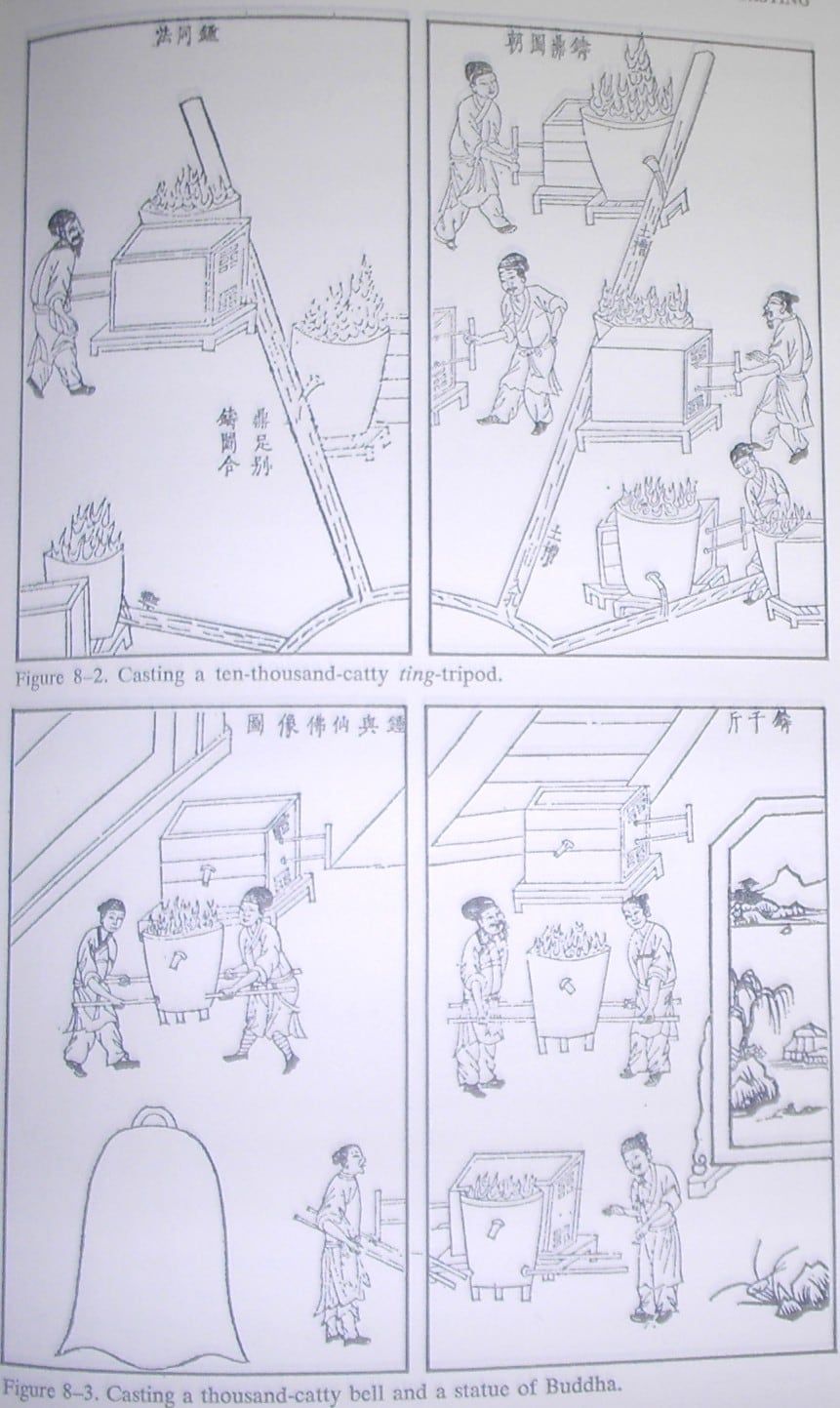
China was casting iron from molten metal by the 5th century BCE, more than a thousand years before Europe’s first blast furnaces; our guide to hundred-refined steel tells that story, and Chinese blacksmiths follows the iron to the anvil. The furnace itself is described in the “Iron” section of chapter 14, “Five Metals” (五金·铁), of Song Yingxing’s Tiangong Kaiwu (天工开物, “The Works of Heaven and the Inception of Things”, 1637):
凡铁炉用盐做造,和泥砌成。其炉多傍山穴为之,或用巨木匡围,朔造盐泥,穷月之力不容造次。盐泥有罅,尽弃全功。凡铁一炉载土二千余斤……扇炉风箱必用四人、六人带拽。土化成铁之后,从炉腰孔流出。炉孔先用泥塞。每旦昼六时,一时出铁一陀。既出即叉泥塞,鼓风再熔。
An iron furnace is built of salt mixed with clay. Most are set against a hillside cave, or framed with great timbers; shaping the salt-clay takes a full month and cannot be hurried, and if the salt-clay cracks, all the work is lost. Each charge holds more than two thousand jin of ore… The bellows that fan the furnace need four or six men to pull them. When the ore has turned to iron it flows out of a hole in the furnace’s waist, which is first stopped with clay. Through the six double-hours of the day, one lump of iron is tapped each double-hour; once it is out, the hole is stopped with clay again, the bellows blow, and the smelting goes on.
That is a furnace that does not stop: a month to build, a crack to ruin, a crew on the bellows, a tap every two hours. The same book, in chapter 11 on fired minerals (燔石·砒石), gives the rules for roasting arsenic: stand upwind, more than ten zhang (over 30 metres) away; downwind every plant dies; and “arsenic burners change trade after two years; otherwise their hair and beards all fall out” (燒砒之人,經兩載即改徙,否則鬚髮盡落). Our Library sets that passage beside the game’s furnace notice (Mystery of Transcension). Our reading: the game’s furnaces that “run idly day and night” are this Ming furnace with the crew gone.
Paddle-wheel warships of the Song
The Engine Boat has a real ancestor: the paddle-wheel ship (车船, chēchuán), worked by men on treadles. Chinese records mention paddle-wheel boats from the fifth century, and Joseph Needham counted “a great number of treadmill-operated paddle-wheel craft” built between 1132 and 1183, some “with as many as 11 paddle-wheels a side”. The rebel Yang Yao (杨幺) held Dongting Lake against the court for years with wheel-ships big enough to carry a thousand men. In 1135 Yue Fei was sent against him, and the Song History describes the fleet in Yue Fei’s biography:
么负固不服,方浮舟湖中,以轮激水,其行如飞,旁置撞竿,官舟迎之辄碎。
Yang Yao trusted his strongholds and would not submit. He floated his boats on the lake; their wheels beat the water and they moved as if flying, with ramming poles set along their sides, and every government boat that met them was smashed.
Yue Fei answered with the lake itself. He cut timber on Junshan for great rafts to block the inlets, floated rotten wood and tangled weeds down from upstream, and sent men who were good at insults to taunt the rebels in the shallows. When they gave chase, “the weeds and timber piled up, and the boats’ wheels jammed” (草木壅积,舟轮碍不行). By the Song History’s count the rising was crushed in eight days and more than a thousand boats were taken. Yue Fei then gave a tower ship (楼船), fully armed, to each of the generals Zhang Jun and Han Shizhong.
Our reading: the Servant’s boat is the Song wheel-ship with Sha-Chi in place of men on the treadles, and the tower ship in the Discordance’s Meigu Lake belongs to the same lake warfare.
Covered bridges
The bridge type behind the Village of Lu’s Covered Bridge has a famous ancestor in the Song capital. The rainbow bridge (虹桥) over the Bian River, a timber arch, survives only in Zhang Zeduan’s scroll Along the River During the Qingming Festival, and scholars long thought its technique lost. In the late 1970s researchers took note of the woven-timber arch bridges (木拱廊桥) of the Zhejiang–Fujian border, and the bridge historian Mao Yisheng (茅以升) cited the Xuezhai Bridge of Taishun and the Zhukou Bridge of Qingyuan to argue that the Northern Song technique had never been lost. Taishun people call them 蜈蚣桥, “centipede bridges”; the county keeps about thirty old covered bridges, among them the twin bridges at Sixi. The Yangxitou Bridge in Shouning, Fujian, built in 1967 under the carpenter Zheng Duojin (郑多金), is held to be the last one built in China. On 30 September 2009 UNESCO put the craft, as submitted by Pingnan, Shouning and Zhouning in Fujian and Taishun and Qingyuan in Zhejiang, on its list of intangible heritage in need of urgent safeguarding; World regions tells how the bridges served their villages.
Ancestral halls and memorial arches
Pangzhen’s white walls, dark tiles and arch at the south gate read as the Huizhou style of southern Anhui, whose “three wonders” are its houses, its ancestral halls (祠堂) and its memorial arches (牌坊). The villages of Xidi and Hongcun were inscribed as World Heritage in 2000, the first village houses on the list, and the Tangyue group of memorial arches is among the style’s best-known examples. The game turns both forms against their purpose: the Lu clan’s ancestral hall becomes the Lady’s Shrine, and one guide describes the doors of the Herald’s illusions as arches.
Guild halls with opera stages
The Mirage Estate’s history, a merchants’ hall that grew into a theatre, is the real history of the 会馆 (huìguǎn). The Xiqin Guild Hall in Zigong, Sichuan, which you can still walk through, was built by salt merchants from Shaanxi: begun in 1736, sixteen years in the building, fifty thousand taels of silver, rebuilt in 1827. Its gate is fused with a four-storey stage tower whose second storey is the 献技楼, the “tower for presenting skills”, under one roof with twenty-four upturned eave corners. Since 1959 it has housed the Zigong Salt History Museum. Our reading: the Mirage Estate is this kind of hall after the Herald moved in, with puppets on the stage.
What the steel means
The game’s steel is new and its buildings are old, and the meaning is in the joint. Every building here was made to hold something sacred or shared: relics, a village’s meetings, a clan’s dead, a festival play. Every machine was made to take something out of people: Sha-Chi from their passions, minds from the Maskwalkers, news from the boatmen. Our reading of wuxiapunk: the machines live inside the buildings, and the buildings are what the machines are eating. The whole art direction, from masks to maps, is laid out in What wuxiapunk looks like, and the force the furnaces burn is explained in Sha-Chi.
Names in this article · Codex
Frequently asked
Q01What is a Sha-Chi Tower in Phantom Blade Zero, and how many are there?
Q02How do you get the boat in Phantom Blade Zero?
Q03Is the Sha-Chi Tower based on a real building?
Q04Did China really have paddle-wheel boats?
Q05Where was the real Crimson Manor built?
Sources & further reading
- Phantom Blade Zero studio says every single piece of content is hand-crafted by real artists (quotes S-GAME's post of 10 Apr 2026) — GamingBolt
- Return to Pangzhen: RTX On gameplay reveal (18 Aug 2025) — S-GAME
- 火狼, 我愿意给到「夯」——《影之刃零》六小时试玩报告 (reader's hands-on report from Zhihu Games, reposted 12 Oct 2026) — gcores (机核)
- Iron Man: Fist (bestiary entry, game text: Kuye Temple monks in the Sha-Chi Tower) — th.gl
- Bronze Man: Fist (bestiary entry, game text: the furnace that burst) — th.gl
- 《影之刃零》预购观影会群访 (Michael Chang on 考据为基、创新为魂, 12 Aug 2026) — 17173
- Instructions for the Sha-Chi Furnace (game text, English and Chinese) — th.gl
- 数智新侠影 | 江南水乡变身大型“痛城” (the Crimson Manor at Puyuan, 4 Nov 2026) — Zhejiang Online (浙江在线)
- 《影之刃零》登陆总台CPOPwave沉浸群像展 (dates and venue, 28 Oct 2026) — Gamersky (游民星空)
- 开始之前:《影之刃零》与梁其伟的25万米红线 (the 2025 demo inside Shougang's No. 3 blast furnace) — ChuApp (触乐)
- Song Yingxing, Tiangong Kaiwu (天工開物, 1637), ch. 14 Five Metals: Iron (五金·鐵) — Wikisource
- Song Yingxing, Tiangong Kaiwu, ch. 11 Fired Minerals: Arsenic (燔石·砒石) — Wikisource
- Cast iron (China by the 5th century BCE; European blast furnaces from the 12th century) — Wikipedia
- Song History (宋史), juan 365: Biography of Yue Fei — Wikisource
- 岳飞剿灭杨幺 (Yue Fei's campaign against Yang Yao on Dongting Lake, 1135) — Chinese Wikipedia
- Chinese pagoda (from the Indian stupa to the Chinese tower) — Wikipedia
- 塔 (the stupa, 卒塔婆, and the name 塔) — Chinese Wikipedia
- Iron Pagoda (Kaifeng, 1049) — Wikipedia
- 玉泉寺 (当阳市) (the Northern Song cast-iron pagoda) — Chinese Wikipedia
- Paddle steamer (Chinese paddle-wheel ships, with Needham's figures) — Wikipedia
- Pagoda of Fogong Temple (the Yingxian Wooden Pagoda, 1056) — Wikipedia
- 廊桥 (covered bridges; the Bian River rainbow bridge, the Zhejiang–Fujian timber arch bridges, the 2009 UNESCO listing) — Chinese Wikipedia
- 西秦会馆 (Xiqin Guild Hall, Zigong) — Chinese Wikipedia
- 徽派建筑 (Huizhou architecture: houses, ancestral halls, memorial arches) — Chinese Wikipedia
Cite this page
Wuxiapunk Editors. (2026, November 15). Sha-Chi Towers, Engine Boats and Iron Pagodas: The Machinery and Architecture of Phantom Blade Zero. Wuxiapunk. https://wuxiapunk.com/art/sha-chi-towers-steam-and-iron/
“Sha-Chi Towers, Engine Boats and Iron Pagodas: The Machinery and Architecture of Phantom Blade Zero.” Wuxiapunk, 15 Nov. 2026, https://wuxiapunk.com/art/sha-chi-towers-steam-and-iron/.
Keep reading
Chinese Blacksmiths: The Real Trade Behind Phantom Blade Zero's Forge
What did Chinese blacksmiths do? Song Yingxing's 1637 forge, the 30% iron loss, mud welding, Ming hereditary smiths, the Great Bell legend and PBZ's smith Forge.
Hundred-Refined Steel: How Chinese Smiths Folded Steel
Chinese sword forging explained: cast iron, puddled steel, hundred-refined folding, co-fusion steel and composite blades, with original texts, dates and layer maths.
The World of Phantom Blade Zero: Nine Regions on Eight Ink-Wash Maps
All nine regions of Phantom Blade Zero in play order: how the eight ink-wash maps connect, what you can miss, and the real Chinese places behind each map.