Music · Inside the fiction
Opera, Songhouses and the Pipa: The Music Inside Phantom Blade Zero
琵琶 · 乐坊 · 戏台pípa · yuèfāng · xìtái
Who makes music inside Phantom Blade Zero: the Chord's pipa, Yan'er of the Meigu Songhouse, Gu Wanyue's opera, the Mirage Estate stage, and the real history.
Key facts
- Inside Phantom Blade Zero's story, music is a trade, a weapon and a trap: performers are invited, bought and thrown away, instruments fire Sonic Blades, and songs lure people into illusions.
- The pipa is the instrument at the centre: the Chord's broken pipa is rebuilt from a head won from the puppeteer Dusk, a backplate from the Mandate Encampment and strings won from Yan Qiansui, and one of its perks, 转轴拨弦, is a phrase from Bai Juyi's Song of the Pipa (816).
- Yan'er (烟儿), star zither player of the Meigu Songhouse, was marked for death by Sect Leader Ming because “the heir of the Ming Sword Sect could never come from a place like that”; she returns as the hidden boss Yan Qiansui.
- Two pages of People of Pangzhen are opera lyric sheets labelled by role type, 武生 (the martial man) and 青衣 (the virtuous woman), and they read as the story of the boss Gu Wanyue and her lover Wei Sanchuan.
- The real models are old: the Tang court's Jiaofang (教坊) for registered musicians, the courtesans Huo Xiaoyu and Du Shiniang in fiction, merchant guild-hall stages (会馆), and Ji Kang's lost Guangling San.
- Performers
- The Chord, Yuzan, Yan'er / Yan Qiansui, Gu Wanyue, the Leading Opera Actress, Qingniang the Songstress Puppet
- Instruments that fight
- Heartrend Pipa → Illusory Pipa; Yan Qiansui's zither; Inanis' Radiant Fan; The Lady's Fan
- Opera on the page
- [Fragment of a Play] Fighter's Verse and Female Lead's Verse (People of Pangzhen)
- Houses of music
- Meigu Songhouse, the Gilded Lotus, Tianxiang Pavilion, the Mirage Estate Opera House
- Real roots
- Jiaofang (教坊), Song of the Pipa, Huo Xiaoyu, Du Shiniang, guild-hall stages (会馆), Guangling San
Inside the world of Phantom Blade Zero , music is three things at once: a trade, a weapon and a trap. The singers, zither players and actresses who make it are invited, bought and thrown away by powerful men. Their instruments fire blades of sound. And again and again, a beautiful sound is what draws someone into an illusion they never come back from.
Below: the performers, their weapons, the opera in the books, the songhouses, and the real history. The score you hear is on the soundtrack page.
The short answer: a trade, a weapon and a trap
Every musician in the game earns a living by music, fights with it or is caught by it, and most do all three.
- A trade. The Meigu Songhouse (梅谷乐坊) brings in “celebrated performers and musicians from the capital” to please officials. Inanis once ran the Gilded Lotus (金玉阁), “the Wulin’s most famed house of pleasure”. Pangzhen has an opera stage and a top-billed actress, and its merchants built a theatre estate.
- A weapon. Pipas fire Sonic Blades (音刃) that cannot be blocked; a zither throws red and blue orbs; an opera singer’s sleeves cut like knives.
- A trap. A zither player’s illusions lured the singer Gu Wanyue into a cult. A pipa’s song turned a forest into a mirror maze. A songhouse is where a cult found the offering it needed.
Spoiler line. Below this point the page describes side characters’ fates, several bosses and some late-game reveals. It does not describe the endings; those are in the endings explained.
The performers, one by one
These are the performers the game gives a story, told through boss records, Memory Flowers and readables, plus one killer who copies them. Names are the English client’s, with the Chinese client’s in brackets.
The Chord (弦者) and her mother Inanis
The Chord is Inanis’s daughter; her mother calls her 弦儿, “little string”. In the artisan Jewel’s words, “Though she inhabits a puppet body, she’s a master of both music and Phantom Arts.” Inanis built both the puppet and the pipa. The first of Inanis’ Memory Flowers is a little girl begging to skip practice: “And I’m really good with the pipa already!” Later petals show the girl’s illness and her mother moving her mind into a puppet.
A year before the game, in a joint battle of the Order and the Pillars of Kunlun against the Maskwalkers, her pipa burst. Inanis believes she played the Song of Annihilation (湮灭之曲), and the depths of the Crimson Forest became the Mirrorwood, the illusory maze that traps Bai Chilian. The weeping heard from the first chapter, in the quest Whence the Weeping (泣声何来), is hers. Spoiler: Huangxing captured her for Leng Tu, the Herald, who used her body as Vessel Zero (零号) to design the vessel of the Lady of the Veil. Soul finds her under the Lady’s Shrine with nothing of her mind left. Inanis: “My child… is finally at peace.”
Inanis ran a house of performers before she served the Order. In the Gilded Lotus petal her master, Meng Hua’s husband, tells her: “Your Gilded Lotus has become the Wulin’s most famed house of pleasure. But everything within it is built on illusion.” The series blurb says she “gathers secrets from across the Wulin”; our reading is that the house was also her intelligence network. More in Lady Inanis.
Yuzan, No. 3 Musician Puppet (玉瓒)
Yuzan is the Chord’s copy, a hovering pipa player in the puppet testing grounds under a well in the Village of Lu who “looks almost like the Chord’s twin”. Her maker wanted a puppet to rival Vessel Zero; she survived the pain of Soul Displacement, but “imitation was all she excelled at”. Her own verdict: “I’m just a defective vessel. Hardly worth mentioning.” She drops the Heartrend Pipa.
Yan’er, who became Yan Qiansui (烟儿 / 烟千岁)
Yan’er was the star zither player of the Meigu Songhouse, and the six petals of Yan’er’s Memory Flower tell her story. The first opens backstage: the house is packed for her piece, Allure of Vanity (浮华引), and a friend reading her pulse finds her pregnant (three months, in the Chinese). The father is Sect Leader Ming (明大掌门), a regular who promised to make her his wife. The second petal is a scene she never saw. Ming hands an assassin gold:
“我正明剑宗的血脉,岂能出自此种场所?”
“The heir of the Ming Sword Sect could never come from a place like that.”
— Sect Leader Ming, Yan’er’s Memory Flower II
She throws herself into the lake. The High Elder (至高者), leader of a cult of illusionists, takes her in, names her Yan Qiansui (烟千岁, “smoke, a thousand years”) and gives her a set of illusion strings for her zither, the Chord’s strings. In the fifth petal he tells Leng Tu what he really gained: her unborn child, “the flesh and blood of a high-ranking righteous leader”, offered to the Lady, has cut the time to open the passage from sixty years to three. She hears it and is driven out. Her record: “In the debauched life of that Mandate sect leader, there was never any place for the happiness a lowly musician could hope for.”
She went back to the ruined songhouse, where fighters now say, “Hear how eerie that zither sounds!” She is the hidden boss Yan Qiansui, the Zither Maiden (琴女烟千岁), and she drops the Illusory Pipa Strings.
Gu Wanyue and Wei Sanchuan (骨婉约 / 魏三船)
Gu Wanyue , the Wailing Wraith, was an opera singer. Her record says she saw a disciple of the High Elder conjure illusions with a zither and followed him, hoping to join opera and Phantom Arts; what the High Elder taught was “merely another form of Sha-Chi Transcension”, and it ruined her face. A letter from the man she loved gave her the will to escape to Pangzhen, where she found only “a lingering trace of her beloved’s memory”.
He was Wei Sanchuan , a disciple of Moji of the Pillars of Kunlun who refused Transcension, and he died in the cellar below a dry well with the Mandate camp’s spare gate key on him. “He had loved listening to her sing in life, so the well became her stage.” She is fought at the Pond of Fading Song (戏声缥缈的水塘), her opera sleeves for blades. Memory Flower: The Search holds both voices. His: “no matter what you’ve become…”. Hers, sung: “if we can’t live together… then together we die” (生难成对死也成双).
The Leading Opera Actress and Qingniang
Two tales put performers into puppets. In Myst’s Tavern in Pangzhen, the Leading Opera Actress (头牌花旦), a woman in red, wants her fan back. Her tale, The Star Performer, leads to the top floor of the Tianxiang Pavilion (天香阁), where a dancer is still dancing; touched, she dissolves into petals and leaves a Tattered Dance Fan. In the Village of Lu, the Songstress Puppet Qingniang (庆娘) sends a letter to her lover, promising to wait “even if the seas run dry”; he reads it and runs.
Qiu Feng, who killed the Nuo players (囚锋)
Qiu Feng , the Crimson Boneblade, is the performer as killer: a Thread-Binding (囚命) assassin in a straw rain cape with red masks stacked on his head, who believes the performing arts (百戏, bǎixì, “the hundred entertainments”) drive out evil. He copies martial-opera footwork and the fang-spitting act (耍牙), killed the Mirage Estate’s Nuo (傩) performers for their Red Judge masks, and imitated sword-swallowing and fire-walking (吞刀履火) by driving a blade into his own skull. His record ends: “this time, it was his own blood that stained the masks and straw cape red.”
Instruments that are weapons: the pipa, the qin and the fan
Three instruments fight in this game, and each comes with a woman’s story.
The pipa: one instrument, gathered from three fights
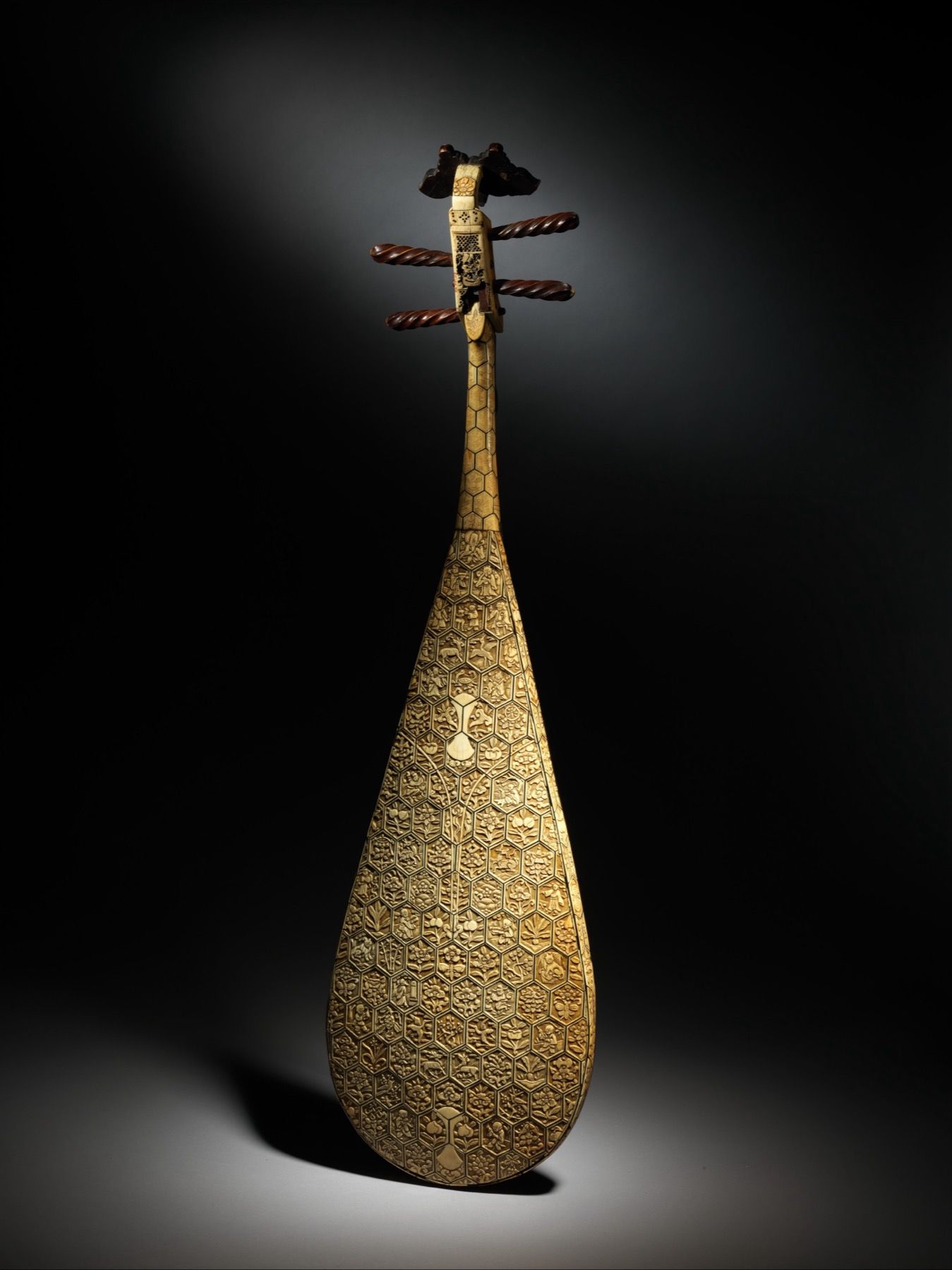
The pipa , the four-string lute held upright on the lap, is the Heartrend Pipa (催心琵琶) in combat: “A replica pipa with a clear, mournful tone that rends the heart. Its music can release Sonic Blades sharp enough to cut through anything.” Blue blades drain Sha-Chi; red ones hit harder and “ignore all Damage Reduction”. Neither can be blocked.
Its Soul Tempering is a quest. Bai Chilian drops the broken pipa, and her own notes list where its parts went. Soul wins the Head from the hidden boss Dusk, the Puppeteer, in the Village of Lu, finds the Backplate in the Mandate Encampment after the puppet Yubi and takes the Strings from Yan Qiansui, and Myst repairs it in Pangzhen. The result, the Illusory Pipa (幻术琵琶), is “The Chord’s reforged Illusory Pipa”, which dispels Phantom Barriers and opens the Spectral Gate north of Meigu Lake. Our reading: the instrument comes back together from people its story broke: the woman its burst trapped, the illusionist who defected and carried off its head, and the singer whose zither wore its strings.
The Chinese perk names are music terms. The first, 转轴拨弦 (English “Evasive Pluck”), “turning the pegs and plucking the strings”, is taken from the moment Bai Juyi’s pipa player tunes up:
转轴拨弦三两声,未成曲调先有情。
She turned the pegs and plucked the strings two or three times; before there was a tune, there was already feeling.
The others are 移商换羽, “shifting the notes” (Harmonic Shift), 金戈鸣, “the ring of metal spears” (Ringing Steel), and 破阵曲, “song for breaking the battle line” (Formation-Breaking Song), which sits Soul down to play a storm of blades.
The qin: Yan Qiansui’s zither
Yan Qiansui plays a qin . The Chinese client calls her 琴女, “the qin woman”; the English calls her the Zither Maiden, the usual English word for 琴. In her fight the instrument signals her moves: red means do not attack, because hits restore her Sha-Chi; blue means parry.
One readable shows a musician at ease with the instrument. Notes on a Music Score (琴谱札记; 琴谱 means a qin score), an unsigned page in the house of Yuyin, eldest of the Pillars of Kunlun, describes an old score whose slow passages “are plaintive, almost like weeping”, and rewrites it: “Better to rearrange the old score, quicken the rhythm, and give it more rise and fall. I seek neither refinement nor novelty, only the thrill of it.” The real practice behind it is below. (The Six-Fingered Qin Demon, whose sonic attacks Soulframe Liang gave in July 2025 as an example of a weapon that expresses emotion, is not a character in the retail game; the idea lives on in the Sonic Blade pipas, this zither and the Chord’s Song of Annihilation.)
The fan: three women of illusion
The Leading Opera Actress’s tale pays out the Dance Fan (舞扇). Inanis’ Radiant Fan (虚空华扇), a gift from Inanis at the end of the quest that finds her daughter, is “capable of creating a sanctuary anywhere”. The Lady’s Fan (圣母邪扇), from the final stretch, is “A bone fan once wielded by Meng Hua before she became The Lady”, channelling ice, fire, lightning and chaos; Meng Hua (梦华) is the woman who planted the Rift inside the Chord. Our reading: the actress, the mother and the false goddess each leave a fan, and only the mother’s protects anyone.
Opera on the page: 武生, 青衣, 花旦 and the shadow play
The game’s opera is mostly written down: two lyric sheets, a role type in a title, a costume used as a weapon and one sung shadow play.
The two fragments
The book People of Pangzhen (庞镇众生相) holds two pages labelled the way a script labels a part. [Fragment of a Play] Fighter’s Verse (【戏文残篇】武生词) lies on the rim of Gu Wanyue’s well after her fight; Female Lead’s Verse (青衣词) lies under an opera stage across from Myst’s Tavern. The Chinese runs mostly in seven-character lines paired like sung couplets; the English client renders both in prose.
A wusheng is the male role type for fighting parts. His lines tell of a Mandate fighter who loved an actress:
“戏台幻术红颜醉,欲焚道牒换戏缘。”
“A play and a beauty’s charm led me astray. I would have burned my righteous seal for this love.”
— [Fragment of a Play] Fighter’s Verse
Sent to fight the Maskwalkers as punishment, he heard “her beauty had changed” and came back to warn her against “That old man known as the Venerable One”: “Talented sister, do not fall deeper. This is but a crooked path of forbidden arts!”
The qingyi (literally “blue-black robe”, also called 正旦) answers. She is the refined young woman of the stage, whose art is singing, often in falsetto. She opens on the vision that caught her, “Behold, five-colored light that pierces the heavens”, and closes: “Knowing only my beloved’s sincerity, I still travel to Pangzhen to meet him.”
Neither page names anyone. Our reading, a strong one: this is Gu Wanyue and Wei Sanchuan. The fighter’s page lies on her well, the Venerable One fits the High Elder, and her record tells the same story. The game told its saddest love story twice, once as a boss and once as a duet, and left the player to join the halves.
The 花旦 and the water sleeves
The third role type is in a title. The Leading Opera Actress is in Chinese the 头牌花旦, the top-billed huadan . Where the qingyi sings, the huadan plays young women of lower station, maids and girls next door, through speech and acting rather than song.
Gu Wanyue’s weapon is the costume. Water sleeves are long extensions sewn to the cuffs of an opera robe, in China usually pure white; throwing and flicking them to show feeling is a skill of its own, 水袖功. She makes that skill a blade.
The shadow play at the Mirage Estate
The Mirage Estate 戏梦山庄 Xìmèng ShānzhuāngLiterally “the estate of plays and dreams”. A merchants’ guild hall built by twelve Pangzhen magnates that grew into a venue for grand performances; now the Herald’s seat. It shares the Pangzhen map.Glossary →, “the estate of plays and dreams”, is the game’s theatre: an Opera House that needs an Opera Ticket, and a Nuo Mask Altar where an old beggar trades three mask shards (joy, anger, sorrow) for the Nuo Mask accessory.
In its theatre the player watches a sung shadow play (皮影戏, píyǐngxì). Spoiler: it is the Herald’s history. A man called the Viper of Seven Venoms (七巧郎君) is framed when his junior brother, Leng Tu, swaps a fake-death drug for a real poison and their master dies. Freed by the Lady after nearly three years in an illusion-prison, he takes the traitor’s place: “From that day forth, the Viper became Leng Tu.” The Herald’s life is staged as a play in the estate where he keeps his study.
Qiu Feng’s belief that performance drives out evil has a real root: China’s oldest recorded exorcism, the Nuo (傩), was a masked performance. The Rites of Zhou describes the officer who led it:
方相氏:掌蒙熊皮、黄金四目、玄衣朱裳、执戈扬盾,帅百隶而时难,以索室驱疫。
The Fangxiang wears a bearskin and a mask of four golden eyes, a black tunic and red skirt; holding a spear and raising a shield, he leads a hundred attendants in the seasonal exorcism, searching the houses to drive out pestilence.
Qiu Feng kills the Nuo players and wears their masks, keeping the form of the rite and none of its purpose. Flame’s lion-dance school performs at the estate every New Year to drive out evil and pray for blessings (驱邪祈福), the same idea in festive costume; see the lion dance.
The songhouse as an institution
The game’s songhouses are businesses run for powerful patrons, and the readables show how they work.
Meigu Lake got its songhouses by changing its name. The Reflections page Six Sights of Meigu says armies once left bones in its mud; later, men of refined taste, “Avoiding the ominous name “Maigu,” or “Buried Bones,"" renamed it “Plum Valley” and “built song houses where they could admire the blossoms and listen to songs”. It ends: “Yet on rainy nights, the clash of weapons and the thunder of warhorses can still be heard lingering.”
Two papers found at the songhouse show whom it served. An Elegant Invitation offers an unnamed lord a seat in “Celestial Hall No. 1 · Pavilion of Wondrous Music” (天字第一号 · 妙音阁). The Letter to Master Ming, from “Your humble subordinate, Li Zimao” (李子茂), recommends a new song house on Meigu Lake, “bringing celebrated performers and musicians from the capital”. The game never says so, but our reading is hard to avoid: this letter is how Sect Leader Ming came to the house where he met Yan’er.
The Mirage Estate began, says the Reflections page on Pangzhen, when “Twelve local magnates even built a small merchant guild hall together, which was later expanded into the Mirage Estate, a venue for grand performances.” The patrons are sect leaders, officials and merchants. The performers are women whose bodies, children and minds end up in someone else’s plan.
Performer, art and real tradition
| Performer or text | The art in the game | The real tradition | Read more on this site |
|---|---|---|---|
| The Chord (弦者) | Pipa and Phantom Arts; the Song of Annihilation | Girls trained to the pipa for the houses of music (Song of the Pipa) | Inanis’ Memory Flower, Heartrend Pipa |
| Yuzan (玉瓒) | Pipa; a copy of the Chord | Puppet theatre | Chinese puppetry |
| Yan’er / Yan Qiansui (烟儿 / 烟千岁) | Qin (zither) at the Meigu Songhouse | Registered musicians (乐籍); Huo Xiaoyu, Du Shiniang | Yan’er’s Memory Flower |
| Gu Wanyue (骨婉约) | Opera singing; water sleeves | Opera role types; 水袖功 | The Search |
| Fighter’s Verse / Female Lead’s Verse | Lyric sheets for 武生 and 青衣 | Role types (行当) | People of Pangzhen |
| Leading Opera Actress (头牌花旦) | Dance and the fan | The 花旦 role; top billing (头牌) | Side quests |
| Inanis and the Gilded Lotus (金玉阁) | A house of pleasure built of illusion | Courtesan houses where officials talked | Lady Inanis |
| Notes on a Music Score (琴谱札记) | A slow qin piece rewritten fast | Reconstructing qin tablature (打谱); Guangling San | Pillars of Kunlun |
| Mirage Estate (戏梦山庄) | Opera house, shadow play, Nuo masks | Guild-hall stages (会馆); masked exorcism (傩) | The Mirage Estate’s Past |
| Qiu Feng (囚锋) | 百戏 turned into killing moves | The Fangxiang exorcist; the “hundred entertainments” | Bosses |
The real history behind the songhouses
The game’s world is invented, but its music trade is built from Chinese institutions and stories that existed. History first; our readings are marked.
The Jiaofang and the registered musicians (教坊)
For most of imperial history, professional musicians were a legal class, entered on a separate register, the 乐籍 (yuèjí), and the state kept its own trained troupes. The Tang emperor Xuanzong, the New Book of Tang records, set up an inner music academy at the palace:
置内教坊于蓬莱宫侧,居新声、散乐、倡优之伎。
He established the Inner Jiaofang beside the Penglai Palace, to house the performers of new music, popular entertainments, singers and actors.
The same chapter has him train three hundred musicians in the Pear Garden (梨园), correcting every wrong note himself; troupes are still called 梨园 and actors 梨园子弟. The Ming founded a Jiaofang Office (教坊司) under the Ministry of Rites to run music, dance and opera. Feng Menglong set his most famous courtesan story in its Beijing compound, where the student Li Jia says that “removing a name from the Jiaofang rolls costs a great deal; nothing less than a thousand will do” (教坊落籍,其费甚多,非千金不可). The Yan’er archive page quotes the Tang law that kept registered families from marrying commoners. When Sect Leader Ming calls the songhouse “a place like that”, he speaks that law’s language.
Bai Juyi’s pipa player: a career in one poem
The Song of the Pipa (琵琶行), written in 816, is a professional musician’s life from start to finish. Bai Juyi’s preface says the woman he heard on a boat at Jiujiang was a former singing girl of Chang’an who, when her looks faded, married a merchant. In the poem she tells it herself:
十三学得琵琶成,名属教坊第一部。
At thirteen I had mastered the pipa; my name stood in the first rank of the Jiaofang.
Then “my brother went off to the army, my madam died”, and the visitors stopped:
门前冷落鞍马稀,老大嫁作商人妇。
Before my door it grew cold and quiet, few horses stopped; grown old, I married a merchant.
Bai Juyi, himself demoted, answers with the poem’s most quoted line, 同是天涯沦落人, “we are both people fallen to the ends of the earth”. Our reading: the Chord, trained from childhood by a mother who ran a house of pleasure, lives the first half of that life; Yan Qiansui, playing to a songhouse no one dares approach, is its end.
Huo Xiaoyu and Du Shiniang: the pattern
Chinese fiction told Yan’er’s story long before. In Jiang Fang’s Tang tale The Story of Huo Xiaoyu (霍小玉传), a singing girl tells the scholar Li Yi on their first night, “I come from a courtesan’s house, and know I am no match for you” (妾本倡家,自知非匹). He swears never to leave her, then accepts a match with the Lu family, “also a great clan” (卢亦甲族也). Dying, she curses him:
我为女子,薄命如斯!君是丈夫,负心若此!
I am a woman, and my fate is this thin! You are a man, and your heart betrays like this!
She vows to “become a vengeful ghost” (必为厉鬼) and dies. In the Ming story Du Shiniang Sinks Her Jewel Box in Anger (杜十娘怒沉百宝箱), set in 1592, a Jiaofang courtesan arranges her release for three hundred taels to marry Li Jia. On the river home a salt merchant hears her singing at night and offers a thousand for her, and Li Jia, afraid of his father, agrees. She throws her treasures into the water and then, “clutching the jewel box, leaps into the heart of the river” (抱持宝匣,向江心一跳).
The pattern is fixed: a musician of the registered class, a man of a great family, a promise, the family’s rule, then water or a curse. Yan’er has every piece. Our reading: the game’s addition is that a cult waits under the water, and it too wants something from her body.
Guild halls with a stage (会馆)
The Mirage Estate’s origin describes a real building type. Huiguan were halls for people from the same home region, first founded in Beijing in the Yongle reign (1403–1424) and common across China in the Qing; outside the capital most were founded by merchants or artisans and worked as guilds. The large ones had banquet halls, gardens and opera stages: in Sichuan at least 1,400 held regular performances, and more than half the guild-hall stages of northern China were paid for by Shanxi and Shaanxi merchants. The Mirage Estate’s Past names the grandest survivor.
Guangling San and Ji Kang: the score that weeps
Yuyin’s weeping old score touches the most famous story in qin music. Ji Kang (嵇康), one of the Seven Sages of the Bamboo Grove, offended Zhong Hui (锺会), a favourite of Sima Zhao, the general who held real power at the Wei court, and was condemned to death:
嵇中散临刑东市,神气不变。索琴弹之,奏《广陵散》。曲终,曰:“袁孝尼尝请学此散,吾靳,固不与,《广陵散》于今绝矣!”
At the Eastern Market, about to be executed, Ji Kang kept his composure. He asked for a qin and played Guangling San. When it ended he said: “Yuan Xiaoni once asked to learn this piece, and I grudged it and would not teach him. Now Guangling San is lost for ever!”
It was not lost. The oldest surviving score is in the Ming collection Shenqi Mipu (神奇秘谱), and by 1956 qin masters including Guan Pinghu (管平湖) had made working reconstructions from it, a process called 打谱 (dǎpǔ). Qin notation records strings and fingering but not rhythm, so no one can say whether today’s Guangling San moves at Ji Kang’s pace. Our reading: Yuyin’s “only the thrill of it” uses exactly that freedom, one more reconstruction of someone else’s grief.
The songhouses of Phantom Blade Zero are places where the sound is beautiful and the business is ugly, and in that the game is faithful to the history. Bai Juyi heard a pipa on a dark river and wept for the woman playing it. The game hands that pipa to Soul, rebuilt from the hands it passed through, and makes it a weapon. For the people, read the characters; for the instruments’ battlefield past, Chinese instruments.
Names in this article · Codex
Frequently asked
Q01Who plays the pipa in Phantom Blade Zero?
Q02How do you get the Illusory Pipa in Phantom Blade Zero?
Q03How do you find and fight Yan Qiansui, the Zither Maiden?
Q04Who is Gu Wanyue in Phantom Blade Zero?
Q05Is the Meigu Songhouse a real place?
Sources & further reading
- All Memory Flowers (English game text of Yan'er's, Inanis' and The Search memories) — Fextralife Phantom Blade Zero Wiki
- People of Pangzhen (book_book_05): the opera fragments, the invitation and the letter to Master Ming — th.gl Phantom Blade Zero database
- Heartrend Pipa (edge_cui_xin_pi_pa): item text, perks and Soul Tempering — th.gl Phantom Blade Zero database
- Soulframe Liang interview on Gu Long and wuxia (30 Jul 2025): weapons as emotion, the Six-Fingered Qin Demon's sonic attacks — Gamersky
- Bai Juyi, Song of the Pipa (琵琶行), with preface — Wikisource
- New Book of Tang (新唐書), ch. 22: Treatise on Rites and Music 12 — Wikisource
- Jiang Fang, The Story of Huo Xiaoyu (霍小玉傳) — Wikisource
- Feng Menglong, Stories to Caution the World (警世通言), ch. 32: Du Shiniang Sinks Her Jewel Box in Anger — Wikisource
- A New Account of the Tales of the World (世說新語), Magnanimity (雅量) 2: Ji Kang plays Guangling San — Wikisource
- 广陵散 (Guangling San: versions, the Shenqi Mipu score, reconstructions) — Chinese Wikipedia
- Huiguan (guild halls and their opera stages) — Wikipedia
- Rites of Zhou (周禮), Offices of Summer: the Fangxiang exorcist — Wikisource
- 傩 (Nuo exorcism and the Zhou-dynasty Fangxiang) — Chinese Wikipedia
- 武生 (the martial male role type) — Chinese Wikipedia
- 教坊 (the Jiaofang from Tang to Qing) — Chinese Wikipedia
- 梨园 (the Pear Garden and the name of the opera world) — Chinese Wikipedia
- 旦 (female role types: 正旦 / 青衣, 花旦) — Chinese Wikipedia
- 水袖 (water sleeves) — Chinese Wikipedia
Cite this page
Wuxiapunk Editors. (2026, November 15). Opera, Songhouses and the Pipa: The Music Inside Phantom Blade Zero. Wuxiapunk. https://wuxiapunk.com/music/opera-and-songhouses/
“Opera, Songhouses and the Pipa: The Music Inside Phantom Blade Zero.” Wuxiapunk, 15 Nov. 2026, https://wuxiapunk.com/music/opera-and-songhouses/.
Keep reading
Chinese Instruments in Phantom Blade Zero: Pipa, Erhu, Xun, Suona
The Chinese instruments in Phantom Blade Zero's score: pipa, erhu, xun, suona, guqin and drums, their real battlefield history, and what each one means in the game.
Chinese Puppetry: The Real Marionettes Behind Phantom Blade Zero
Chinese puppetry explained: Yan Shi's automaton, puppets as Han and Tang funeral music, Song string puppets, Quanzhou marionettes, and PBZ's Thread-Binding Sect.
Wuxia Heroines: The Real Women Warriors Behind Mu Xiaokui
Were there real women warriors in ancient China? Fu Hao, the Maiden of Yue, Lady Gongsun, Nie Yinniang and Qin Liangyu, sorted into history, legend and fiction.